Department of Medicine and Medical Specialities, Faculty of Medicine and Health Sciences, Network Biomedical Research Center for Liver and Digestive Diseases (CIBEREHD), University of Alcalá, Alcalá de Henares, Spain.
Ramón y Cajal Institute of Sanitary Research (IRYCIS), Madrid, Spain.
Int J Biol Sci. 2024 Oct 14;20(14):5608-5672. doi: 10.7150/ijbs.98107. eCollection 2024.
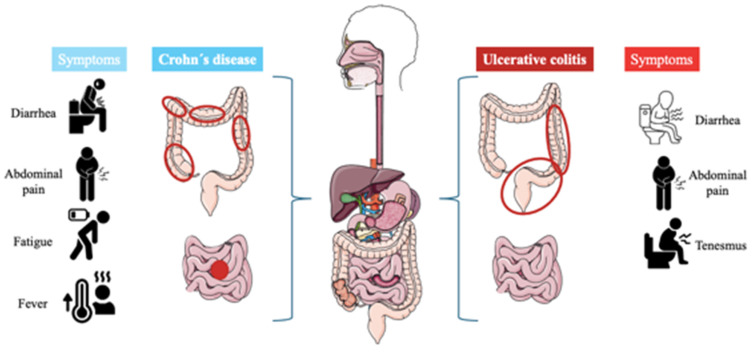
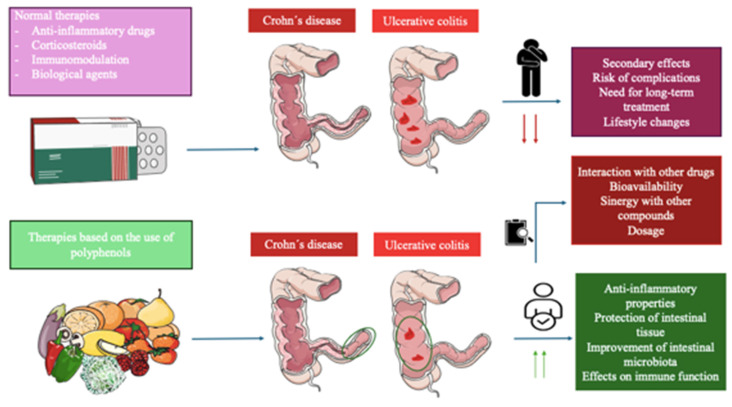
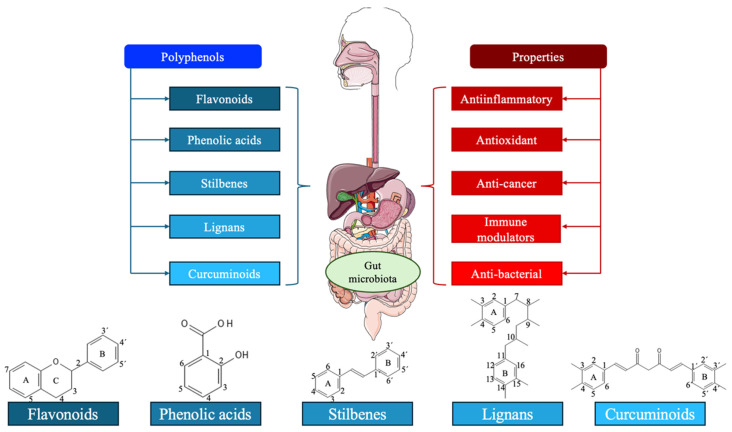
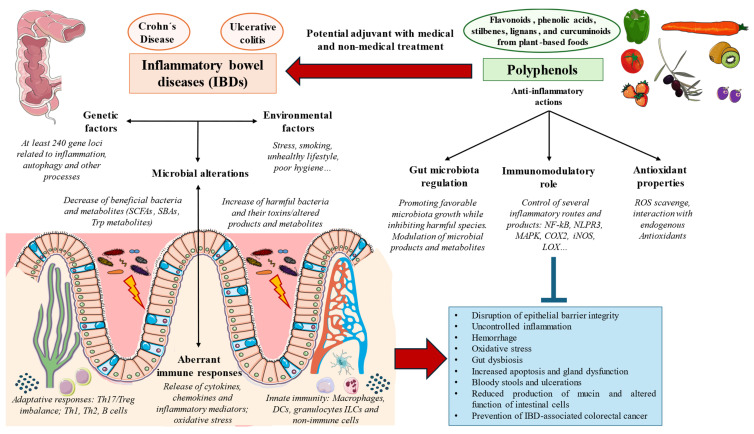
Inflammatory bowel disease (IBD) encompasses a spectrum of chronic inflammatory conditions affecting the gastrointestinal tract, notably ulcerative colitis (UC) and Crohn's disease (CD). Both UC and CD result from the interplay between genetic and environmental factors that trigger an exacerbated immune response against gut microorganisms, leading to non-resolving inflammatory damage in the mucosa of specific zones in the intestine. Despite extensive research, current treatments often entail invasive interventions with considerable adverse effects on patient well-being. Consequently, there is a pressing need to find alternative and complementary therapeutic strategies aimed at ameliorating chronic inflammation and restoring intestinal barrier integrity. Polyphenols are plant-based compounds formed naturally or as semi-synthetic/synthetic derivatives with proven health-promoting effects and translational applications in a broad spectrum of chronic diseases. Preclinical models of IBD largely support the efficacy of a broad variety of polyphenols due to their well-documented antioxidant and modulatory properties on the immune system and gut microbiota. Likewise, a growing number of studies using distinct types of polyphenols are being conducted in humans, although more efforts are still warranted. In the present review, the main polyphenols investigated and models of IBD will be summarized, as well as the available trials or observational data accessible in humans. Finally, the role of polyphenols in the clinical context of IBDs, along with the main problematics regarding their translational issues and concerns will be discussed, including bioavailability, their inclusion in healthy dietary patterns and foods, interaction with other drugs, and other important points to be addressed by future research.
炎症性肠病(IBD)包括一系列影响胃肠道的慢性炎症性疾病,主要包括溃疡性结肠炎(UC)和克罗恩病(CD)。UC 和 CD 都是由遗传和环境因素相互作用引起的,这些因素会引发针对肠道微生物的过度免疫反应,导致肠道特定区域的黏膜发生非缓解性炎症损伤。尽管进行了广泛的研究,但目前的治疗方法通常需要进行侵入性干预,这会对患者的健康状况产生相当大的不利影响。因此,迫切需要寻找替代和补充的治疗策略,以减轻慢性炎症并恢复肠道屏障的完整性。多酚是植物来源的化合物,可天然形成或作为半合成/合成衍生物存在,具有已被证实的促进健康的作用,并在广泛的慢性疾病中具有转化应用。IBD 的临床前模型在很大程度上支持了多种多酚的疗效,因为它们具有良好记录的抗氧化和对免疫系统和肠道微生物群的调节特性。同样,越来越多的使用不同类型多酚的研究正在人类中进行,尽管仍需要更多的努力。在本综述中,将总结主要研究的多酚和 IBD 模型,以及在人类中可获得的试验或观察性数据。最后,将讨论多酚在 IBD 临床背景中的作用,以及关于其转化问题和关注点的主要问题,包括生物利用度、它们在健康饮食模式和食物中的包含、与其他药物的相互作用以及未来研究中需要解决的其他重要问题。