Zhu Yuwei, Ma Jiale, Li Yulan, Gu Mengyang, Feng Xiang, Shao Yujin, Tan Lei, Lou Hui-Fang, Sun Li, Liu Yijun, Zeng Ling-Hui, Qiu Zilong, Li Xiao-Ming, Duan Shumin, Yu Yan-Qin
Department of Neurology of Second Affiliated Hospital and School of Brain Science and Brain Medicine, Zhejiang University School of Medicine, Hangzhou, 310058, China.
Liangzhu Laboratory, MOE Frontier Science Center for Brain Science & Brain-Machine Integration, State Key Laboratory of Brain-machine Intelligence, Zhejiang University, Hangzhou, 311121, China.
Adv Sci (Weinh). 2024 Dec;11(48):e2407706. doi: 10.1002/advs.202407706. Epub 2024 Nov 4.
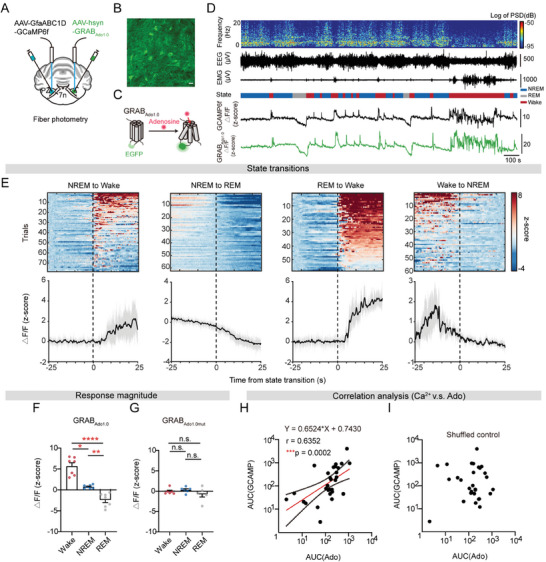
Astrocytes play a crucial role in regulating sleep-wake behavior. However, how astrocytes govern a specific sleep-arousal circuit remains unknown. Here, the authors show that parafacial zone (PZ) astrocytes responded to sleep-wake cycles with state-differential Ca activity, peaking during transitions from sleep to wakefulness. Using chemogenetic and optogenetic approaches, they find that activating PZ astrocytes elicited and sustained wakefulness by prolonging arousal episodes while impeding transitions from wakefulness to non-rapid eye movement (NREM) sleep. Activation of PZ astrocytes specially induced the elevation of extracellular adenosine through the ATP hydrolysis pathway but not equilibrative nucleoside transporter (ENT) mediated transportation. Strikingly, the rise in adenosine levels induced arousal by activating A receptors, suggesting a distinct role for adenosine in the PZ beyond its conventional sleep homeostasis modulation observed in the basal forebrain (BF) and cortex. Moreover, at the circuit level, PZ astrocyte activation induced arousal by suppressing the GABA release from the PZ neurons, which promote NREM sleep and project to the parabrachial nucleus (PB). Thus, their study unveils a distinctive arousal-promoting effect of astrocytes within the PZ through extracellular adenosine and elucidates the underlying mechanism at the neural circuit level.
星形胶质细胞在调节睡眠-觉醒行为中起着关键作用。然而,星形胶质细胞如何控制特定的睡眠-觉醒回路仍不清楚。在此,作者表明,面神经旁区(PZ)星形胶质细胞对睡眠-觉醒周期有状态差异的钙活性反应,在从睡眠过渡到觉醒时达到峰值。通过化学遗传学和光遗传学方法,他们发现激活PZ星形胶质细胞可通过延长觉醒期同时阻碍从觉醒到非快速眼动(NREM)睡眠的转变来引发并维持觉醒。PZ星形胶质细胞的激活特别通过ATP水解途径而非平衡核苷转运体(ENT)介导的转运诱导细胞外腺苷升高。令人惊讶的是,腺苷水平的升高通过激活A受体诱导觉醒,这表明腺苷在PZ中的作用不同于其在基底前脑(BF)和皮层中观察到的传统睡眠稳态调节作用。此外,在回路水平上,PZ星形胶质细胞激活通过抑制PZ神经元释放GABA来诱导觉醒,这些神经元促进NREM睡眠并投射到臂旁核(PB)。因此,他们的研究揭示了PZ内星形胶质细胞通过细胞外腺苷产生的独特的促觉醒作用,并阐明了神经回路水平的潜在机制。