Department of Orthopedics, Zigong First People's Hospital, Zigong, China.
Department of Orthopedics, Dandong Central Hospital, China Medical University, Dandong, China.
Sci Rep. 2024 Nov 4;14(1):26637. doi: 10.1038/s41598-024-60390-2.
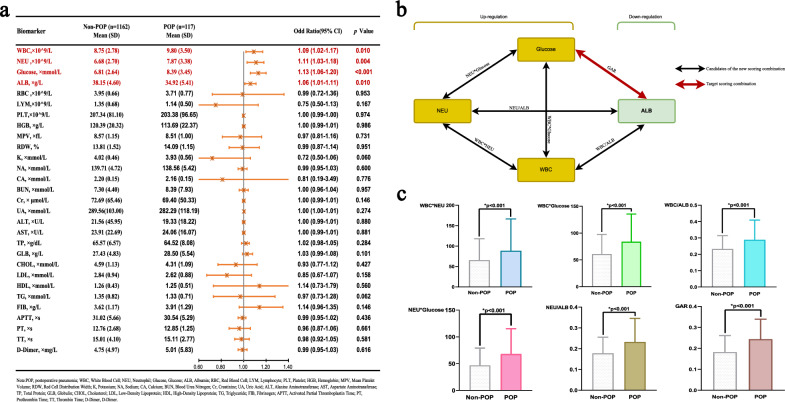
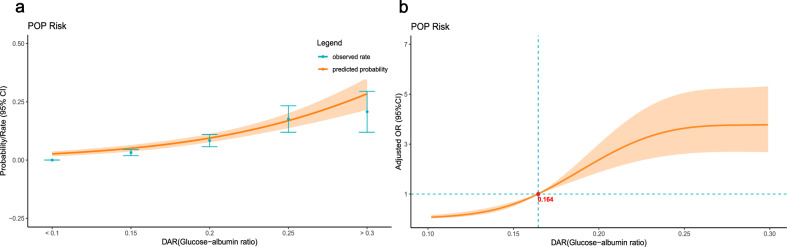
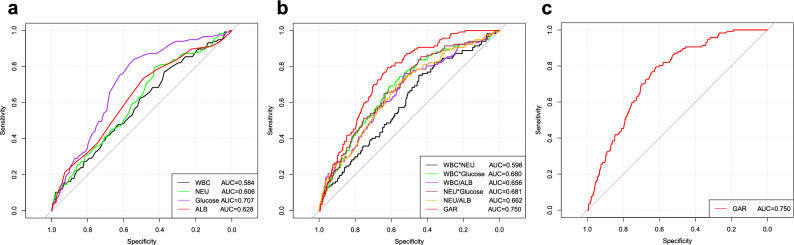
Postoperative pneumonia (POP) is a common complication after hip fracture surgery and is associated with increased mortality and other complications in elderly patients. This study aims to evaluate biomarkers, especially the glucose-albumin ratio (GAR), for predicting POP in elderly hip fracture patients. A total of 1279 elderly patients admitted to our hospital with hip fractures were included. We assessed 29 biomarkers and focused on GAR to determine its prognostic and predictive value for POP. Multivariable logistic regression and propensity score-matched analyses were conducted to calculate adjusted odds ratios (ORs) and 95% confidence intervals (CIs) for POP, adjusting for potential confounders. Receiver operating characteristic (ROC) curves were utilized to determine the optimal cut-off of GAR for predicting POP. Among the biomarkers and combinations assessed, GAR demonstrated superior predictive capability for POP in elderly hip fracture patients. ROC analyses showed moderate predictive accuracy of GAR for POP, with an area under the curve of 0.750. Using the optimal cut-off of 0.175, the high GAR group was significantly associated with increased odds of POP (adjusted OR 2.14, 95%, CI 1.50-3.05). These associations remained significant after propensity score matching and subgroup analyses. Dose-response relationships between GAR and POP were observed. In conclusion, GAR may be a promising biomarker to predict POP risk in elderly hip fracture patients. Further studies are warranted to validate its clinical utility. However, this study has certain limitations, including its retrospective design, potential for selection bias due to the exclusion criteria, and the single-center nature of the study, which should be addressed in future prospective, multicenter studies.
术后肺炎(POP)是髋部骨折手术后常见的并发症,与老年患者的死亡率增加和其他并发症相关。本研究旨在评估生物标志物,尤其是血糖-白蛋白比值(GAR),用于预测老年髋部骨折患者的 POP。共纳入我院 1279 例髋部骨折老年患者。我们评估了 29 种生物标志物,并重点关注 GAR,以确定其对 POP 的预后和预测价值。进行多变量逻辑回归和倾向评分匹配分析,以计算调整后的比值比(OR)和 95%置信区间(CI),以调整潜在的混杂因素。使用接收者操作特征(ROC)曲线确定 GAR 预测 POP 的最佳截断值。在所评估的生物标志物和组合中,GAR 对老年髋部骨折患者的 POP 具有卓越的预测能力。ROC 分析显示 GAR 对 POP 的预测准确性中等,曲线下面积为 0.750。使用最佳截断值 0.175,高 GAR 组与 POP 的发生几率增加显著相关(调整 OR 2.14,95%CI 1.50-3.05)。这些关联在倾向评分匹配和亚组分析后仍然显著。观察到 GAR 与 POP 之间存在剂量反应关系。总之,GAR 可能是预测老年髋部骨折患者 POP 风险的有前途的生物标志物。需要进一步的研究来验证其临床实用性。然而,本研究存在一定的局限性,包括回顾性设计、排除标准导致的选择偏倚的可能性,以及研究的单中心性质,这些都应在未来的前瞻性、多中心研究中得到解决。