Channing Division of Network Medicine, Brigham and Women's Hospital, Harvard Medical School, Boston, MA, USA.
Department of Molecular Physiology and Biophysics, Vanderbilt University, Nashville, TN, USA.
BMC Pulm Med. 2024 Nov 4;24(1):553. doi: 10.1186/s12890-024-03372-4.
Bronchodilator response (BDR) is a measure of improvement in airway smooth muscle tone, inhibition of liquid accumulation and mucus section into the lumen in response to short-acting beta-2 agonists that varies among asthmatic patients. MicroRNAs (miRNAs) are well-known post-translational regulators. Identifying miRNAs associated with BDR could lead to a better understanding of the underlying complex pathophysiology.
The purpose of this study is to identify circulating miRNAs associated with bronchodilator response in asthma and decipher possible mechanism of bronchodilator response variation.
We used available small RNA sequencing on blood serum from 1,134 asthmatic children aged 6 to 14 years who participated in the Genetics of Asthma in Costa Rica Study (GACRS). We filtered the participants into the highest and lowest bronchodilator response (BDR) quartiles and used DeSeq2 to identify miRNAs with differential expression (DE) in high (N = 277) vs. low (N = 278) BDR group. Replication was carried out in the Leukotriene modifier Or Corticosteroids or Corticosteroid-Salmeterol trial (LOCCS), an adult asthma cohort. The putative target genes of DE miRNAs were identified, and pathway enrichment analysis was performed.
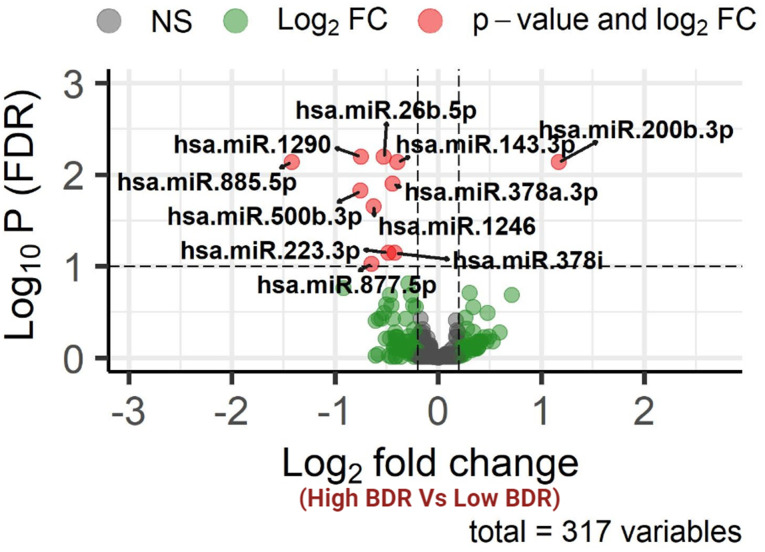
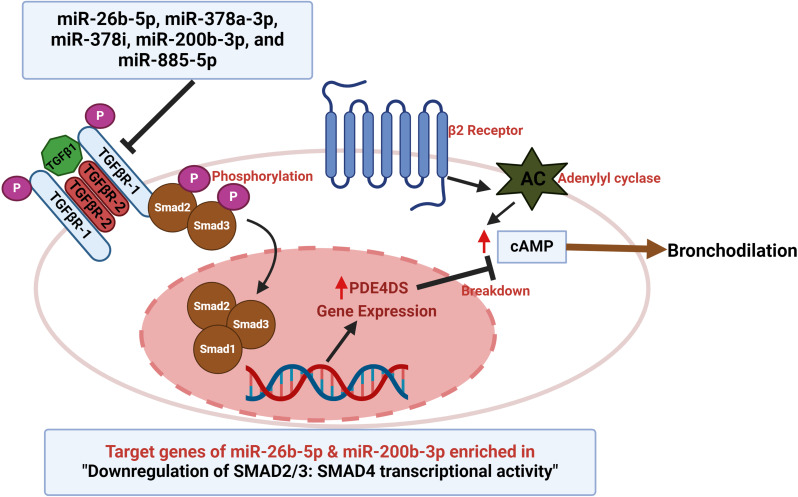
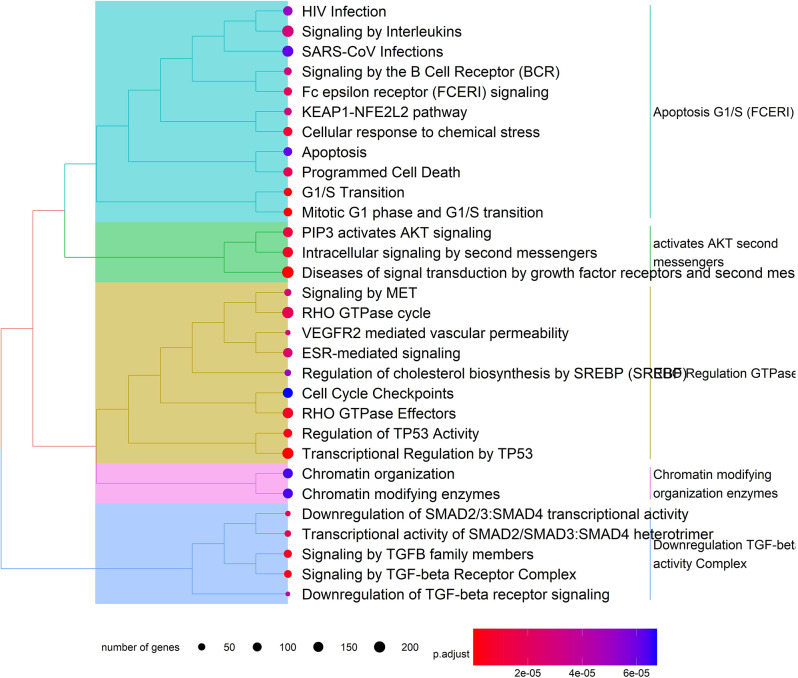
We identified 10 down-regulated miRNAs having odds ratios (OR) between 0.37 and 0.76 for a doubling of miRNA counts and one up-regulated miRNA (OR = 2.26) between high and low BDR group. These were assessed for replication in the LOCCS cohort, where two miRNAs (miR-200b-3p and miR-1246) were associated. Further, functional annotation of 11 DE miRNAs were performed as well as of two replicated miRs. Target genes of these miRs were enriched in regulation of cholesterol biosynthesis by SREBPs, ESR-mediated signaling, G1/S transition, RHO GTPase cycle, and signaling by TGFB family pathways.
MiRNAs miR-1246 and miR-200b-3p are associated with both childhood and adult asthma BDR. Our findings add to the growing body of evidence that miRNAs play a significant role in the difference of asthma treatment response among patients as it points to genomic regulatory machinery underlying difference in bronchodilator response among patients.
LOCCS cohort [ClinicalTrials.gov number NCT00156819, Registration date 20050912], GACRS cohort [ClinicalTrials.gov number NCT00021840].
支气管扩张剂反应(BDR)是衡量气道平滑肌张力改善、抑制液体积聚和粘液进入管腔的指标,对短效β-2 激动剂有反应,在哮喘患者中存在差异。microRNAs(miRNAs)是众所周知的翻译后调控因子。确定与 BDR 相关的 miRNAs 可以帮助更好地理解潜在的复杂病理生理学。
本研究旨在鉴定与哮喘支气管扩张剂反应相关的循环 miRNAs,并阐明支气管扩张剂反应变化的可能机制。
我们使用已有的小 RNA 测序技术对来自 1134 名年龄在 6 至 14 岁的参加哥斯达黎加哮喘遗传学研究(GACRS)的哮喘儿童的血清进行了检测。我们将参与者分为支气管扩张剂反应最高和最低的四分位数(BDR),并使用 DeSeq2 鉴定高(N=277)和低(N=278)BDR 组中差异表达(DE)的 miRNAs。在白三烯调节剂或皮质类固醇或皮质类固醇-沙美特罗试验(LOCCS)中进行了复制,这是一个成人哮喘队列。鉴定了 DE miRNAs 的假定靶基因,并进行了通路富集分析。
我们鉴定了 10 个下调的 miRNAs,其 miRNA 计数增加一倍的优势比(OR)在 0.37 到 0.76 之间,而高 BDR 组和低 BDR 组之间有一个上调的 miRNA(OR=2.26)。在 LOCCS 队列中对这些 miRNA 进行了复制,其中 2 个 miRNA(miR-200b-3p 和 miR-1246)与支气管扩张剂反应相关。此外,还对 11 个 DE miRNAs 及其两个复制的 miRNAs 进行了功能注释。这些 miRNAs 的靶基因富集在 SREBP 调节的胆固醇生物合成、ESR 介导的信号转导、G1/S 转换、RHO GTPase 循环和 TGFB 家族途径的信号转导中。
miR-1246 和 miR-200b-3p 与儿童和成人哮喘的 BDR 均相关。我们的发现增加了越来越多的证据,即 miRNAs 在患者治疗反应的差异中发挥重要作用,因为它指出了患者支气管扩张剂反应差异的基因组调控机制。
LOCCS 队列[临床试验.gov 编号 NCT00156819,注册日期 20050912],GACRS 队列[临床试验.gov 编号 NCT00021840]。