Department of Pharmacology and Chemical Biology, Shanghai Jiao Tong University School of Medicine, Shanghai, 200025, China.
Academy of Integrative Medicine, Shanghai University of Traditional Chinese Medicine, Shanghai, 201203, China.
Transl Neurodegener. 2024 Nov 4;13(1):54. doi: 10.1186/s40035-024-00442-9.
Lysosomal homeostasis and functions are essential for the survival of neural cells. Impaired lysosomal biogenesis and acidification in Alzheimer's disease (AD) pathogenesis leads to proteolytic dysfunction and neurodegeneration. However, the key regulatory factors and mechanisms of lysosomal homeostasis in AD remain poorly understood.
ROCK1 expression and its co-localization with LAMP1 and SQSTM1/p62 were detected in post-mortem brains of healthy controls and AD patients. Lysosome-related fluorescence probe staining, transmission electron microscopy and immunoblotting were performed to evaluate the role of ROCK1 in lysosomal biogenesis and acidification in various neural cell types. The interaction between ROCK1 and TFEB was confirmed by surface plasmon resonance and in situ proximity ligation assay (PLA). Moreover, we performed AAV-mediated ROCK1 downregulation followed by immunofluorescence, enzyme-linked immunosorbent assay (ELISA) and behavioral tests to unveil the effects of the ROCK1-TFEB axis on lysosomes in APP/PS1 transgenic mice.
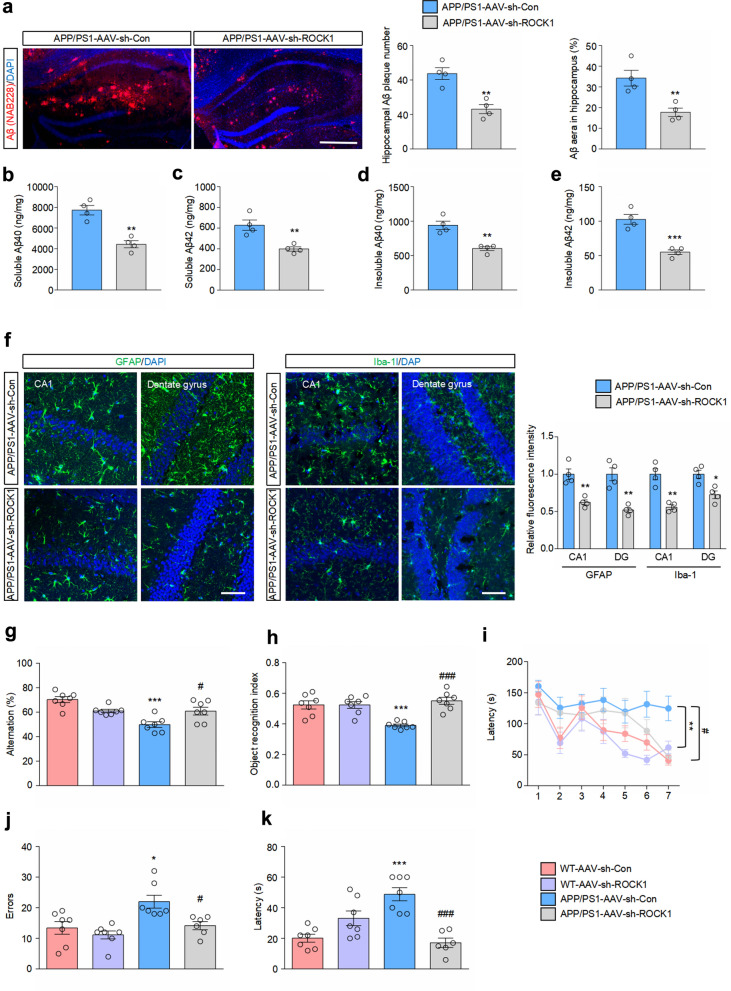
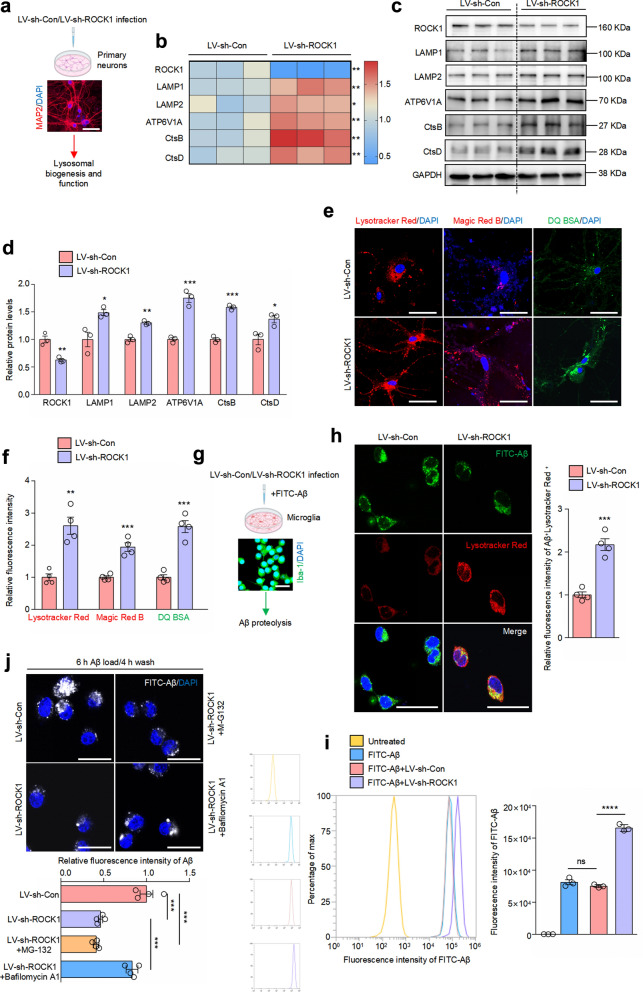
ROCK1 level was significantly increased in the brains of AD individuals, and was positively correlated with lysosomal markers and Aβ. Lysosomal proteolysis was largely impaired by the high abundance of ROCK1, while ROCK1 knockdown mitigated the lysosomal dysfunction in neurons and microglia. Moreover, we verified ROCK1 as a previously unknown upstream kinase of TFEB independent of m-TOR or GSK-3β. ROCK1 elevation resulted in abundant extracellular Aβ deposition which in turn bound to Aβ receptors and activated RhoA/ROCK1, thus forming a vicious circle of AD pathogenesis. Genetically downregulating ROCK1 lowered its interference with TFEB, promoted TFEB nuclear distribution, lysosomal biogenesis and lysosome-mediated Aβ clearance, and eventually prevented pathological traits and cognitive deficits in APP/PS1 mice.
In summary, our results provide a mechanistic insight into the critical role of ROCK1 in lysosomal regulation and Aβ clearance in AD by acting as a novel upstream serine kinase of TFEB.
溶酶体的稳态和功能对于神经细胞的存活至关重要。在阿尔茨海默病(AD)发病机制中,溶酶体发生生物发生和酸化受损会导致蛋白水解功能障碍和神经退行性变。然而,AD 中溶酶体稳态的关键调节因子和机制仍知之甚少。
检测了健康对照者和 AD 患者死后大脑中的 ROCK1 表达及其与 LAMP1 和 SQSTM1/p62 的共定位。使用溶酶体相关荧光探针染色、透射电子显微镜和免疫印迹法评估 ROCK1 在各种神经细胞类型中的溶酶体生物发生和酸化中的作用。通过表面等离子体共振和原位邻近连接分析(PLA)证实了 ROCK1 与 TFEB 的相互作用。此外,我们通过 AAV 介导的 ROCK1 下调,随后进行免疫荧光、酶联免疫吸附测定(ELISA)和行为测试,以揭示 ROCK1-TFEB 轴对 APP/PS1 转基因小鼠溶酶体的影响。
AD 个体大脑中的 ROCK1 水平显著增加,并且与溶酶体标志物和 Aβ呈正相关。高丰度的 ROCK1 使溶酶体蛋白水解功能严重受损,而 ROCK1 下调则减轻了神经元和小胶质细胞的溶酶体功能障碍。此外,我们证实 ROCK1 是 TFEB 的一个以前未知的上游激酶,独立于 m-TOR 或 GSK-3β。ROCK1 升高导致大量的细胞外 Aβ沉积,而 Aβ反过来与 Aβ 受体结合并激活 RhoA/ROCK1,从而形成 AD 发病机制的恶性循环。遗传下调 ROCK1 降低了其对 TFEB 的干扰,促进了 TFEB 的核分布、溶酶体生物发生和溶酶体介导的 Aβ清除,最终防止了 APP/PS1 小鼠的病理特征和认知缺陷。
总之,我们的研究结果提供了一种机制上的见解,即 ROCK1 通过作为 TFEB 的新型上游丝氨酸激酶,在 AD 中溶酶体调节和 Aβ清除中发挥关键作用。