Celaya Liliana, Kolb Koslobsky Nicolás
Department of Chemical Engineering, National Scientific and Technical Research Council (CONICET UNaM), Félix de Azara 1552, 3300-Posadas, Argentina.
Central Laboratory, School of Exact, Chemical and Life Sciences, Misiones National University, Félix de Azara 1552, 3300-Posadas, Argentina.
Food Technol Biotechnol. 2024 Sep;62(3):354-360. doi: 10.17113/ftb.62.03.24.8492.
The process for producing purified steviol glycosides from leaves (stevia) generally involves pretreatments, extraction, purification and crystallization. Pre-extraction or defatting can sometimes be a part of this process. It can remove impurities of low polarity, such as chlorophyll and fatty compounds. Nonpolar solvents can be used to defat stevia leaves.
In this study, we investigated ethyl acetate as a pre-extraction solvent for the defatting of dried and crushed stevia leaves. We compared pure ethyl acetate and water-saturated ethyl acetate as pre-extraction solvents in percolation extraction. We then evaluated the effects of pre-extraction on the concentration and purity of the extracts obtained with ethanol/water solvents.
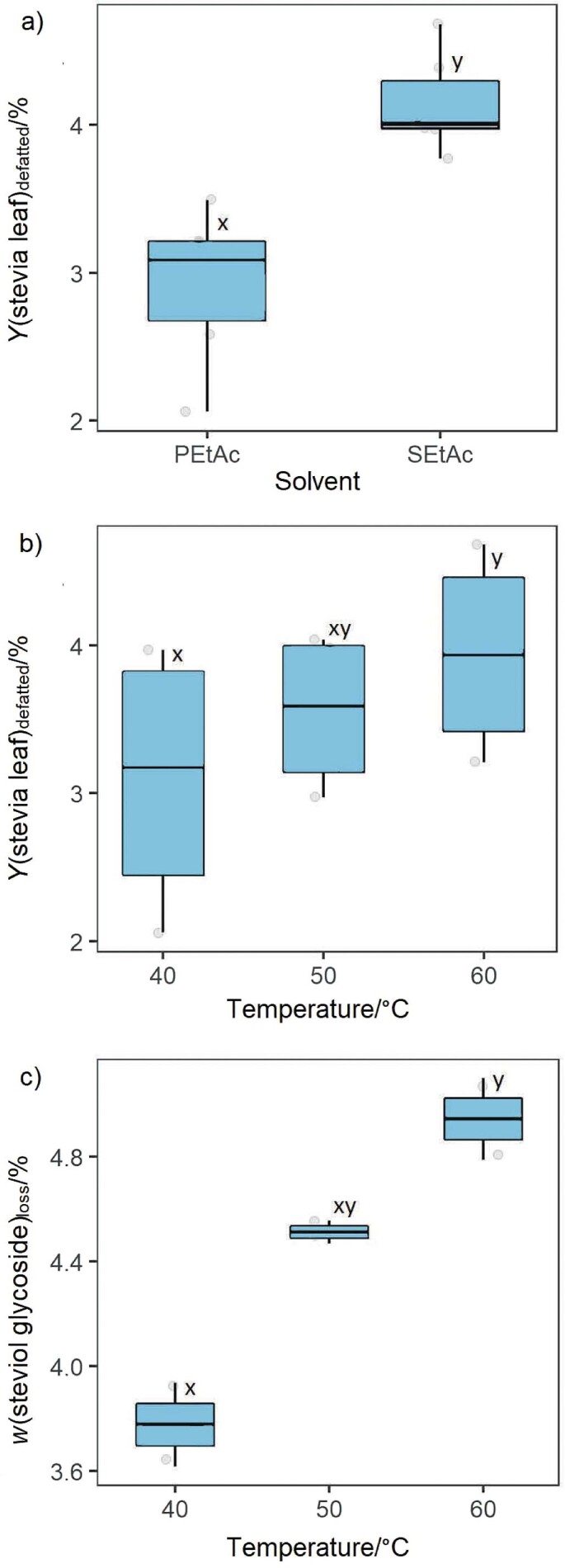
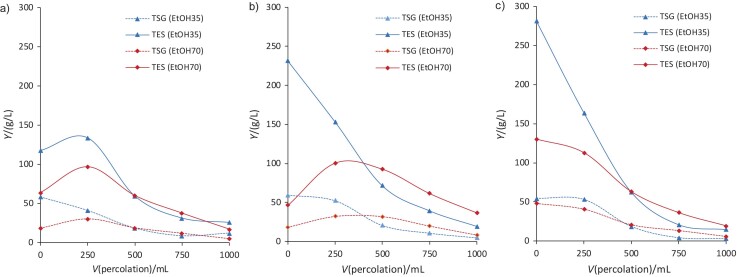
The recovery of nonpolar solvents was 2.3-3.9 % in pure ethyl acetate and 3.4-4.5 % in water-saturated ethyl acetate (from 40 to 60 °C). A low steviol glycoside loss can occur only with water-saturated ethyl acetate (on dry mass basis <0.5 %). In the Soxhlet extraction, the obtained yields were 8.43 with pure ethyl acetate and 10.44 % with water-saturated ethyl acetate. The steviol glycoside loss in the Soxhlet extraction was 10.70 % with water-saturated ethyl acetate. Defatted and non-defatted leaves were extracted with two ethanol/water solvents. Comparison of the results showed higher concentrations of glycoside in the pretreated leaves.
The pre-extraction with ethyl acetate followed by the extraction with ethanol/water solvent lead to a higher concentration of steviol glycosides and a higher purity of the extracts. Ethyl acetate can be used as a pre-extraction solvent for the defatting of stevia leaves in the industrial production of this sweetener.
从甜叶菊叶片中生产纯化甜菊糖苷的过程通常包括预处理、提取、纯化和结晶。提取前的脱脂有时是该过程的一部分。它可以去除低极性杂质,如叶绿素和脂肪化合物。非极性溶剂可用于甜叶菊叶片的脱脂。
在本研究中,我们研究了乙酸乙酯作为干燥粉碎甜叶菊叶片脱脂的提取前溶剂。我们比较了纯乙酸乙酯和水饱和乙酸乙酯作为渗滤提取中的提取前溶剂。然后,我们评估了提取前处理对用乙醇/水溶剂获得的提取物浓度和纯度的影响。
在纯乙酸乙酯中,非极性溶剂的回收率为2.3 - 3.9%,在水饱和乙酸乙酯中为3.4 - 4.5%(40至60°C)。只有使用水饱和乙酸乙酯时,甜菊糖苷损失才会较低(以干质量计<0.5%)。在索氏提取中,纯乙酸乙酯的产率为8.43%,水饱和乙酸乙酯的产率为10.44%。水饱和乙酸乙酯在索氏提取中的甜菊糖苷损失为10.70%。用两种乙醇/水溶剂对脱脂和未脱脂的叶片进行提取。结果比较表明,预处理叶片中的糖苷浓度更高。
先用乙酸乙酯进行提取前处理,然后用乙醇/水溶剂进行提取,可使甜菊糖苷浓度更高,提取物纯度更高。在这种甜味剂的工业生产中,乙酸乙酯可作为甜叶菊叶片脱脂的提取前溶剂。