Son Changwon, Hegde Sudeep, Smith Alec, Wang Xiaomei, Sasangohar Farzan
Department of Industrial and Systems Engineering, Texas A&M University, College Station, TX, United States.
Center for Outcomes Research, Houston Methodist Hospital, Houston, TX, United States.
J Med Internet Res. 2020 Sep 3;22(9):e21279. doi: 10.2196/21279.
Student mental health in higher education has been an increasing concern. The COVID-19 pandemic situation has brought this vulnerable population into renewed focus.
Our study aims to conduct a timely assessment of the effects of the COVID-19 pandemic on the mental health of college students.
We conducted interview surveys with 195 students at a large public university in the United States to understand the effects of the pandemic on their mental health and well-being. The data were analyzed through quantitative and qualitative methods.
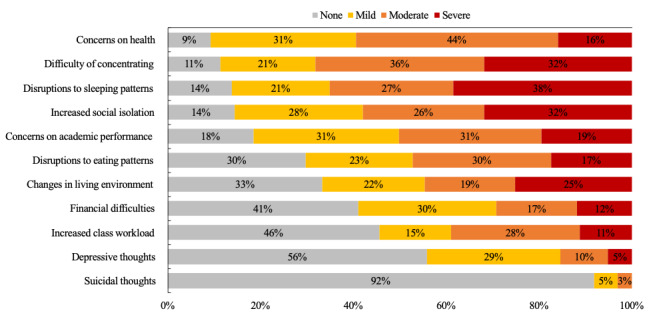
Of the 195 students, 138 (71%) indicated increased stress and anxiety due to the COVID-19 outbreak. Multiple stressors were identified that contributed to the increased levels of stress, anxiety, and depressive thoughts among students. These included fear and worry about their own health and of their loved ones (177/195, 91% reported negative impacts of the pandemic), difficulty in concentrating (173/195, 89%), disruptions to sleeping patterns (168/195, 86%), decreased social interactions due to physical distancing (167/195, 86%), and increased concerns on academic performance (159/195, 82%). To cope with stress and anxiety, participants have sought support from others and helped themselves by adopting either negative or positive coping mechanisms.
Due to the long-lasting pandemic situation and onerous measures such as lockdown and stay-at-home orders, the COVID-19 pandemic brings negative impacts on higher education. The findings of our study highlight the urgent need to develop interventions and preventive strategies to address the mental health of college students.
高等教育中的学生心理健康问题日益受到关注。新冠疫情使这一弱势群体再次成为焦点。
我们的研究旨在及时评估新冠疫情对大学生心理健康的影响。
我们对美国一所大型公立大学的195名学生进行了访谈调查,以了解疫情对他们心理健康和幸福感的影响。通过定量和定性方法对数据进行了分析。
在195名学生中,138名(71%)表示由于新冠疫情爆发,压力和焦虑有所增加。确定了多种导致学生压力、焦虑和抑郁情绪水平上升的压力源。这些包括对自己和亲人健康的恐惧和担忧(177/195,91%报告疫情有负面影响)、注意力难以集中(173/195,89%)、睡眠模式紊乱(168/195,86%)、因保持社交距离导致社交互动减少(167/195,86%)以及对学业成绩的担忧增加(159/195,82%)。为了应对压力和焦虑,参与者向他人寻求支持,并通过采用消极或积极的应对机制来自我帮助。
由于长期的疫情形势以及封锁和居家令等严格措施,新冠疫情给高等教育带来了负面影响。我们的研究结果凸显了迫切需要制定干预措施和预防策略来解决大学生的心理健康问题。