Mousavi Zeinab, Bagheri Masood, Rostaminasab Gelavizh, Mikaeili Abdolhamid, Djalilian Ali R, Rezakhani Leila
Kermanshah University of Medical Sciences, Kermanshah, Iran.
Clinical Research Development Center, Imam Khomeini and Mohammad Kermanshahi and Farabi Hospitals, Kermanshah University of Medical Sciences, Kermanshah, Iran.
Heliyon. 2024 Oct 15;10(20):e39398. doi: 10.1016/j.heliyon.2024.e39398. eCollection 2024 Oct 30.
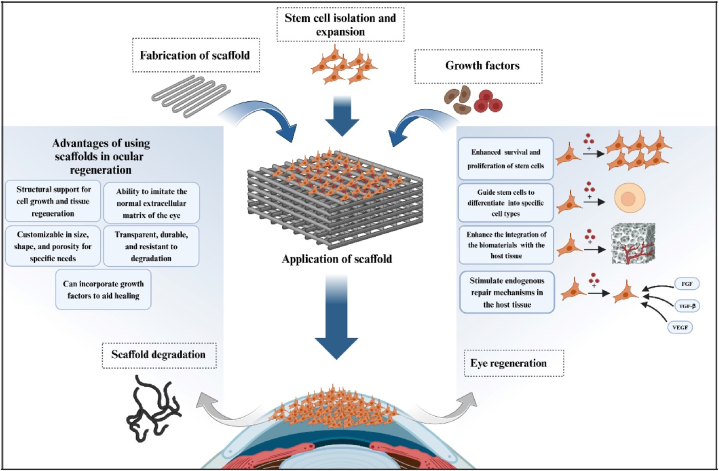
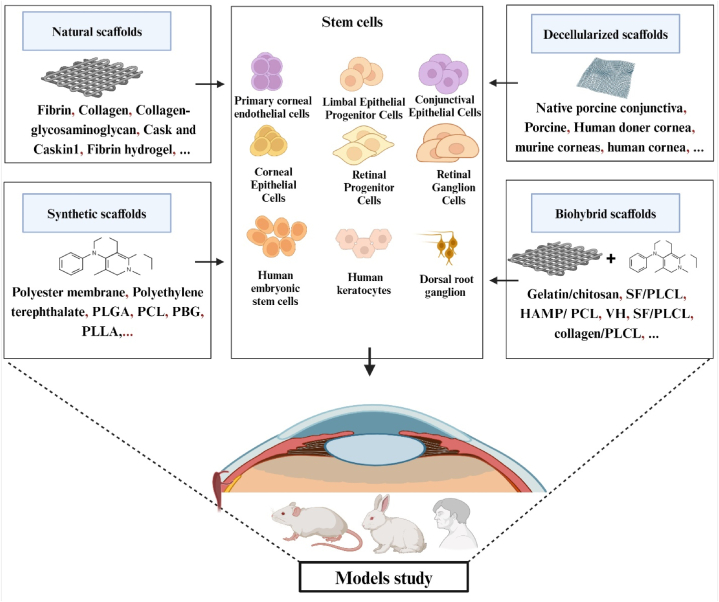
Millions globally suffer from visual impairment, complicating the management of eye diseases due to various ocular barriers. The eye's complex structure and the limitations of existing treatments have spurred interest in tissue engineering (TE) as a solution. This approach offers new functionalities and improves therapeutic outcomes over traditional drug delivery methods, creating opportunities for treating various eye disorders, from corneal injuries to retinal degeneration. In our review of recent articles concerning the use of scaffolds for eye repair, we categorized scaffolds employed in eye TE from recent studies into four types based on tissue characteristics: natural, synthetic, biohybrid, and decellularized tissue. Additionally, we gathered data on the cell types and animal models associated with each scaffold. This allowed us to gather valuable insights into the benefits and drawbacks of each material. Our research elucidates that, in comparison to conventional treatment modalities, scaffolds in TE emulate the extracellular matrix (ECM) of the eye and facilitate cell proliferation and tissue regeneration. These scaffolds can be precisely tailored to incorporate growth factors that augment the healing process while also providing considerable advantages such as bacterial inhibition, biocompatibility, and enhanced durability. However, they also have drawbacks, such as potential immune responses, poor tissue integration, complex and costly manufacturing, and inconsistent degradation rates that can affect their effectiveness. In this review, we provide an overview of the present condition of eye regenerative treatments, assess notable preclinical and clinical research endeavors, contemplate the obstacles encountered, and speculate on potential advancements in the upcoming decade.
全球数以百万计的人患有视力障碍,由于各种眼部障碍,这使得眼病的治疗变得复杂。眼睛的复杂结构以及现有治疗方法的局限性激发了人们对组织工程(TE)作为一种解决方案的兴趣。与传统的药物递送方法相比,这种方法提供了新的功能并改善了治疗效果,为治疗从角膜损伤到视网膜变性的各种眼部疾病创造了机会。在我们对近期有关用于眼部修复的支架的文章的综述中,我们根据组织特征将近期研究中用于眼部组织工程的支架分为四种类型:天然支架、合成支架、生物杂交支架和脱细胞组织支架。此外,我们收集了与每种支架相关的细胞类型和动物模型的数据。这使我们能够深入了解每种材料的优缺点。我们的研究表明,与传统治疗方式相比,组织工程中的支架模仿眼睛的细胞外基质(ECM),促进细胞增殖和组织再生。这些支架可以精确定制,以纳入促进愈合过程的生长因子,同时还具有诸如细菌抑制、生物相容性和增强的耐久性等显著优点。然而,它们也有缺点,例如潜在的免疫反应、较差的组织整合性、复杂且昂贵的制造过程以及可能影响其有效性的不一致的降解速率。在本综述中,我们概述了眼部再生治疗的现状,评估了显著的临床前和临床研究成果,思考了遇到的障碍,并推测了未来十年的潜在进展。