Machetanz Kathrin, Lins Mario, Roder Constantin, Naros Georgios, Tatagiba Marcos, Hurth Helene
Department of Neurosurgery and Neurotechnology, Eberhard Karls University, Tuebingen, Germany.
Institute of Networks and Security, Johannes Kepler University, Linz, Austria.
Front Digit Health. 2024 Oct 21;6:1471426. doi: 10.3389/fdgth.2024.1471426. eCollection 2024.
Facial palsy after vestibular schwannoma surgery is temporary in many cases but can significantly affect patients' quality of life. Physical training-initially guided and subsequently performed by the patient-is of paramount importance for recovery of facial nerve function. The introduction of medical application software (apps) might improve therapy by maintaining motivation for daily home-based training and surveilling patients' rehabilitation progress.
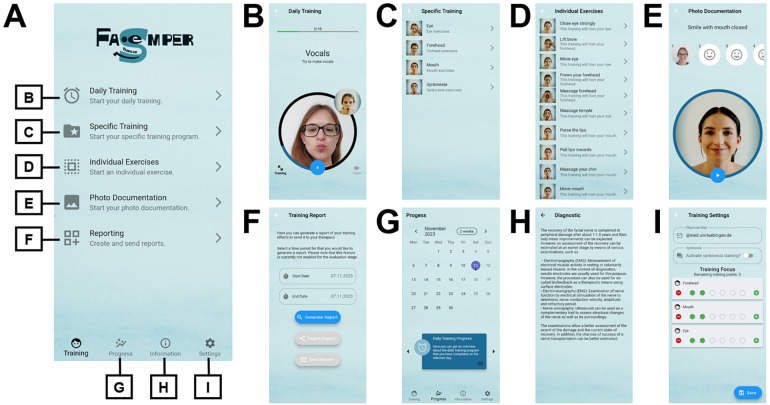
We developed a mobile app, "FACEsemper", for home-based facial nerve rehabilitation. This app guides patients through a daily training program comprising six variable exercises, each performed in three repetitions. The app allows the user to customize the exercise intensity for different facial areas and includes a reminder function for daily training. Additional features include photo documentation, a calendar function, training report generation, and the possibility of direct communication with the attending physician. The app's usability was prospectively investigated with 27 subjects, including 8 physicians, 9 patients with facial palsy and 10 healthy subjects, over a two-week period. Usability was assessed using various self-rating questionnaires (i.e., mHealth App Usability Questionnaire, MAUQ; System Usability Scale, SUS; Visual Aesthetics of Apps Inventory, VisAAI) and scores were compared across the groups.
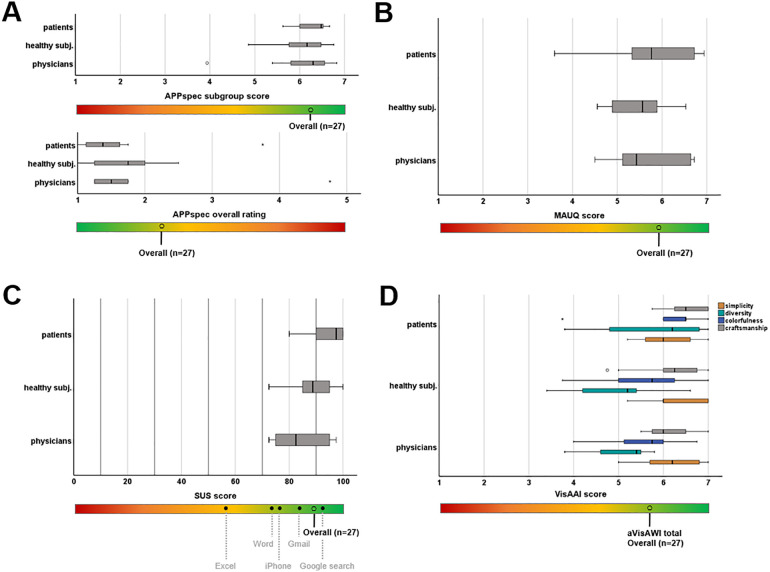
The participants reported an average smartphone use of 12.19 years and completed a mean number of 290 ± 163 facial exercises during the study period. Patients used the app significantly more frequently than the other two groups ( = 0.017). The average total scores of the questionnaires were: MAUQ 5.67/7, SUS 89.6/100, VisAAI 5.88/7 and specific rating 6.13/7. In particular, the simplicity of use and craftsmanship of the app were rated very highly. Usability scores did not significantly differ between groups. A primary limitation identified was malfunction of the daily reminder feature in some Android versions.
This usability study demonstrated a positive user experience and excellent usability of the FACEsemper app. However, some limitations and areas for improvement were identified. As a next step, the app should be evaluated in a large patient cohort with facial palsy to determine its potential medical benefits for facial rehabilitation compared to traditional training methods.
前庭神经鞘瘤手术后的面瘫在许多情况下是暂时的,但会显著影响患者的生活质量。物理训练最初由专业人员指导,随后由患者自行进行,这对面神经功能的恢复至关重要。医学应用软件(应用程序)的引入可能通过维持患者居家日常训练的积极性并监测其康复进展来改善治疗效果。
我们开发了一款用于居家面神经康复的移动应用程序“FACEsemper”。该应用程序指导患者完成每日训练计划,包括六项可变练习,每项练习重复三次。该应用程序允许用户针对不同面部区域自定义练习强度,并包括每日训练提醒功能。其他功能包括照片记录、日历功能、训练报告生成以及与主治医生直接沟通的可能性。在两周时间内,对27名受试者进行了该应用程序可用性的前瞻性研究,其中包括8名医生、9名面瘫患者和10名健康受试者。使用各种自评问卷(即移动健康应用程序可用性问卷,MAUQ;系统可用性量表,SUS;应用程序视觉美学量表,VisAAI)评估可用性,并比较各组得分。
参与者报告平均使用智能手机12.19年,在研究期间平均完成290±163次面部练习。患者使用该应用程序的频率明显高于其他两组(=0.017)。问卷的平均总分分别为:MAUQ 5.67/7、SUS 89.6/100、VisAAI 5.88/7和特定评分6.13/7。特别是,该应用程序的易用性和制作工艺得到了很高的评价。各组之间的可用性得分没有显著差异。确定的一个主要限制是某些安卓版本中的每日提醒功能出现故障。
这项可用性研究证明了“FACEsemper”应用程序具有积极的用户体验和出色的可用性。然而,也发现了一些局限性和有待改进的方面。下一步,应在大量面瘫患者队列中对该应用程序进行评估,以确定与传统训练方法相比,其对面部康复的潜在医疗益处。