Despain David, Hoffman Brenda L
School of Communication and Journalism, Stony Brook University, Stony Brook, NY, USA.
Obes Pillars. 2024 Oct 13;12:100143. doi: 10.1016/j.obpill.2024.100143. eCollection 2024 Dec.
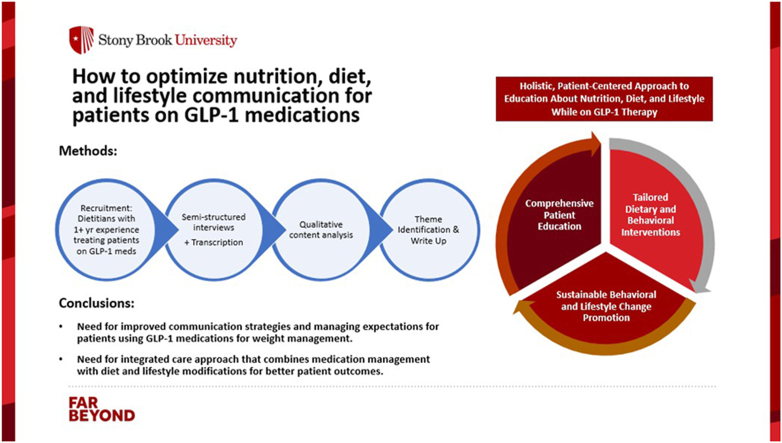
This qualitative study used semi-structured interviews to examine registered dietitians' perspectives on diet, nutrition, and lifestyle communication for patients on GLP-1 medications for obesity management.
Through in-depth interviews with registered dietitians, this research identifies elements that could improve both the efficacy of GLP-1 medication therapies and patient adherence.
indicate that a comprehensive approach, integrating patient communication with proactive management of side effects and ongoing lifestyle counseling, is essential for optimizing treatment outcomes.
Key findings include the importance of using visual and metaphorical aids to improve understanding, the necessity for structured lifestyle programs, and the pivotal role of personalized diet plans. These insights offer valuable directions for enhancing patient care and formulating clinical practices around the use of GLP-1 receptor agonist medications.
这项定性研究采用半结构化访谈,以探究注册营养师对于使用GLP-1药物治疗肥胖症的患者在饮食、营养和生活方式沟通方面的看法。
通过对注册营养师进行深入访谈,本研究确定了可提高GLP-1药物治疗疗效和患者依从性的因素。
表明采用综合方法,将患者沟通与副作用的积极管理以及持续的生活方式咨询相结合,对于优化治疗效果至关重要。
主要发现包括使用视觉和隐喻辅助工具以增进理解的重要性、结构化生活方式计划的必要性以及个性化饮食计划的关键作用。这些见解为加强患者护理以及围绕GLP-1受体激动剂药物的使用制定临床实践提供了有价值的指导。