Costantini Paolo Emidio, Saporetti Roberto, Iencharelli Marika, Flammini Soraia, Montrone Maria, Sanità Gennaro, De Felice Vittorio, Mattioli Edoardo Jun, Zangoli Mattia, Ulfo Luca, Nigro Michela, Rossi Tommaso, Di Giosia Matteo, Esposito Emanuela, Di Maria Francesca, Tino Angela, Tortiglione Claudia, Danielli Alberto, Calvaresi Matteo
Dipartimento di Farmacia e Biotecnologie, Alma Mater Studiorum, Università di Bologna, Via Francesco Selmi 3, Bologna, 40126, Italy.
IRCCS Azienda Ospedaliero-Universitaria di Bologna, Bologna, 40138, Italy.
Small. 2025 Jan;21(1):e2405832. doi: 10.1002/smll.202405832. Epub 2024 Nov 5.
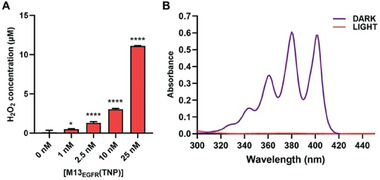
Thiophene-based nanoparticles (TNPs) are promising therapeutic and imaging agents. Here, using an innovative phage-templated synthesis, a strategy able to bypass the current limitations of TNPs in nanomedicine applications is proposed. The phage capsid is decorated with oligothiophene derivatives, transforming the virus in a 1D-thiophene nanoparticle (1D-TNP). A precise control of the shape/size of the nanoparticles is obtained exploiting the well-defined morphology of a refactored filamentous M13 phage, engineered by phage display to selectively recognize the Epidermal Growth Factor Receptor (EGFR). The tropism of the phage is maintained also after the bioconjugation of the thiophene molecules on its capsid. Moreover, the 1D-TNP proved highly fluorescent and photoactive, generating reactive oxygen species through both type I and type II mechanisms. The phototheranostic properties of this platform are investigated on biosystems presenting increasing complexity levels, from in vitro cancer cells in 2D and 3D architectures, to the in vivo tissue-like model organism Hydra vulgaris. The phage-templated 1D-TNP showed photocytotoxicity at picomolar concentrations, and the ability to deeply penetrate 3D spheroids and Hydra tissues. Collectively the results indicate that phage-templated synthesis of organic nanoparticles represents a general strategy, exploitable in many diagnostic and therapeutic fields based on targeted imaging and light mediated cell ablation.
基于噻吩的纳米颗粒(TNPs)是很有前景的治疗和成像剂。在此,利用一种创新的噬菌体模板合成方法,提出了一种能够绕过TNPs在纳米医学应用中当前局限性的策略。噬菌体衣壳用寡噻吩衍生物进行修饰,将病毒转化为一维噻吩纳米颗粒(1D-TNP)。利用经噬菌体展示工程改造以选择性识别表皮生长因子受体(EGFR)的重构丝状M13噬菌体的明确形态,实现了对纳米颗粒形状/大小的精确控制。在噬菌体衣壳上进行噻吩分子的生物共轭后,噬菌体的靶向性得以保留。此外,1D-TNP被证明具有高荧光性和光活性,通过I型和II型机制产生活性氧。在从二维和三维结构的体外癌细胞到体内组织样模式生物普通水螅等复杂性不断增加的生物系统上研究了该平台的光诊疗特性。噬菌体模板化的1D-TNP在皮摩尔浓度下表现出光细胞毒性,并且能够深入穿透三维球体和水螅组织。总体而言,结果表明噬菌体模板化合成有机纳米颗粒代表了一种通用策略,可在基于靶向成像和光介导细胞消融的许多诊断和治疗领域中加以利用。