Ou Junyong, Su Dandan, Guan Yunhe, Ge Liyuan, Deng Shaohui, Yan Ye, Hao Yichang, Lu Min, Zhang Shudong, Xie Ruiyang
Department of Urology, Peking University Third Hospital, Peking University Health Science Center, 49 North Garden Road, Beijing, 100191, China.
Department of Pathology, School of Basic Medical Sciences, Peking University Health Science Center, Beijing, 100191, China.
Discov Oncol. 2024 Nov 5;15(1):619. doi: 10.1007/s12672-024-01494-z.
Desmoid tumors (DT) are rare, locally invasive tumors originating from connective tissue. Surgical intervention is no longer the standard treatment for DT, as systemic therapy gradually replaces it due to its superior efficacy. Despite the availability of various treatment modalities, there is a need for a first-line systemic treatment regimen that offers both effective disease control and acceptable safety profiles.
To assess the efficacy and safety of different systemic treatment agents for DT, we conducted a systematic review and network meta-analysis. Eligible studies were identified through searches of PubMed, Embase, and the Cochrane Library databases, and data were extracted according to predefined inclusion criteria.
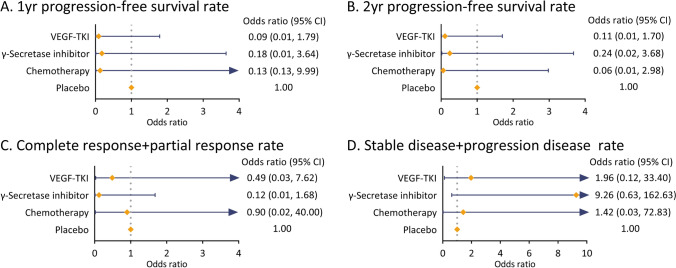
Three articles and clinical data from 295 patients with progressive and refractory DT were included in this Bayesian network meta-analysis. When considered by objective response rate (ORR), the efficacy of γ-secretase inhibitor versus placebo (OR 0.12, 95%CI 0.01-1.68) is superior to that of TKI (OR 0.49, 95%CI 0.03-7.62) and chemotherapy (OR 0.90, 95%CI 0.02-40.00). Vascular endothelial growth factor (VEGF)-TKI (OR, 0.09; 95% CI, 0.01-1.79) seemed to have the highest improvement in terms of 1-yr PFS rate, while chemotherapy seemed to have the highest improvement across all therapies in terms of 2-yr PFS rate across all therapies (OR, 0.06; 95 percent CI, 0.01-2.98). In terms of safety, the incidence of AEs is highest for γ-secretase inhibitor versus placebo (OR 0.16, 95%CI 0.02-1.55), while TKI is associated with the least AEs (OR 0.62, 95%CI 0.06-6.97).
γ-secretase inhibitor provides superior local control of tumors, while chemotherapy and TKI may offer better long-term survival benefits. Among the three regimens, TKI demonstrated better treatment-related safety. These findings have important implications for guiding clinical practice in systemic treatment of DT.
韧带样瘤(DT)是一种罕见的起源于结缔组织的局部侵袭性肿瘤。由于全身治疗疗效更佳,逐渐取代手术干预成为DT的标准治疗方法。尽管有多种治疗方式可供选择,但仍需要一种一线全身治疗方案,既能有效控制疾病,又具有可接受的安全性。
为评估不同全身治疗药物对DT的疗效和安全性,我们进行了一项系统评价和网状Meta分析。通过检索PubMed、Embase和Cochrane图书馆数据库确定符合条件的研究,并根据预定义的纳入标准提取数据。
本贝叶斯网状Meta分析纳入了3篇文章及295例进展期和难治性DT患者的临床数据。从客观缓解率(ORR)来看,γ-分泌酶抑制剂对比安慰剂的疗效(OR 0.12,95%CI 0.01-1.68)优于酪氨酸激酶抑制剂(TKI)(OR 0.49,95%CI 0.03-7.62)和化疗(OR 0.90,95%CI 0.02-40.00)。血管内皮生长因子(VEGF)-TKI(OR,0.09;95%CI,0.01-1.79)在1年无进展生存率方面似乎改善最大,而化疗在所有治疗方法中2年无进展生存率方面似乎改善最大(OR,0.06;95%CI,0.01-2.98)。在安全性方面,γ-分泌酶抑制剂对比安慰剂的不良事件发生率最高(OR 0.16,95%CI 0.02-1.55),而TKI的不良事件最少(OR 0.62,95%CI 0.06-6.97)。
γ-分泌酶抑制剂能更好地实现肿瘤局部控制,而化疗和TKI可能带来更好的长期生存获益。在这三种治疗方案中,TKI显示出更好的治疗相关安全性。这些发现对指导DT全身治疗的临床实践具有重要意义。