Department of Community Health, Tufts University, Boston, Massachusetts, USA.
Department of Health Policy, The London School of Economics and Political Science, London, UK
BMJ Glob Health. 2024 Nov 5;9(11):e015527. doi: 10.1136/bmjgh-2024-015527.
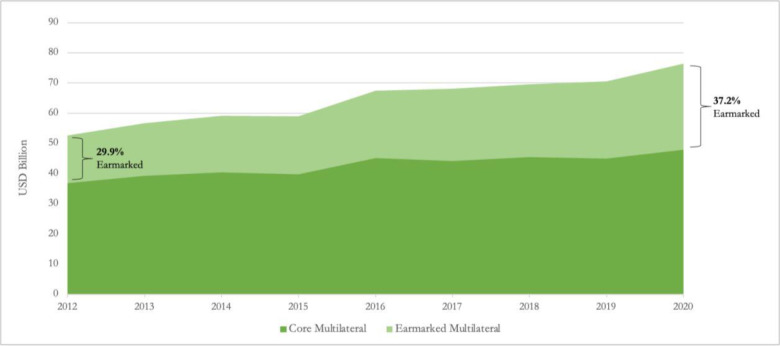
In contrast to bilateral aid, aid disbursed from multilateral institutions increased significantly at the onset of the COVID-19 pandemic. Yet, at a time when a coherent and effective multilateral response is needed most, the COVID-19 pandemic revealed a shifting landscape of donor agencies that struggle with basic functions, such as cross-national coordination. While multilaterals are uniquely positioned to transcend national priorities and respond to pandemics, functionally we find official development assistance (ODA) from these entities may increasingly mimic the attributes of bilateral aid. We explore three important, but not comprehensive, attributes of aid leading up to and during the COVID-19 pandemic: (1) earmarking, (2) donor concentration and (3) aid modality.
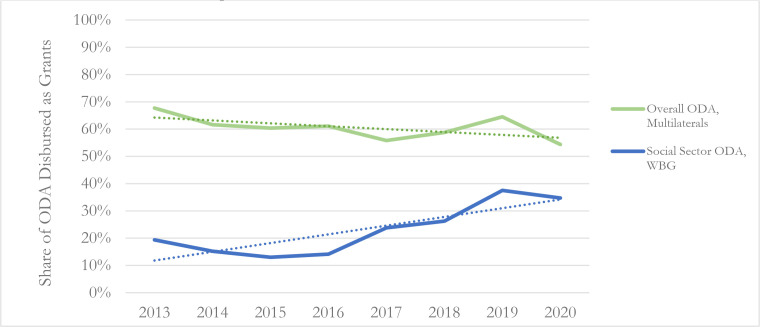
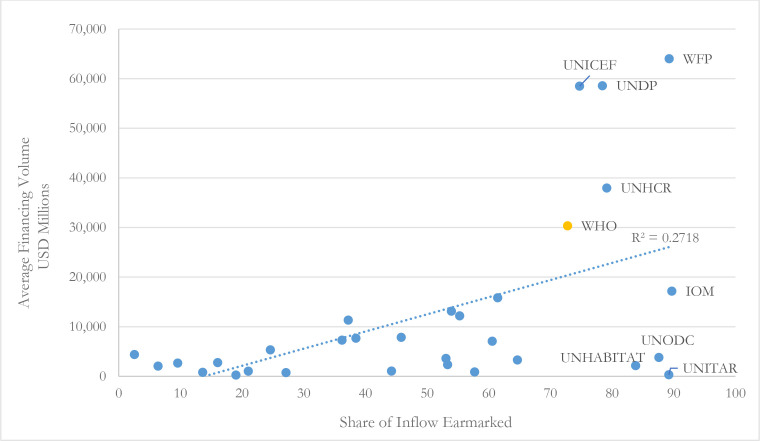
We examine ODA disbursements over time in 2020 constant prices from 2010 to 2021 and plot share of inflow that is earmarked against each United Nations multilateral against their average annual financing volume. We then assess market diversity with two measures: the Shannon-Weiner Function and Gini-Simpson Index. Finally, we examine financing vehicles used to disburse and look at 'grant share' of total ODA from all formal donors over time.
We find that while the absolute number of formal multilateral actors and market diversity have been increasing since 2011, there has been a concurrent market consolidation led by the World Bank Group at 37% of market share in 2021. This coincides with an increasing prevalence of earmarking of aid inflows to the multilateral system and, unique to multilaterals but concerning given increasing debt risk, a rise in loan-based ODA disbursements.
In theory, this consolidation may streamline revenue pooling and allow for a more collective approach to mitigating pandemic risk but, paired with increased earmarking, has the potential to sideline both collective goals (eg, the Sustainable Development Goals) and counties' core mandates (such as the pursuit of universal health coverage).
与双边援助相反,多边机构提供的援助在 COVID-19 大流行开始时大幅增加。然而,在最需要协调一致和有效多边应对的时刻,COVID-19 大流行揭示了一个不断变化的捐助机构格局,这些机构在跨国协调等基本职能方面存在困难。虽然多边机构最有能力超越国家优先事项并应对大流行病,但在功能上,我们发现这些机构的官方发展援助(ODA)可能越来越类似于双边援助的属性。我们探讨了 COVID-19 大流行之前和期间援助的三个重要但不全面的属性:(1)指定用途,(2)捐助者集中程度,(3)援助方式。
我们按照 2010 年至 2021 年的 2020 年不变价格审查 2020 年的 ODA 支出,并根据每个联合国多边机构的平均年度融资额,将指定用途的流入份额与各自进行比较。然后,我们使用两种措施评估市场多样性:香农-威纳函数和基尼-辛普森指数。最后,我们审查用于支出的融资工具,并随着时间的推移查看所有正式捐助者的 ODA 总拨款份额。
我们发现,虽然自 2011 年以来,正式多边行为体的绝对数量和市场多样性一直在增加,但自 2011 年以来,世界银行集团领导的市场整合一直在增加,2021 年的市场份额为 37%。这与援助流入多边系统的指定用途的普遍增加同时发生,并且对于多边机构来说是独特的,但鉴于不断增加的债务风险,基于贷款的 ODA 支出有所增加。
从理论上讲,这种整合可能会简化资金汇集,并允许更集体的方法来减轻大流行病风险,但与增加指定用途相结合,有可能使集体目标(例如可持续发展目标)和各国的核心任务(例如追求全民健康覆盖)边缘化。