SS Physiopathology of Human Reproduction, IRCCS Ospedale Policlinico San Martino, Genova, Italy.
Experimental Medicine Department, University of Genova, Genova, Italy.
Sci Rep. 2024 Nov 5;14(1):26819. doi: 10.1038/s41598-024-77823-7.
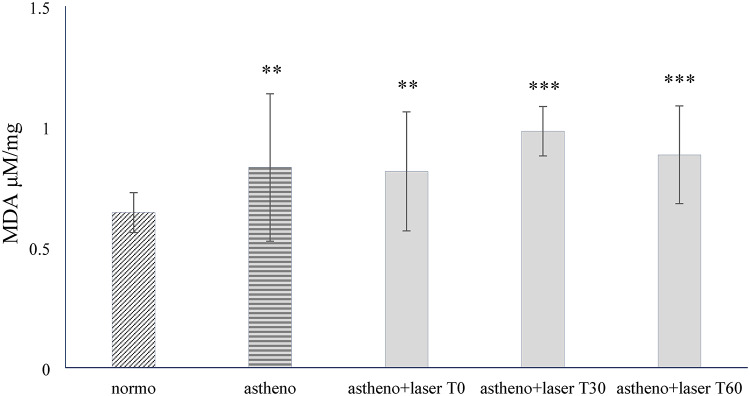
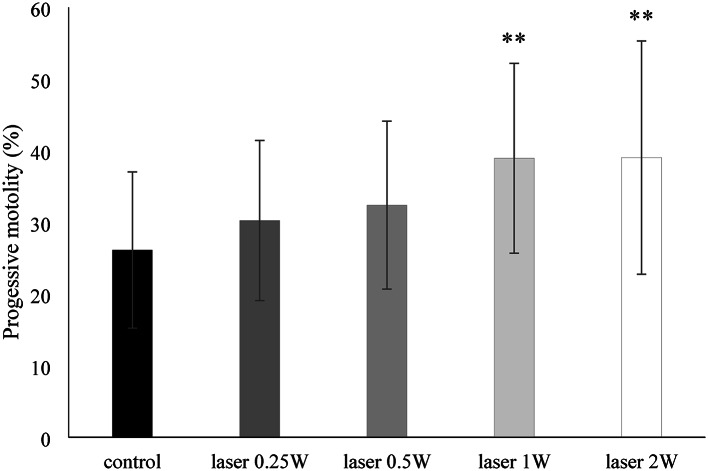
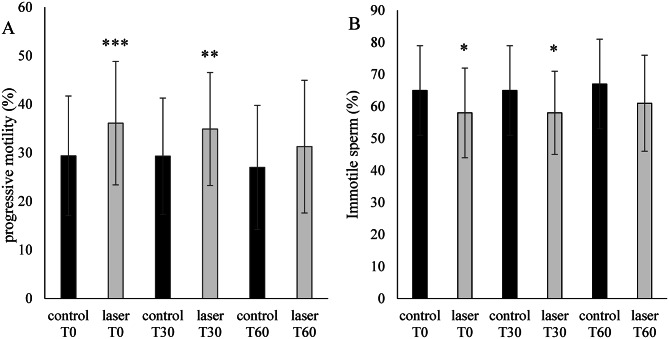
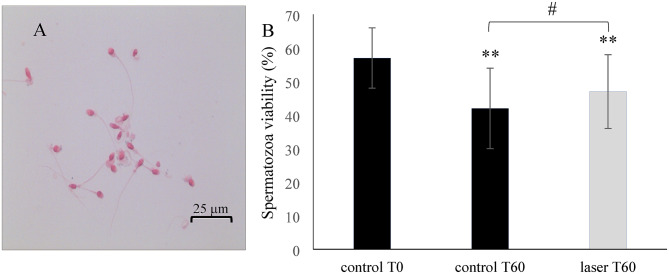
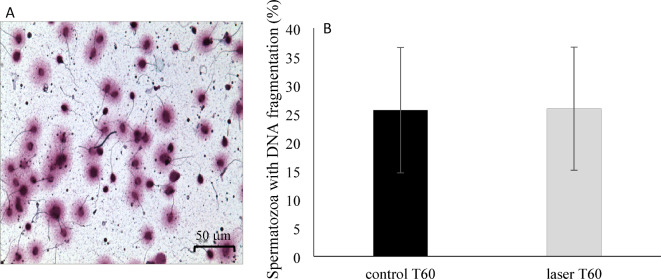
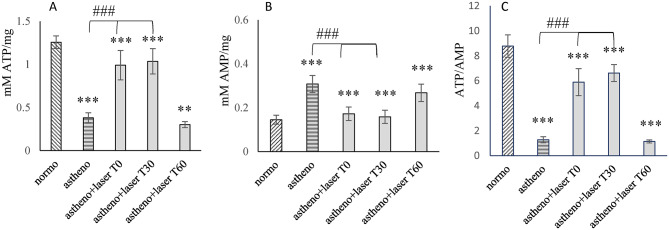
Sperm motility is a crucial factor in male fertility. Photobiomodulation (PBM) has been reported to increase sperm motility, but a consistent approach suitable for identifying standardizable protocols is lacking. We collected asthenozoospermic (n = 70) and normozoospermic (n = 20) semen. The asthenozoospermic samples were irradiated with an 810 nm diode laser, in continuous wave mode, at 0.25 W, 0.5 W, 1 W and 2 W for 60 s on a circular area of 1 cmthrough a novel handpiece with an innovative flat-top profile. Sperm motility was assessed immediately, after 30 and 60 min. A sample size calculator, unpaired t-test and one-way ANOVA with post-hoc Tukey HSD tests were used for statistics. One and 2 W were the most effective outputs in increasing progressive motility compared to control (p < 0.001). The maximum effect was immediately after 1 W-PBM (p < 0.001) and decreased after 60 min (p < 0.001). Time physiologically decreased vitality (p < 0.001), but less in the 1 W-PBM samples (p < 0.05). 1 W-PBM did not affect chromatin condensation. Asthenozoospermic samples displayed an impairment of 80% in oxygen consumption and ATP production and a slight inefficiency of oxidative phosphorylation compared to normozoospermic samples (p < 0.001). 1 W-PBM partially restored the functionality of aerobic metabolism (p < 0.001) by recovery of oxidative phosphorylation efficiency. PBM did not affect lactate dehydrogenase (glycolysis pathway). No irradiated samples increased accumulated malondialdehyde, a marker of lipidic peroxidation. In conclusion, PBM improves progressive motility in asthenozoospermia through increased mitochondrial energetic metabolism without harmful oxidative stress.
精子活力是男性生育能力的一个关键因素。已经有报道称光生物调节(PBM)可以提高精子活力,但缺乏一种适用于识别标准化方案的一致方法。我们收集了弱精症(n=70)和正常精子(n=20)的精液。弱精症样本采用 810nm 二极管激光进行照射,连续波模式,在 1cm 的圆形区域上以 0.25W、0.5W、1W 和 2W 的功率照射 60s,使用带有创新平顶轮廓的新型手柄。立即、30 分钟和 60 分钟后评估精子活力。使用样本量计算器、未配对 t 检验和单向方差分析(事后 Tukey HSD 检验)进行统计学分析。与对照组相比,1W 和 2W 是提高前向运动精子活力最有效的输出(p<0.001)。最大效果出现在 1W-PBM 后立即(p<0.001),60 分钟后下降(p<0.001)。时间上生理上降低了活力(p<0.001),但在 1W-PBM 样本中减少较少(p<0.05)。1W-PBM 不影响染色质凝聚。与正常精子样本相比,弱精症样本的耗氧量和 ATP 生成减少了 80%,氧化磷酸化效率略有降低(p<0.001)。1W-PBM 通过恢复氧化磷酸化效率,部分恢复了有氧代谢的功能(p<0.001)。PBM 不影响乳酸脱氢酶(糖酵解途径)。没有照射的样本增加了丙二醛的积累,丙二醛是脂质过氧化的标志物。总之,PBM 通过增加线粒体能量代谢来改善弱精症中的前向运动精子活力,而不会产生有害的氧化应激。