Post-graduation Program in Internal Medicine, Federal University of Paraná (UFPR), Street General Carneiro, 181, Central Building - 11th Floor, Alto da Glória, Curitiba, 80.060-900, Paraná, Brazil.
Public Health Department, Federal University of Paraná (UFPR), Curitiba, Brazil.
BMC Public Health. 2024 Nov 5;24(1):3047. doi: 10.1186/s12889-024-20535-4.
The impact of the COVID-19 pandemic on breast cancer care across Brazilian regions with varying Human Development Index (HDI) levels remains unclear. This study evaluates the pandemic's effects on screening mammograms, tumor staging at diagnosis, and treatment initiation in the Brazilian Public Health System between 2017 and 2022, focusing on regions with different HDI levels.
This ecological time series study uses an inflection point regression model and monthly percentage change (MPC) to analyze an open-access Brazilian Public Healthcare System dataset. The study focuses on trends and variations in these variables among women aged 50-69 in three state groups classified by HDI: Group A (very high), Group B (medium), and Group C (high).
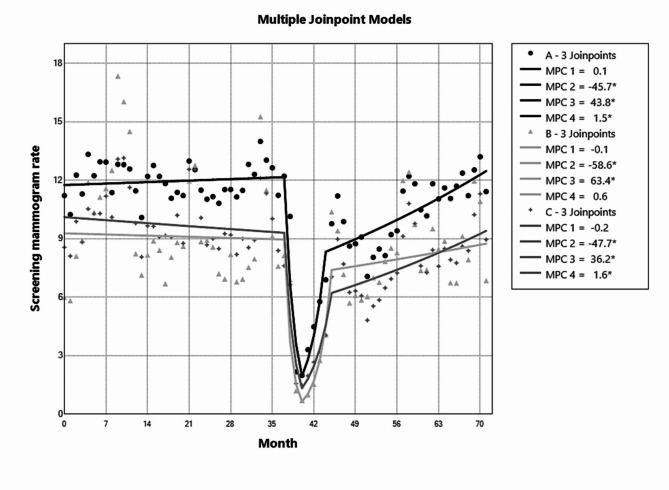
The average monthly rate of screening mammograms was highest in Group A (10.70) and lowest in Group B (8.38). At the onset of the COVID-19 pandemic, screening rates dropped significantly, with the most significant decline in Group B (58.6% decrease) and the smallest in Group A (45.7% decrease), lasting for three months. Subsequently, this variable recovered until December 2022 but was insufficient to restore the total series MPC to pre-pandemic levels. Group B had the lowest average rate of early-stage (0-II) diagnoses (2.88), while Group C had the highest (3.68). Early-stage diagnoses declined in the first three months of the pandemic, followed by a partial recovery that was insufficient to restore the pre-pandemic MPC levels. The proportion of advanced-stage diagnoses was highest in Group B (49.02%) and lowest in Group A (45.97%). The pandemic maintained the upward trend of advanced-stage (III-IV) diagnoses across all groups in the total time series. The average proportion of treatments initiated after 60 days of diagnosis was above 60% across all groups, with Group B at 64.50%. This variable began to rise 3 to 4 months after the pandemic and continued increasing until December 2022, with a greater intensity than the pre-pandemic period across all groups.
The COVID-19 pandemic reduced breast cancer screening and early diagnosis in Brazil, leading to more advanced cases and treatment delays across all regions, with varying impacts according to regional HDI levels.
COVID-19 大流行对巴西不同人类发展指数(HDI)水平地区的乳腺癌护理的影响尚不清楚。本研究评估了 2017 年至 2022 年间大流行对巴西公共卫生系统中筛查乳房 X 光片、诊断时肿瘤分期和治疗开始的影响,重点关注具有不同 HDI 水平的地区。
本生态时间序列研究使用拐点回归模型和每月百分比变化(MPC)分析巴西公共医疗保健系统的开放访问数据集。该研究关注三个州组中 50-69 岁女性中这些变量的趋势和变化,这些州组根据 HDI 进行分类:A 组(很高)、B 组(中)和 C 组(高)。
筛查乳房 X 光片的平均每月率在 A 组中最高(10.70),在 B 组中最低(8.38)。在 COVID-19 大流行开始时,筛查率显著下降,B 组下降幅度最大(下降 58.6%),A 组下降幅度最小(下降 45.7%),持续三个月。随后,该变量恢复,直到 2022 年 12 月,但不足以将总系列 MPC 恢复到大流行前水平。B 组的早期(0-II)诊断的平均比率最低(2.88),而 C 组的比率最高(3.68)。在大流行的头三个月,早期诊断下降,随后部分恢复,但不足以恢复大流行前的 MPC 水平。在所有组中,B 组的晚期诊断比例最高(49.02%),A 组的比例最低(45.97%)。在整个时间序列中,大流行维持了所有组中晚期(III-IV)诊断的上升趋势。所有组中,诊断后 60 天开始治疗的平均比例均高于 60%,B 组为 64.50%。该变量在大流行后 3 至 4 个月开始上升,并持续上升至 2022 年 12 月,在所有组中均比大流行前时期更为剧烈。
COVID-19 大流行减少了巴西的乳腺癌筛查和早期诊断,导致所有地区的病例更为晚期和治疗延迟,根据区域 HDI 水平的不同,影响程度也不同。