Li Ke-Fan, Li Jun, Xia A-Long, Wang Xiao-Wei, Wang Ai-Ling, Shi Ying, Chen Huai-Zhen
Department of Neurology, The First Affiliated Hospital of Anhui University of Traditional Chinese Medicine, Hefei, China.
Anhui Branch Center of National Clinical Research Center for Geriatric Disorders, Hefei, China.
Clin Park Relat Disord. 2024 Oct 16;11:100276. doi: 10.1016/j.prdoa.2024.100276. eCollection 2024.
Fine motor impairment is common in Parkinson's disease (PD), which reduces patients' quality of life. There are few suitable targeted treatments. We conducted a clinical trial to determine whether Baduanjin Qigong exercise would increase fine motor skills in PD patients.
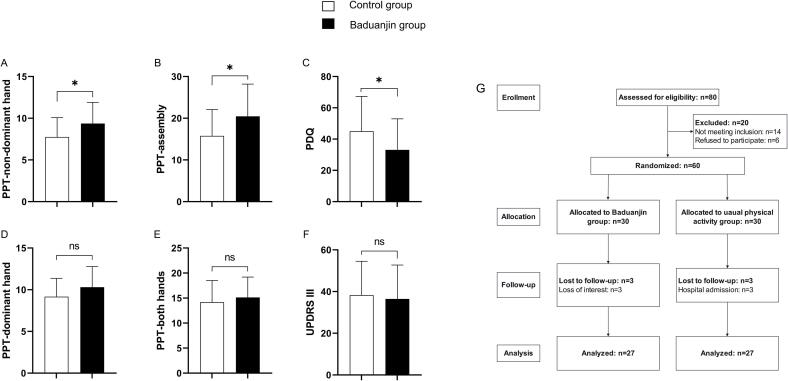
Sixty PD patients (Hoehn-Yahr stage 1-4) with hand fine motor impairment were randomly assigned to the Baduanjin group and the physical activity group. Baduanjin group practiced Baduanjin exercise five times weekly for 40 min (warm-up 5 min, Baduanjin 30 min, cool-down 5 min). The usual physical activity groups maintained their habit of usual physical activities. The participants underwent assessments in the "ON" medication state at baseline and 4-week follow-up time points. The Purdue Pegboard Test (PPT) was used as the primary outcome to assess manual dexterity. The secondary outcomes included the Movement Disorders Society-Unified Parkinson's Disease Rating Scale, part III (MDS-UPDRS III), and the Parkinson's disease questionnaire (PDQ-39).
The results of PPT revealed the Baduanjin group showed statistically significant improvement in the "non-dominant hand" and "assembly" scores compared to the usual physical activity group (P < 0.05), but with no significant difference in "dominant hand" and "both hands" (P > 0.05). Additionally, the Baduanjin group showed better performance in the PDQ-39 (P < 0.05).
Our study concludes that a 4-week Baduanjin exercise is effective in improving fine motor function and quality of life in patients with mild and moderate PD. The results suggest a promising intervention to be implemented in community or home settings for managing fine motor impairment in PD.
精细运动障碍在帕金森病(PD)中很常见,这会降低患者的生活质量。合适的靶向治疗方法很少。我们进行了一项临床试验,以确定八段锦气功练习是否能提高PD患者的精细运动技能。
60名患有手部精细运动障碍的PD患者(Hoehn-Yahr分期1-4期)被随机分配到八段锦组和体育活动组。八段锦组每周进行5次八段锦练习,每次40分钟(热身5分钟,八段锦练习30分钟,放松5分钟)。常规体育活动组保持其日常体育活动习惯。参与者在基线和4周随访时间点处于药物“开”状态下接受评估。普渡钉板测试(PPT)用作评估手部灵活性的主要指标。次要指标包括运动障碍协会统一帕金森病评定量表第三部分(MDS-UPDRS III)和帕金森病问卷(PDQ-39)。
PPT结果显示,与常规体育活动组相比,八段锦组在“非优势手”和“组装”得分上有统计学意义的改善(P<0.05),但在“优势手”和“双手”得分上无显著差异(P>0.05)。此外,八段锦组在PDQ-39上表现更好(P<0.05)。
我们的研究得出结论,为期4周的八段锦练习可有效改善轻度和中度PD患者的精细运动功能和生活质量。结果表明,在社区或家庭环境中实施一种有前景的干预措施来管理PD患者的精细运动障碍是可行的。