Dhanasekaran Maheswaran, Schmitz John, Castro Maria Regina, Rajwani Aadil, Lee Robert Alan, Hamadi Dana, Morris John C, Callstrom Matthew R, Stan Marius N
Department of Endocrinology, Diabetes, Metabolism and Nutrition, Mayo Clinic, Rochester, MN 55905, USA.
Department of Diagnostic Radiology, Mayo Clinic, Rochester, MN 55905, USA.
J Endocr Soc. 2024 Oct 17;8(12):bvae175. doi: 10.1210/jendso/bvae175. eCollection 2024 Oct 29.
Autonomously functioning thyroid nodules (AFTNs) constitute 5% to 7% of thyroid nodules and represent the second most common cause of hyperthyroidism following Graves' disease. Currently, radioactive iodine (RAI) and surgery are the standard treatment options, and both incur a risk of postprocedural hypothyroidism and other surgery and radiation-related complications.
This work aimed at assessing the efficacy of radiofrequency ablation (RFA) as an alternative treatment option for resolving hyperthyroidism and the nodule volume rate reduction (VRR) and its associated adverse events.
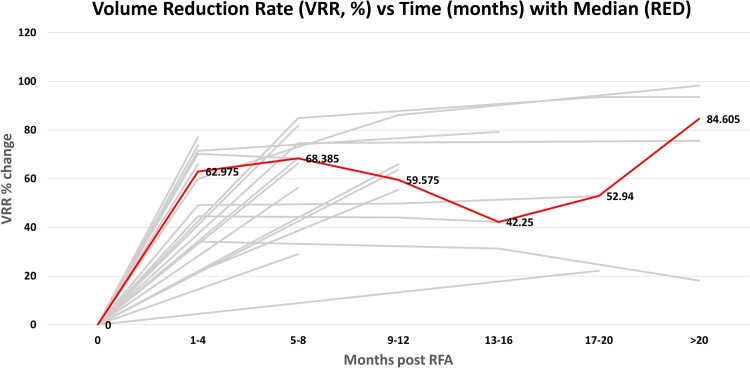
A total of 22 patients underwent RFA for a solitary AFTN. Seventy-two percent (n = 16) had subclinical hyperthyroidism, 9% (n = 2) had overt hyperthyroidism, and 18% (n = 4) were biochemically euthyroid on antithyroid medication. Average pretreatment TSH was 0.41 mIU/L (SD = 0.98) and free T4 1.29 ng/dL (SD = 0.33). Following a single RFA session, hyperthyroidism resolved in 90.9% (n = 20) and average VRR (61.13%) was achieved within 3 to 6 months following the ablation. Except for 1 nodule, none of the nodules grew during the follow-up period (16.5 months). Two patients (9%) developed transient tachycardia requiring short-term beta-blocker therapy, and 2 developed mild hypothyroidism requiring levothyroxine therapy. Two patients developed recurrent hyperthyroidism and elected to undergo lobectomy and repeat RFA respectively. No serious adverse effects were noted in this cohort.
RAI and/or surgery represent the standard of care for toxic adenomas, but RFA shows excellent efficacy and safety profile. Therefore, at centers with RFA expertise, it should be considered an alternative treatment strategy, avoiding radiation and surgery-related complications.
自主功能性甲状腺结节(AFTN)占甲状腺结节的5%至7%,是继格雷夫斯病之后引起甲状腺功能亢进的第二大常见原因。目前,放射性碘(RAI)和手术是标准的治疗选择,但两者都有术后甲状腺功能减退以及其他与手术和放疗相关并发症的风险。
本研究旨在评估射频消融(RFA)作为解决甲状腺功能亢进及降低结节体积率(VRR)的替代治疗方案及其相关不良事件。
共有22例患者因单发AFTN接受了RFA治疗。72%(n = 16)为亚临床甲状腺功能亢进,9%(n = 2)为显性甲状腺功能亢进,18%(n = 4)在服用抗甲状腺药物时甲状腺功能生化指标正常。治疗前平均促甲状腺激素(TSH)为0.41 mIU/L(标准差 = 0.98),游离甲状腺素(FT4)为1.29 ng/dL(标准差 = 0.33)。单次RFA治疗后,90.9%(n = 20)的甲状腺功能亢进得到缓解,消融后3至6个月内平均结节体积缩小率(VRR)达到61.13%。除1个结节外,随访期间(16.5个月)无结节增大。2例患者(9%)出现短暂性心动过速,需要短期使用β受体阻滞剂治疗,2例出现轻度甲状腺功能减退,需要左旋甲状腺素治疗。2例患者出现复发性甲状腺功能亢进,分别选择接受叶切除术和再次RFA治疗。该队列中未观察到严重不良反应。
RAI和/或手术是毒性腺瘤的标准治疗方法,但RFA显示出优异的疗效和安全性。因此,在具备RFA专业技术的中心,应将其视为一种替代治疗策略,以避免与放疗和手术相关的并发症。