Hussain Iram, Zulfiqar Fizza, Li Xilong, Ahmad Shahzad, Aljammal Jules
Division of Endocrinology, Department of Internal Medicine, University of Texas Southwestern Medical Center, Dallas, TX 75390-8537, USA.
The Thyroid Clinic, Salt Lake City, UT 84124, USA.
J Endocr Soc. 2021 Jun 10;5(8):bvab110. doi: 10.1210/jendso/bvab110. eCollection 2021 Aug 1.
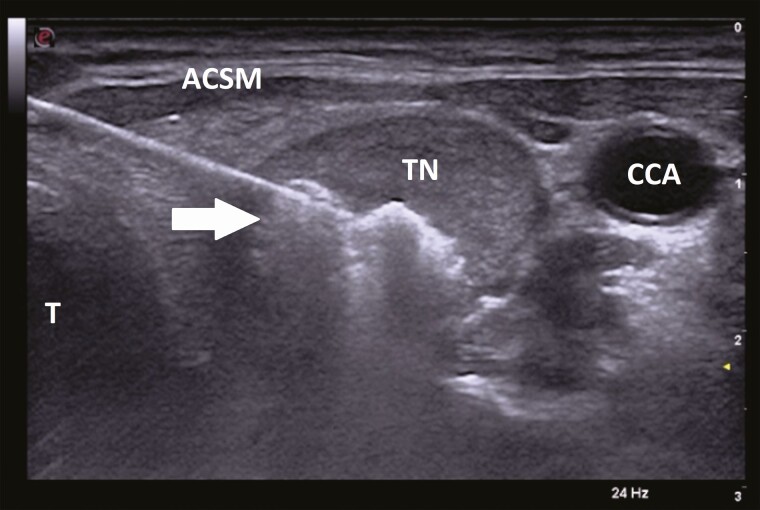
Radiofrequency ablation (RFA) has only recently gained popularity in the United States for treatment of thyroid nodules (TNs), with a limited number of patients having undergone the procedure in this country.
To evaluate the safety and efficacy of RFA of TNs performed in an outpatient setting in the United States.
This is a retrospective, single-center study of 53 patients who underwent RFA of 58 TNs between November 2018 and January 2021. The reduction in volume of nodule, cosmetic and symptomatic improvement, effect on thyroid function, and complications following RFA were assessed.
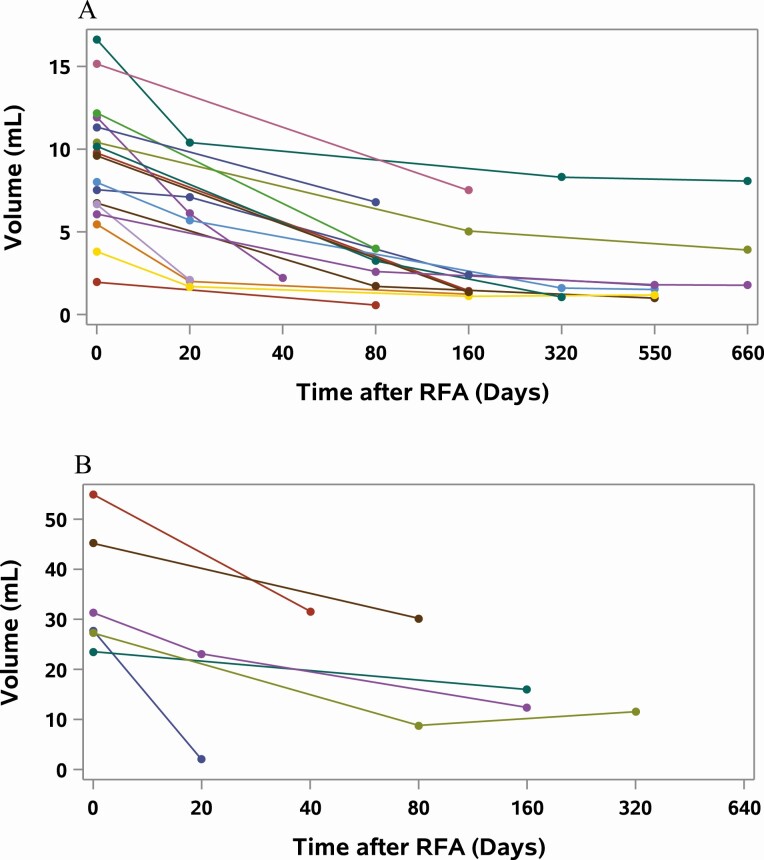
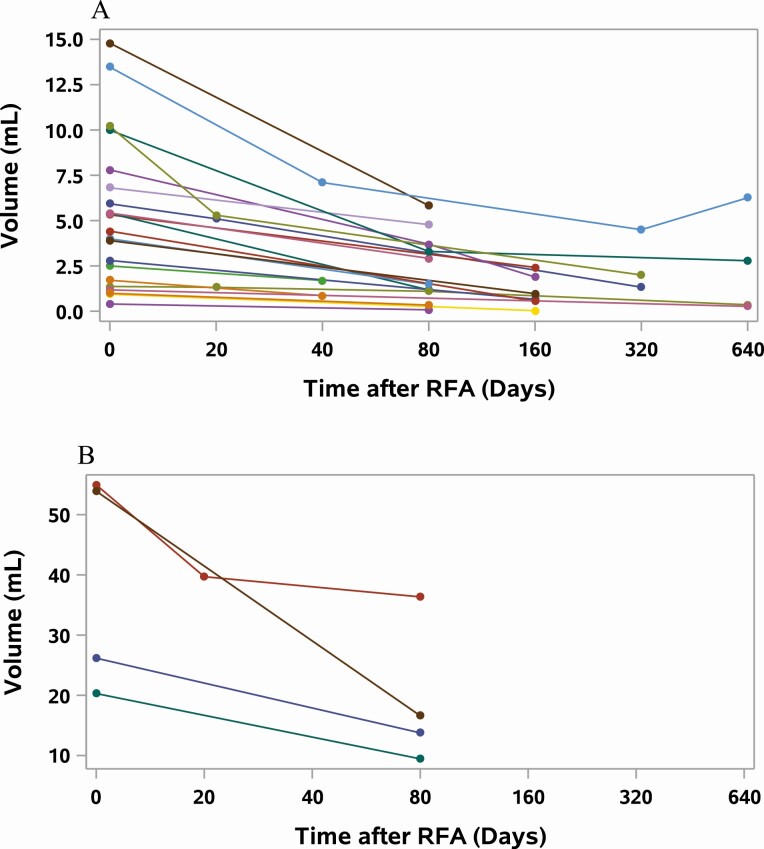
Eleven out of 53 patients were excluded from the analysis. A total of 47 benign TNs (23 nonfunctioning thyroid nodules [NFTNs] and 24 autonomously functioning thyroid nodules [AFTNs]), were assessed after RFA. The median reduction in volume was 70.8% after a median follow-up period of 109 days, with symptomatic and cosmetic improvement ( < 0.0001). Compared with larger nodules, smaller nodules had greater volume reduction ( = 0.0266). RFA improved thyrotropin (TSH) in AFTNs ( value = 0.0015) and did not affect TSH in NFTNs ( value = 0.23). There were no major complications; however, 1 patient had self-limited local bleeding and another had transient voice change that recovered in 6 months.
RFA is a safe and efficacious treatment for symptomatic NFTNs and AFTNs in our population and is especially effective for smaller nodules. RFA should be considered an alternative for TNs in patients who cannot or do not want to undergo surgery.
射频消融术(RFA)在美国用于治疗甲状腺结节(TNs)是最近才开始流行的,在该国接受该手术的患者数量有限。
评估在美国门诊环境中对甲状腺结节进行射频消融术的安全性和有效性。
这是一项回顾性单中心研究,研究对象为2018年11月至2021年1月期间接受58个甲状腺结节射频消融术的53例患者。评估了结节体积的缩小情况、美容和症状改善情况、对甲状腺功能的影响以及射频消融术后的并发症。
53例患者中有11例被排除在分析之外。射频消融术后共评估了47个良性甲状腺结节(23个无功能甲状腺结节[NFTNs]和24个自主功能性甲状腺结节[AFTNs])。中位随访期109天后,体积的中位缩小率为70.8%,症状和美容方面均有改善(P<0.0001)。与较大的结节相比,较小的结节体积缩小幅度更大(P = 0.0266)。射频消融术改善了自主功能性甲状腺结节患者的促甲状腺激素(TSH)水平(P值=0.0015),而对无功能甲状腺结节患者的TSH水平无影响(P值=0.23)。没有出现重大并发症;然而,1例患者出现了自限性局部出血,另1例患者出现了短暂的声音改变,6个月后恢复。
射频消融术对我们研究人群中有症状的无功能甲状腺结节和自主功能性甲状腺结节是一种安全有效的治疗方法对于较小的结节尤其有效。对于不能或不想接受手术的甲状腺结节患者,应考虑将射频消融术作为一种替代治疗方法。