Oka Toshiki, Hatano Koji, Tani Masaru, Yoshimura Akihiro, Horibe Yuki, Liu Yutong, Sassi Nesrine, Okuda Yohei, Yamamoto Akinaru, Uemura Toshihiro, Yamamichi Gaku, Ishizuya Y U, Yamamoto Yoshiyuki, Kato Taigo, Kawashima Atsunari, Fujita Kazutoshi, Nonomura Norio
Department of Urology, Osaka University Graduate School of Medicine, Osaka, Japan.
Department of Urology, Kindai University Faculty of Medicine, Osaka, Japan.
Cancer Diagn Progn. 2024 Nov 3;4(6):706-714. doi: 10.21873/cdp.10385. eCollection 2024 Nov-Dec.
BACKGROUND/AIM: There is little evidence regarding the predictive value of prostate-specific antigen (PSA) kinetics in patients with castration-resistant prostate cancer treated with an androgen receptor signaling inhibitor. This study investigated the correlation between PSA kinetics and prognosis in patients with castration-resistant prostate cancer treated with enzalutamide.
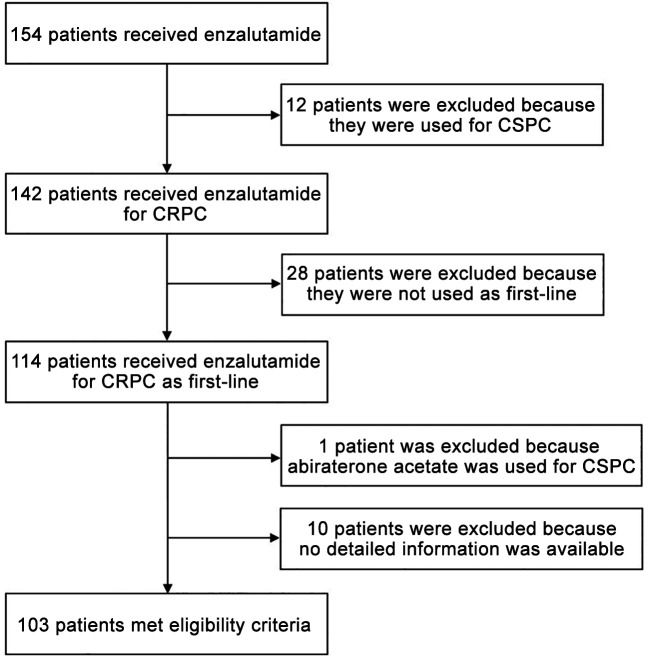
We analyzed data from 103 patients who received enzalutamide as primary treatment for castration-resistant prostate cancer at our hospital, focusing on the associations between overall survival and PSA kinetics variables, such as maximal PSA response, PSA nadir, and time to PSA nadir.
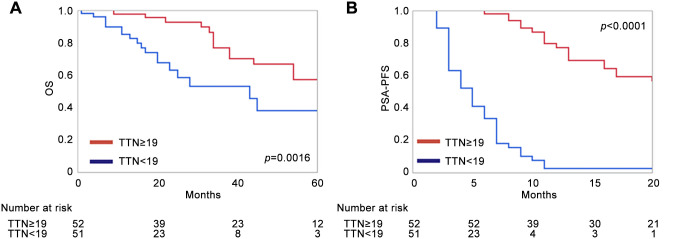
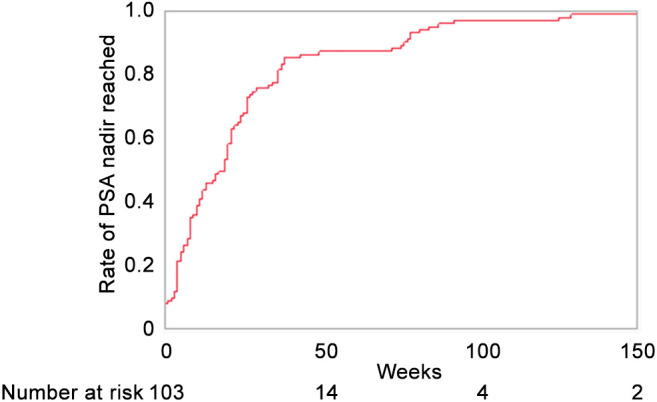
The median PSA level at the initiation of enzalutamide was 18.1 ng/ml (interquartile range=7.9-61.2 ng/ml). The median maximal PSA response rate was 88% (interquartile range 55-98), and the median PSA nadir was 1.84 (interquartile range (IQR)=0.38-14.7) ng/ml. The median time to PSA nadir was 19 (IQR=6-28.5) weeks. Maximal PSA response rate <90% [hazard ratio (HR)=2.28, 95% confidence interval (CI)=1.03-5.03, p=0.0413], PSA nadir >2 ng/ml (HR=2.30, 95%CI=1.05-5.07, p=0.0379), time to nadir <19 weeks (HR=2.48, 95%CI=1.15-5.35, p=0.0204) were all independently predictive of shortened overall survival even after adjusting for pre-treatment factors.
Maximal PSA response, PSA nadir, and time to PSA nadir correlated with survival in patients with castration-resistant prostate cancer receiving enzalutamide as a first-line therapy.
背景/目的:关于雄激素受体信号抑制剂治疗去势抵抗性前列腺癌患者时前列腺特异性抗原(PSA)动力学的预测价值,证据较少。本研究调查了恩杂鲁胺治疗的去势抵抗性前列腺癌患者中PSA动力学与预后的相关性。
我们分析了我院103例接受恩杂鲁胺作为去势抵抗性前列腺癌一线治疗的患者的数据,重点关注总生存期与PSA动力学变量之间的关联,如最大PSA反应、PSA最低点及达到PSA最低点的时间。
开始使用恩杂鲁胺时的PSA中位数水平为18.1 ng/ml(四分位间距=7.9 - 61.2 ng/ml)。最大PSA反应率中位数为88%(四分位间距55 - 98),PSA最低点中位数为1.84(四分位间距(IQR)=0.38 - 14.7)ng/ml。达到PSA最低点的时间中位数为19(IQR = 6 - 28.5)周。即使在对治疗前因素进行校正后,最大PSA反应率<90%[风险比(HR)=2.28,95%置信区间(CI)=1.03 - 5.03,p = 0.0413]、PSA最低点>2 ng/ml(HR = 2.30,95%CI = 1.05 - 5.07,p = 0.0379)、达到最低点的时间<19周(HR = 2.48,95%CI = 1.15 - 5.35,p = 0.0204)均独立预测总生存期缩短。
最大PSA反应、PSA最低点及达到PSA最低点的时间与接受恩杂鲁胺一线治疗的去势抵抗性前列腺癌患者的生存相关。