School of Medicine and Dentistry, Griffith University, Southport, Queensland, Australia.
The Australians Together Health Initiative Program (The ATHENA Program), Sunshine Coast University Hospital, Queensland Health, Birtinya, Queensland, Australia.
JMIR Form Res. 2024 Nov 6;8:e57165. doi: 10.2196/57165.
Dynamic consent has the potential to address many of the issues facing traditional paper-based or electronic consent, including enrolling informed and engaged participants in the decision-making process. The Australians Together Health Initiative (ATHENA) program aims to connect participants across Queensland, Australia, with new research opportunities. At its core is dynamic consent, an interactive and participant-centric digital platform that enables users to view ongoing research activities, update consent preferences, and have ongoing engagement with researchers.
This study aimed to describe the development of the ATHENA dynamic consent platform within the framework of the ATHENA program, including how the platform was designed, its utilization by participants, and the insights gained.
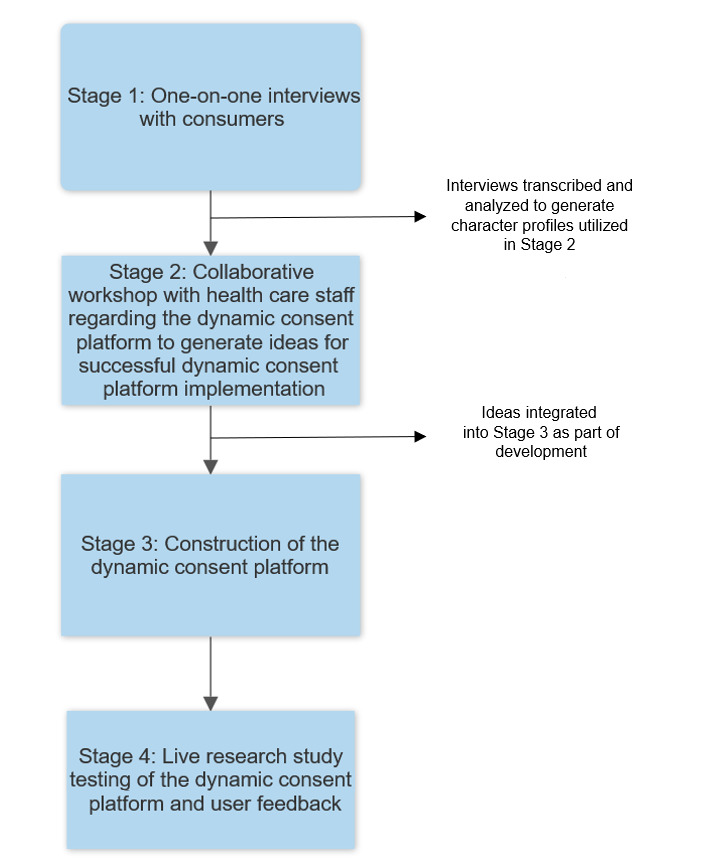
One-on-one interviews were undertaken with consumers, followed by a workshop with health care staff to gain insights into the dynamic consent concept. Five problem statements were developed, and solutions were posed, from which a dynamic consent platform was constructed, tested, and used for implementation in a clinical trial. Potential users were randomly recruited from a pre-existing pool of 615 participants in the ATHENA program. Feedback on user platform experience was gained from a survey hosted on the platform.
In the 13 consumer interviews undertaken, participants were positive about dynamic consent, valuing privacy, ease of use, and adequate communication. Motivators for registration were feedback on data usage and its broader community benefits. Problem statements were security, trust and governance, ease of use, communication, control, and need for a scalable platform. Using the newly constructed dynamic consent platform, 99 potential participants were selected, of whom 67 (68%) were successfully recontacted. Of these, 59 (88%) agreed to be sent the platform, 44 (74%) logged on (indicating use), and 22 (57%) registered for the clinical trial. Survey feedback was favorable, with an average positive rating of 78% across all questions, reflecting satisfaction with the clarity, brevity, and flexibility of the platform. Barriers to implementation included technological and health literacy.
This study describes the successful development and testing of a dynamic consent platform that was well-accepted, with users recognizing its advantages over traditional methods of consent regarding flexibility, ease of communication, and participant satisfaction. This information may be useful to other researchers who plan to use dynamic consent in health care research.
动态同意有可能解决传统纸质或电子同意书面临的许多问题,包括让知情和参与的参与者参与决策过程。澳大利亚团结健康倡议(ATHENA)计划旨在将澳大利亚昆士兰州的参与者与新的研究机会联系起来。其核心是动态同意,这是一个互动的、以参与者为中心的数字平台,使用户能够查看正在进行的研究活动、更新同意偏好,并与研究人员保持持续互动。
本研究旨在描述 ATHENA 计划中 ATHENA 动态同意平台的开发情况,包括平台的设计方式、参与者的使用情况以及获得的见解。
对消费者进行了一对一访谈,随后与医疗保健人员一起举办了一次研讨会,以了解动态同意的概念。制定了五个问题陈述,并提出了解决方案,由此构建、测试了一个动态同意平台,并将其用于临床试验的实施。潜在用户是从 ATHENA 计划中现有的 615 名参与者中随机招募的。在平台上托管的调查中获得了对用户平台体验的反馈。
在进行的 13 次消费者访谈中,参与者对动态同意持积极态度,重视隐私、易用性和充分的沟通。注册的动机是对数据使用及其更广泛的社区利益的反馈。问题陈述包括安全性、信任和治理、易用性、沟通、控制和对可扩展平台的需求。使用新构建的动态同意平台,选择了 99 名潜在参与者,其中 67 名(68%)成功重新联系。在这些人中,有 59 名(88%)同意发送平台,44 名(74%)登录(表示使用),22 名(57%)注册参加临床试验。调查反馈是积极的,所有问题的平均正面评价率为 78%,反映了参与者对平台的清晰度、简洁性和灵活性的满意。实施的障碍包括技术和健康素养。
本研究描述了一个成功开发和测试的动态同意平台,该平台得到了广泛认可,用户认识到它在灵活性、沟通便利性和参与者满意度方面优于传统的同意方法。这些信息可能对其他计划在医疗保健研究中使用动态同意的研究人员有用。