Jones-Whitehead Charlotte, Tran John, Wilson Timothy D, Loh Eldon
Department of Anatomy and Cell Biology, Schulich School of Medicine & Dentistry, Western University, London, Ontario, Canada.
Surgery (Division of Anatomy), Temerty Faculty of Medicine, University of Toronto, Toronto, Ontario, Canada.
Pain Med. 2025 Feb 1;26(2):70-75. doi: 10.1093/pm/pnae112.
Radiofrequency ablation is a treatment for facetogenic low back pain that targets medial branches of lumbar dorsal rami to denervate facet joints. Clinical outcomes vary; optimizing cannula placement to better capture the medial branch could improve clinical outcomes. A novel parasagittal technique was proposed from an anatomic model; this technique was proposed to optimize capture of the medial branch. The anatomic feasibility of the novel technique has not been evaluated.
To simulate and evaluate the proposed parasagittal technique in its ability to achieve proper cannula placement and proximity of uninsulated cannula tips to the medial branches of the dorsal rami in cadaveric specimens.
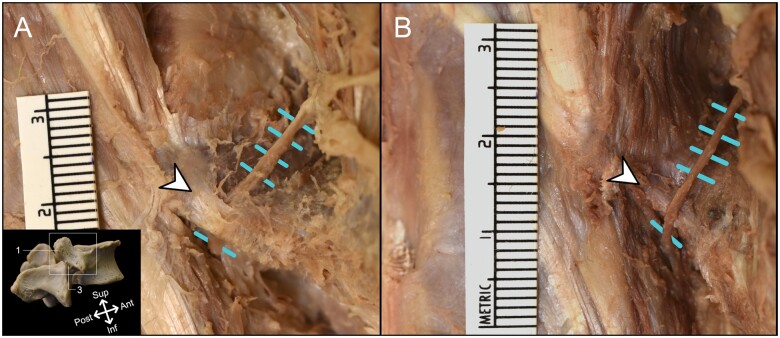
Under fluoroscopic guidance, the parasagittal technique was used to place 14 cannulae targeting the lumbar medial branches of 2 cadavers. Meticulous dissection was undertaken to assess cannula alignment and measure proximities to target nerves with a digital caliper.
The novel parasagittal technique was successfully performed in a cadaveric model in 12 of 14 attempts. The technique achieved close proximity of cannula tips to medial branches (0.8 ± 1.1 mm). In 2 instances, cannulae were placed unsuccessfully; in one instance, the cannula was too far anterior, and in the other, it was too far retracted.
In this cadaveric simulation study, the feasibility of performing the parasagittal technique for lumbar radiofrequency ablation was evaluated. This study suggests that the parasagittal technique is a feasible option for lumbar medial branch radiofrequency ablation.
射频消融是一种治疗小关节源性下腰痛的方法,其靶点是腰背侧支的内侧支以去神经支配小关节。临床结果各异;优化套管置入以更好地捕捉内侧支可能会改善临床结果。基于一个解剖模型提出了一种新的矢旁技术;该技术旨在优化对内侧支的捕捉。尚未评估该新技术的解剖学可行性。
在尸体标本中模拟并评估所提出的矢旁技术实现套管正确置入以及未绝缘套管尖端与背侧支内侧支接近程度的能力。
在荧光镜引导下,使用矢旁技术将14根套管置入2具尸体的腰内侧支靶点。进行细致解剖以评估套管对齐情况,并用数字卡尺测量与目标神经的接近程度。
在14次尝试中有12次在尸体模型中成功实施了新的矢旁技术。该技术使套管尖端非常接近内侧支(0.8±1.1毫米)。有2次套管置入未成功;一次套管过于靠前,另一次则过于后缩。
在这项尸体模拟研究中,评估了实施腰射频消融矢旁技术的可行性。本研究表明矢旁技术是腰内侧支射频消融的一种可行选择。