Myeloma Center, Winthrop P. Rockefeller Institute, Department of Internal Medicine, University of Arkansas for Medical Sciences, Little Rock, AR, 72205, USA.
Department of Pathology, College of Medicine, University of Arkansas for Medical Sciences, Little Rock, AR, 72205, USA.
Blood Cancer J. 2024 Nov 6;14(1):194. doi: 10.1038/s41408-024-01172-x.
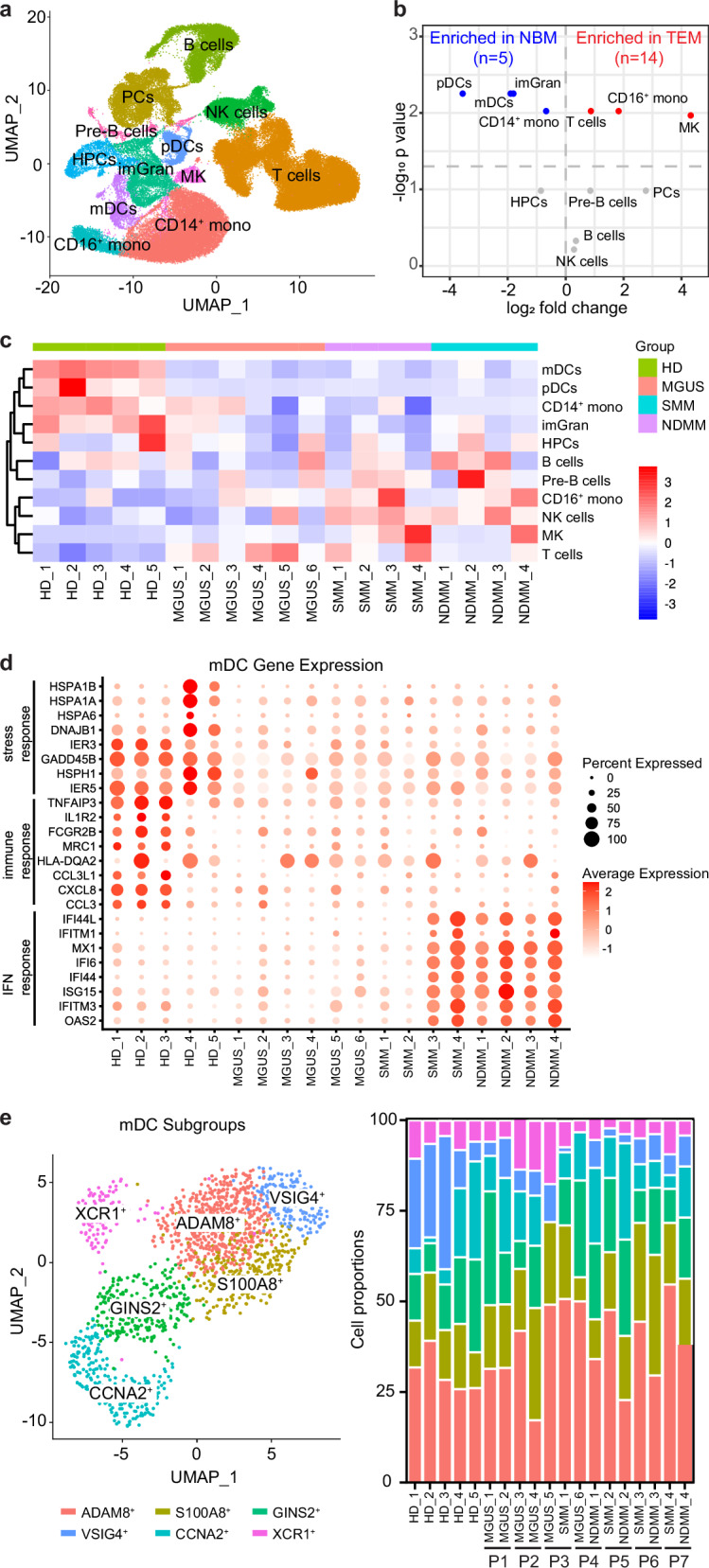
Tumor immune microenvironmental alterations occur early in multiple myeloma (MM) development. In this study, we aim to systematically characterize the tumor immune microenvironment (TME) and the tumor-immune interactions from precursor stages, i.e., monoclonal gammopathy of undetermined significance (MGUS) and smoldering MM (SMM), to newly diagnosed MM, comparing these to healthy donors. Using CIBERSORT, mass cytometry (CyTOF), and single-cell RNA sequencing (scRNA-Seq), we examined innate and adaptive immune changes across these stages. We found a decrease in granulocytes in the TME predicts MM outcomes. HLA-DR is reduced in CD16 monocytes and plasmacytoid dendritic cells, while myeloid dendritic cells show decreased expression of stress and immune-response genes. NK cells and CD8 T cells shift from a GZMK to a GZMB cytotoxic phenotype in the TME, with increased inhibitory markers TIM3 and TIGIT. In paired samples, the proportion and gene expression pattern in patient-specific GZMBCD8 T cells remain largely unchanged despite MM progression. Our findings provide a comprehensive immune landscape of MM and its precursors, offering insights into therapeutic strategies. Enhancing neutrophil and NK cell cytotoxicity, tumor antigen presentation, and CD8 T cell versatility in precursor stages may prevent MM progression.
肿瘤免疫微环境改变发生在多发性骨髓瘤(MM)发展的早期。在这项研究中,我们旨在系统地描述肿瘤免疫微环境(TME)和肿瘤-免疫相互作用,从前驱阶段,即意义未明单克隆丙种球蛋白血症(MGUS)和冒烟型 MM(SMM),到新诊断的 MM,并与健康供体进行比较。我们使用 CIBERSORT、质谱流式细胞术(CyTOF)和单细胞 RNA 测序(scRNA-Seq),研究了这些阶段的先天和适应性免疫变化。我们发现 TME 中粒细胞的减少可预测 MM 的结局。CD16 单核细胞和浆细胞样树突状细胞中的 HLA-DR 减少,而髓样树突状细胞显示应激和免疫反应基因表达减少。NK 细胞和 CD8 T 细胞在 TME 中从 GZMK 向 GZMB 细胞毒性表型转变,同时抑制性标志物 TIM3 和 TIGIT 增加。在配对样本中,尽管 MM 进展,但患者特异性 GZMB+CD8 T 细胞的比例和基因表达模式基本保持不变。我们的研究结果提供了 MM 及其前驱物的全面免疫图谱,为治疗策略提供了新的见解。在前驱阶段增强中性粒细胞和 NK 细胞的细胞毒性、肿瘤抗原呈递和 CD8 T 细胞的多功能性可能有助于预防 MM 的进展。