Department of Zoonoses, Faculty of Veterinary Medicine, Cairo University, PO Box 12211, Giza, Egypt.
Sci Rep. 2024 Nov 6;14(1):26977. doi: 10.1038/s41598-024-77519-y.
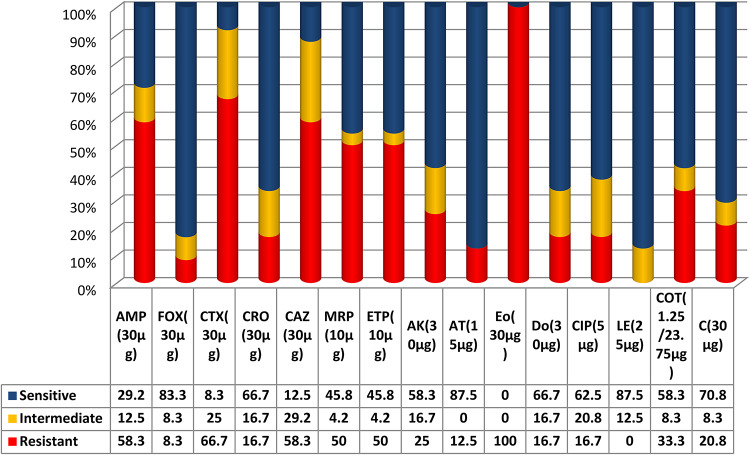
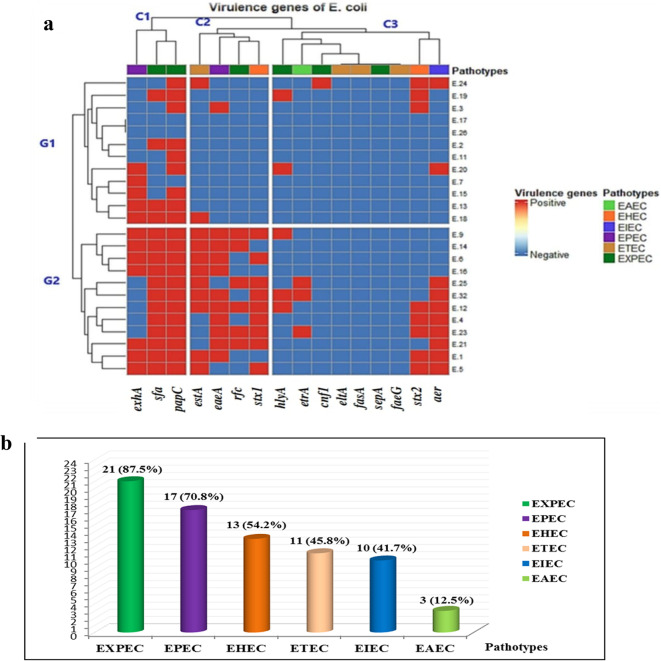
The emergence of critical-priority E. coli, carrying a wide array of resistance and virulence factors through food sources, poses a significant challenge to public health. This study aimed to investigate the potential role of oysters sold in Egypt as a source for E. coli, identify their resistance and virulence-associated gene profiles, and assess associated zoonotic risks. A total of 33 pooled fresh oyster samples were obtained from various retail fish markets in Egypt and examined bacteriologically for the presence of E. coli. Antimicrobial resistance was performed by the disk-diffusion method, and the multiple antibiotic resistance index (MAR) was calculated. All isolates were screened for extended-spectrum beta-lactamase (ESBL) (bla, bla, bla and bla), plasmid-mediated AmpC bla, and carbapenemases (bla, bla, bla, and bla) genes by Polymerase chain reaction. Moreover, the presence of virulence-encoding genes was investigated. The virulent MDR strains were clustered using R with the pheatmap package. The prevalence of E. coli was 72.7% (24 out of 33), with 66.7% of the isolates classified as multi-drug resistant, and 75% exhibited MAR values exceeding the 0.2 threshold. Different antimicrobial sensitivity phenotypes and genotype profiles were identified in E. coli isolates. The most prevalent gene detected among all isolates was bla (22/24, 91.7%). Notably, all non-ESBL producers were positive for bla. Carbapenem-resistant and carbapenem-intermediate strains were carbapenemase producers, with the predominance of the bla gene (11/24, 45.8%). Remarkably, twelve out of sixteen virulence genes were identified, with papC (21/24, 87.5%) and sfa (16/24, 66.7%) genes being the most prevalent. Most isolates carry virulence genes primarily associated with extra-intestinal pathogenic E. coli (ExPEC) (87.5%) and enteropathogenic (EPEC) (70.8%) pathotypes. Four E. coli isolates exhibit cluster patterns. This study provides the first insight into the emergence of virulent MDR E. coli among oysters in Egypt. It underscores the potential role of oysters as a source for disseminating these strains within aquatic ecosystems, presenting a possible threat to public health.
产 ESBL 和携带 AmpC 酶及碳青霉烯酶耐药基因的食源性大肠埃希菌的出现对公共卫生构成了重大挑战。本研究旨在调查埃及销售的牡蛎作为大肠埃希菌来源的潜在作用,确定其耐药和毒力相关基因谱,并评估相关的人畜共患病风险。从埃及各地零售鱼市场采集了 33 个 pooled 新鲜牡蛎样本,并进行细菌学检测以确定是否存在大肠埃希菌。采用纸片扩散法进行抗菌药物耐药性检测,并计算多重抗生素耐药指数 (MAR)。所有分离株均通过聚合酶链反应筛查超广谱β-内酰胺酶 (ESBL) (blaCTX-M、blaTEM、blaSHV 和 blaOXA)、质粒介导的 AmpC 酶 blaCMY、碳青霉烯酶 (blaNDM、blaIMP、blaVIM 和 blaGES) 基因。此外,还研究了毒力编码基因的存在情况。使用 R 语言和 pheatmap 包对毒力 MDR 菌株进行聚类。大肠埃希菌的流行率为 72.7%(24/33),66.7%的分离株为多药耐药菌,75%的分离株 MAR 值超过 0.2 阈值。在大肠埃希菌分离株中发现了不同的抗菌药物敏感性表型和基因型谱。在所有分离株中检测到的最常见基因是 blaCTX-M(22/24,91.7%)。值得注意的是,所有非 ESBL 产生菌均 blaCTX-M 阳性。耐碳青霉烯和碳青霉烯中介菌株为碳青霉烯酶产生菌,以 blaNDM 基因为主(11/24,45.8%)。值得注意的是,16 个毒力基因中有 12 个被鉴定出来,papC(21/24,87.5%)和 sfa(16/24,66.7%)基因是最常见的。大多数分离株携带主要与肠外致病性大肠埃希菌 (ExPEC)(87.5%)和肠致病性大肠埃希菌 (EPEC)(70.8%)表型相关的毒力基因。4 株大肠埃希菌分离株具有聚类模式。本研究首次揭示了产 ESBL 和携带 AmpC 酶及碳青霉烯酶耐药基因的食源性大肠埃希菌在埃及牡蛎中的出现。它强调了牡蛎作为这些菌株在水生生态系统中传播的来源的潜在作用,对公共卫生构成了潜在威胁。