Laboratory of Bioengineering, Department of Orthopedics and Anesthesiology, School of Medicine of Ribeirão Preto, University of São Paulo (USP), Ribeirão Preto, SP, Brazil.
Orthopedics and hand surgery service, Hospital Federal da Lagoa, Rio de Janeiro, RJ, Brazil.
BMC Musculoskelet Disord. 2024 Nov 6;25(1):885. doi: 10.1186/s12891-024-08011-x.
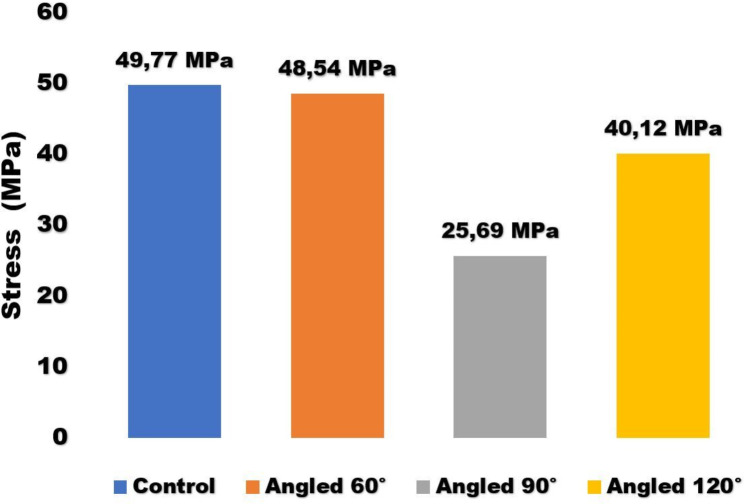
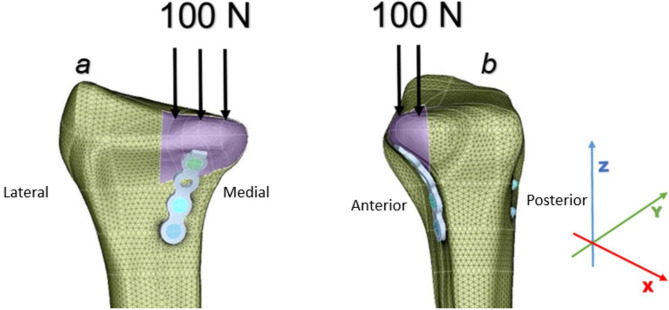
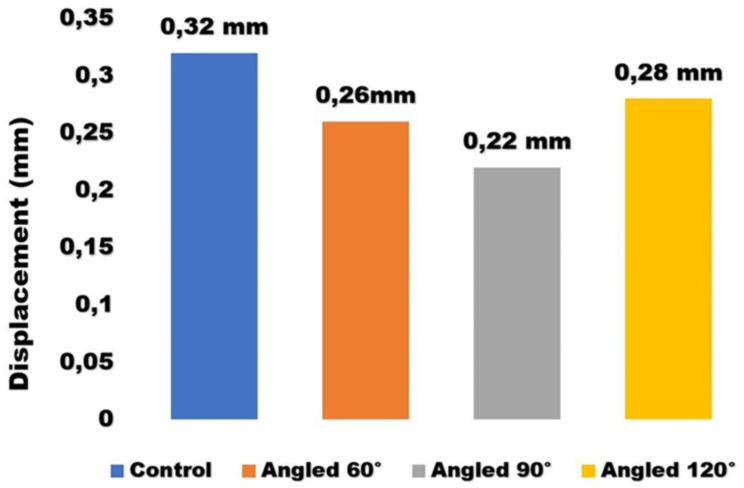
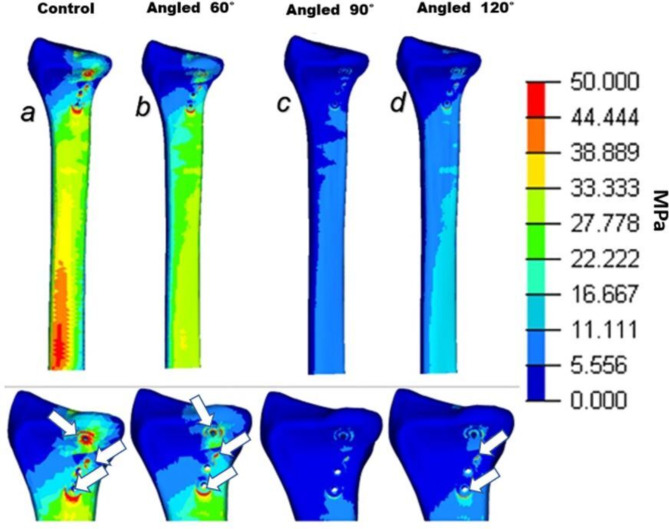
Intra-articular fractures of the distal radius require anatomical reduction and stable fixation. When the fracture encompasses the articular facet of the bone, maintaining the reduction is challenging due to the fragment's size and high instability. While specific implants have been developed to fix this fragment, their effectives have been limited. This study evaluates the mechanical performance of a novel hook plate conceived to stabilize the small fragment of the semilunar facet of the radius in non-osteoporotic bones. A simulated lunate facet fracture was created in an adult radius in a virtual model, and a modification of a hook plate was developed using computer-aided design (CAD). Two groups were established for the finite element method (FEM) simulation: a control group (standard plate Medartis™ (Switzerland, A-5500.23) and an angled plate with hooks set at 60º, 90º and 120º. In the FEM simulation, an axial load of 100 N was applied in the Z-axis direction on the fragment. Fracture displacement along the Z axis was more pronounced in the control model (0.32 mm) and less in the angled models, ranging from 0.22 to 0.28 mm. Notably, the plate with a 90° angle showed a more effective reduction in fragment displacement. The distribution of stresses in the system showed the highest levels of stress in the control group (59.31 MPa), followed by the subgroup with a 60° angle (55.78 MPa).In the side view, the control model showed a higher concentration of stresses (59.74 MPa), while the model with a 90° angle showed a lower value of stresses (18.87 MPa). Critical stress regions were identified in the bolts of the control and 120° models (59.47 MPa and 57.64 MPa, respectively). However, in the 90° model, no critical regions were observed in the bolts, which showed lower stress values, reaching 26.33 MPa. In the bone, the greatest concentration of stress occurred in the region where the plate was anchored. Our results showed that the 90° hook plate had a superior mechanical performance in fixing simulate lunate facet fractures at the distal radius. This angle led to minor displacements and minimized stress concentrations in the hardware, thus contributing to enhance the stability of this specific fracture.
桡骨远端关节内骨折需要解剖复位和稳定固定。当骨折累及骨的关节面时,由于骨折块的大小和高度不稳定,维持复位具有挑战性。虽然已经开发出特定的植入物来固定这个骨折块,但它们的效果有限。本研究评估了一种新型钩钢板的机械性能,该钢板旨在稳定非骨质疏松骨的桡骨半月形关节面的小骨折块。在虚拟模型中创建了成人桡骨的模拟月状面骨折,并使用计算机辅助设计 (CAD) 开发了钩钢板的修改版。为有限元方法 (FEM) 模拟建立了两组:对照组(标准板 Medartis™(瑞士,A-5500.23)和带有角度的板,角度为 60°、90°和 120°。在 FEM 模拟中,在 Z 轴方向上向骨折块施加 100 N 的轴向载荷。在对照组模型中,骨折块沿 Z 轴的位移更为明显(0.32mm),而在角度模型中,位移范围从 0.22 到 0.28mm。值得注意的是,角度为 90°的钢板显示出更有效的骨折块位移减少。系统中的应力分布显示出对照组的最高应力水平(59.31MPa),其次是角度为 60°的亚组(55.78MPa)。在侧视图中,对照组模型显示出更高的应力集中(59.74MPa),而角度为 90°的模型显示出较低的应力值(18.87MPa)。在对照组和 120°模型的螺栓中确定了临界应力区域(分别为 59.47MPa 和 57.64MPa)。然而,在 90°模型中,螺栓中未观察到临界区域,其应力值较低,达到 26.33MPa。在骨骼中,最大的应力集中发生在钢板固定的区域。我们的结果表明,90°钩钢板在固定桡骨远端模拟月状面骨折方面具有更好的机械性能。该角度导致较小的骨折块位移和最小化硬件中的应力集中,从而有助于增强这种特定骨折的稳定性。