Apurba I K Gusral Ghosh, Islam Md Rasidul, Rahman Md Shizer, Rahman Md Ferdous, Ahmad Sohail
Department of Electrical and Electronic Engineering, Bangamata Sheikh Fojilatunnesa Mujib Science & Technology University, Jamalpur, 2012, Bangladesh.
Department of Electrical and Electronic Engineering, Begum Rokeya University, Rangpur, 5400, Bangladesh.
Heliyon. 2024 Oct 16;10(20):e39218. doi: 10.1016/j.heliyon.2024.e39218. eCollection 2024 Oct 30.
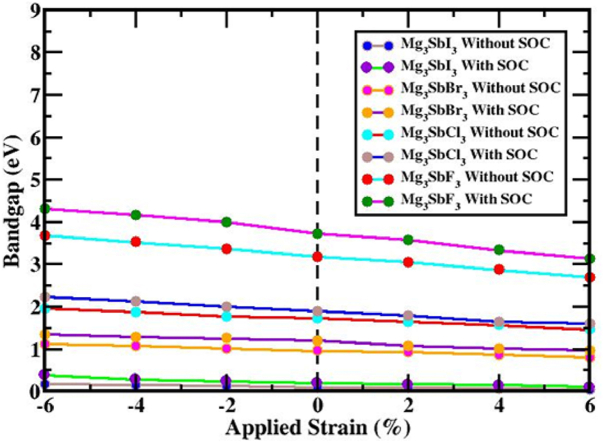
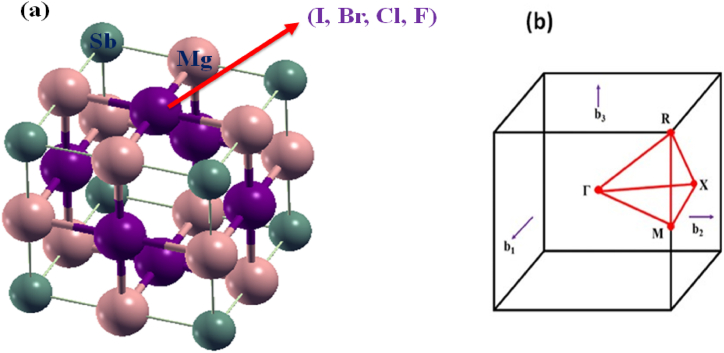
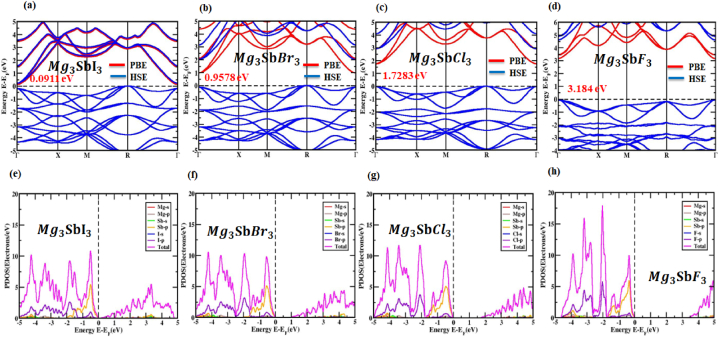
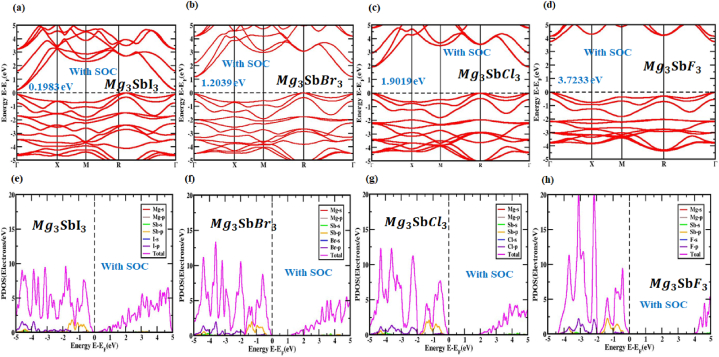
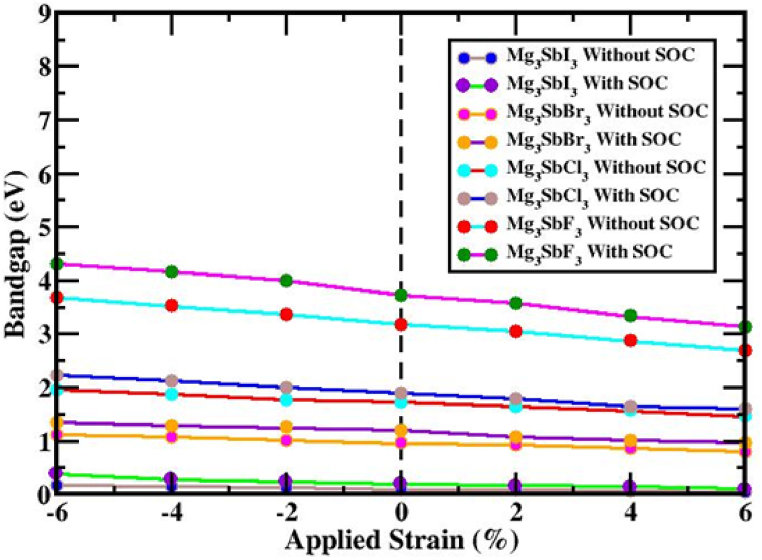
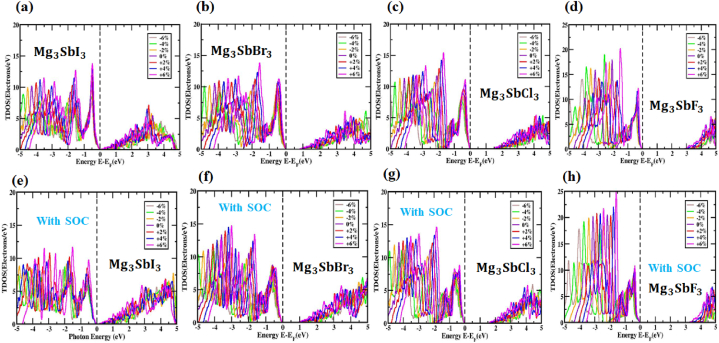
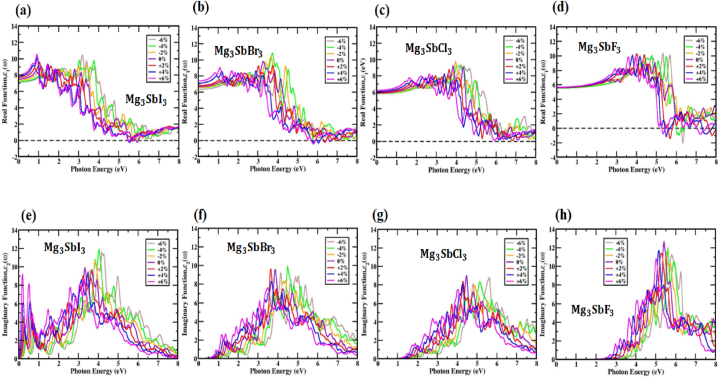
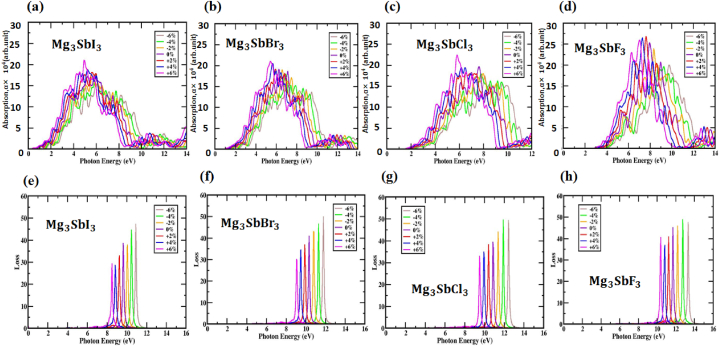
The solar technology industry has lately given inorganic perovskite materials an abundance of thought because of their unique optical, electrical and structural characteristics. Issues pertaining to lead (Pb) toxicity and instability require being referred to promptly, making lead-free atomically designed metal halide perovskites of foremost importance to the photovoltaic and optoelectronic industries. Perovskites, a class of inorganic metal halide semiconductors, have variant similarities with (X = I, Br, Cl and F). According to the space group Pm-3m (X = I, Br, Cl and F) has a cubic perovskite crystal structure. Utilizing first-principles density-functional theory (FPDFT), The intention of this investigation is to analyze how strain and spin-orbit coupling (SOC) impact the structural, electrical, optical and mechanical features of the inorganic cubic perovskite of (X = I, Br, Cl and F). At the point between R and Γ, the molecule displays an indirect bandgap of 0.105 eV, 0.957 eV, 1.728 eV. At the Γ point, the molecule displays a direct bandgap of 3.184 eV. The bandgaps of the and perovskites are 0.198 eV, 1.203 eV, 1.901 eV and 3.723 eV respectively, when considering the spin-orbital coupling (SOC) quantum influence. A wider bandgap is investigated for increasing compressive strain while a smaller bandgap is observed for increasing tensile strain. Apart from the elastic constants and anisotropic factors, other factors that are anticipated include Pugh's ratio, Poisson's ratio, bulk modulus and others. Isotropic, ductile and mechanically stable are the words that best describe these materials, according to the elastic property evaluations. In the photon energy range that is appropriate for solar cells, the dielectric constant spikes of are found to be visible. Therefore, (X = I, Br, Cl and F) perovskite is a good material to use in solar cells for managing light and producing electricity.
由于其独特的光学、电学和结构特性,太阳能技术行业最近对无机钙钛矿材料给予了大量关注。与铅(Pb)毒性和不稳定性相关的问题需要立即加以解决,这使得无铅原子设计的金属卤化物钙钛矿对光伏和光电子行业至关重要。钙钛矿是一类无机金属卤化物半导体,与(X = I、Br、Cl和F)有多种相似之处。根据空间群Pm-3m,(X = I、Br、Cl和F)具有立方钙钛矿晶体结构。利用第一性原理密度泛函理论(FPDFT),本研究旨在分析应变和自旋轨道耦合(SOC)如何影响(X = I、Br、Cl和F)无机立方钙钛矿的结构、电学、光学和力学特性。在R和Γ之间的点,分子显示出间接带隙为0.105 eV、0.957 eV、1.728 eV。在Γ点,分子显示出直接带隙为3.184 eV。考虑自旋轨道耦合(SOC)量子影响时,和钙钛矿的带隙分别为0.198 eV、1.203 eV、1.901 eV和3.723 eV。研究发现,随着压缩应变增加,带隙变宽;随着拉伸应变增加,带隙变小。除了弹性常数和各向异性因子外,预计还包括普氏比、泊松比、体积模量等其他因素。根据弹性性能评估,各向同性、韧性和机械稳定性是最能描述这些材料的词汇。在适合太阳能电池的光子能量范围内,发现的介电常数峰值是可见的。因此,(X = I、Br、Cl和F)钙钛矿是用于太阳能电池中管理光和发电的良好材料。