Zheng Quan, Zhou Jian, Zhang Yuanjin, Wang Tengyong, Wu Dongsheng, Pu Qiang, Mei Jiandong, Liao Hu, Liu Lunxu
Department of Thoracic Surgery and Institute of Thoracic Oncology, West China Hospital, Sichuan University, Chengdu, China.
Chinese Evidence-based Medicine Center, West China Hospital, Sichuan University, Chengdu, China.
Transl Lung Cancer Res. 2024 Oct 31;13(10):2549-2560. doi: 10.21037/tlcr-24-336. Epub 2024 Oct 23.
The appreciation of sex differences is substantial for precise cancer management. Surgery is the main treatment for non-small cell lung cancer (NSCLC). We aimed to identify sex differences on perioperative outcomes in NSCLC patients and to uncover the origins of sex effect in outcomes using a Chinese cohort.
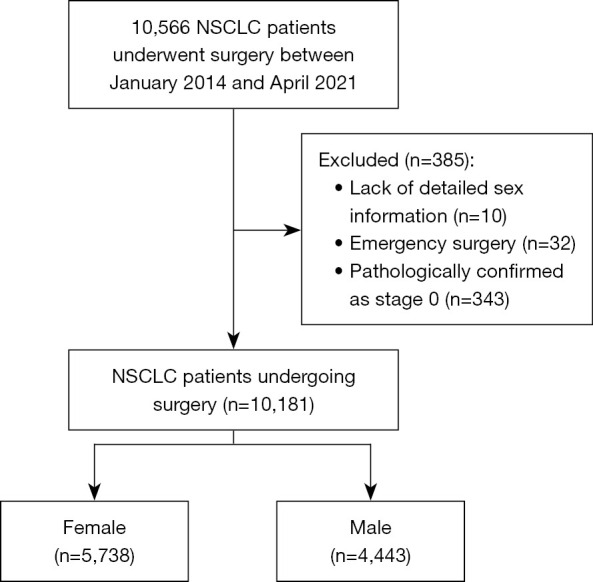
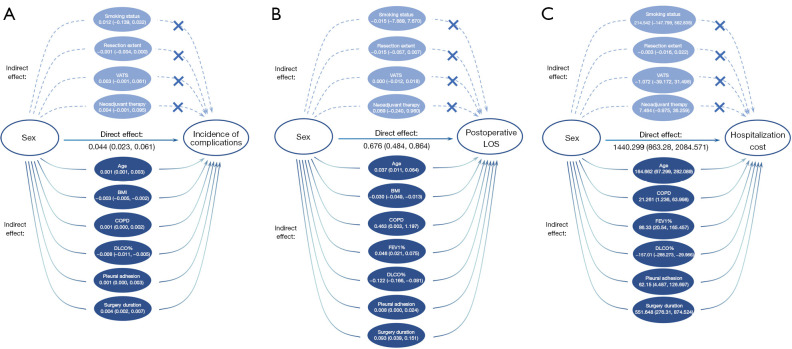
We retrospectively enrolled patients undergoing NSCLC surgery in the Western China Lung Cancer Database from January 2014 to April 2021. We compared baseline characteristics and perioperative outcomes between male and female. Multivariable analyses were performed. We conducted causal mediation analysis to identify drivers to sex differences in perioperative outcomes.
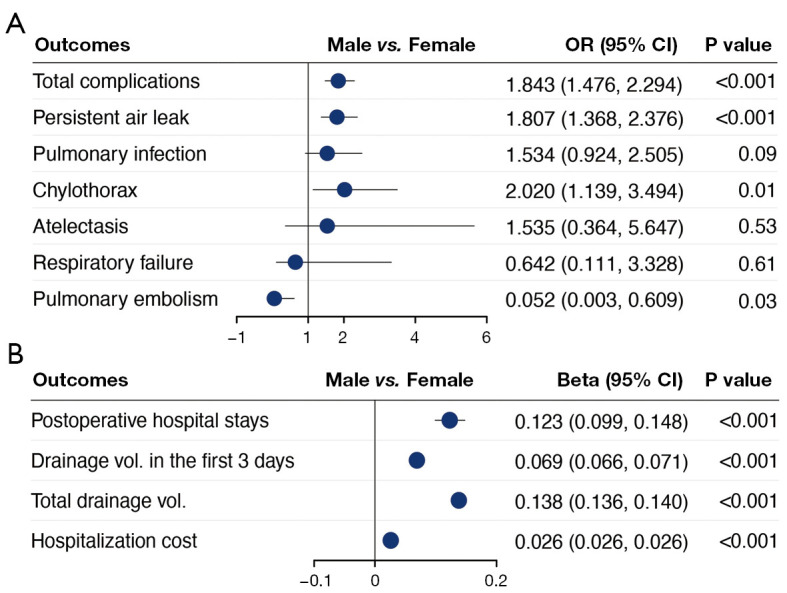
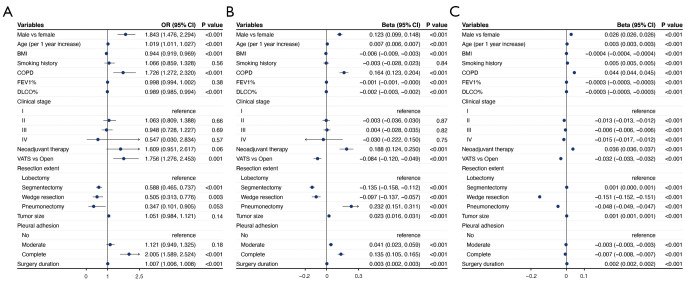
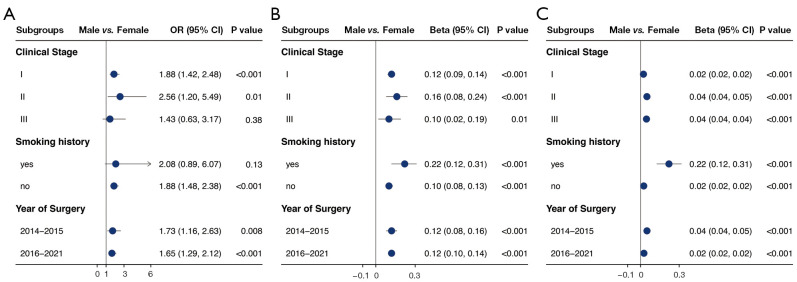
Altogether, data of 10,181 patients (5,738 women and 4,443 men) were analyzed. Women had lower incidence of complications (5.05% 12.15%), shorter postoperative length of stays (4.92 6.41 days), and less hospitalization cost (50,713.69 54,580.85, Chinese Yuan). Multivariable regression analysis identified sex as an independent factor of perioperative complications [odds ratio (OR), 1.843, 95% confidence interval (CI): 1.476-2.294], as well as of postoperative length of hospital stays (beta 0.123, 95% CI: 0.099-0.148), and hospitalization cost (beta 0.026, 95% CI: 0.026-0.026). Mediation analysis revealed that age, body mass index, prevalence of chronic obstructive pulmonary disease, predicted diffusion capacity for carbon monoxide, tumor size, pleural adhesion, and surgery duration were identified as mediators for sex differences in outcomes, while smoking status, surgery type, and resection extent were not.
Female NSCLC patients demonstrated lower incidence of complications, shorter postoperative length of stays, and less hospitalization cost after surgery. Those differences between men and women could be explained by their inherent biological differences and baseline health status. Perioperative management strategies for NSCLC should prioritize recognizing the potentially poorer outcomes among male patients and implementing tailored precautions accordingly.
认识性别差异对于精确的癌症管理至关重要。手术是非小细胞肺癌(NSCLC)的主要治疗方法。我们旨在确定NSCLC患者围手术期结局的性别差异,并利用中国队列揭示结局中性别效应的来源。
我们回顾性纳入了2014年1月至2021年4月在中国西部肺癌数据库中接受NSCLC手术的患者。我们比较了男性和女性的基线特征和围手术期结局。进行了多变量分析。我们进行了因果中介分析,以确定围手术期结局性别差异的驱动因素。
共分析了10181例患者的数据(5738例女性和4443例男性)。女性并发症发生率较低(5.05%对12.15%),术后住院时间较短(4.92对6.41天),住院费用较低(50713.69对54580.85元人民币)。多变量回归分析确定性别是围手术期并发症的独立因素[比值比(OR),1.843,95%置信区间(CI):1.476 - 2.294],也是术后住院时间的独立因素(β 0.123,95% CI:0.099 - 0.148)和住院费用的独立因素(β 0.026,95% CI:0.026 - 0.026)。中介分析显示,年龄、体重指数、慢性阻塞性肺疾病患病率、预测的一氧化碳弥散能力、肿瘤大小、胸膜粘连和手术持续时间被确定为结局性别差异的中介因素,而吸烟状况、手术类型和切除范围则不是。
女性NSCLC患者术后并发症发生率较低,术后住院时间较短,住院费用较低。男性和女性之间的这些差异可以通过他们固有的生物学差异和基线健康状况来解释。NSCLC的围手术期管理策略应优先认识到男性患者可能较差的结局,并相应地采取针对性的预防措施。