Kirchner Miranda, Nunez-Garcia Javier, Duggett Nicholas, Gosling Rebecca J, Anjum Muna F
Department of Bacteriology, Animal and Plant Health Agency, Addlestone, United Kingdom.
Front Microbiol. 2024 Oct 23;15:1477683. doi: 10.3389/fmicb.2024.1477683. eCollection 2024.
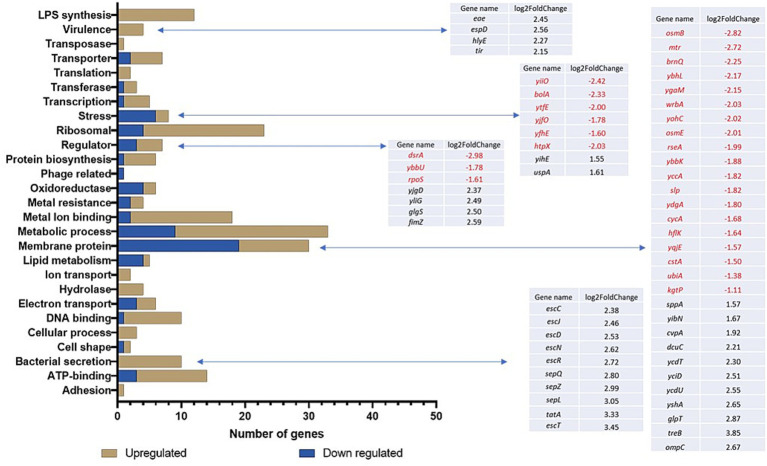
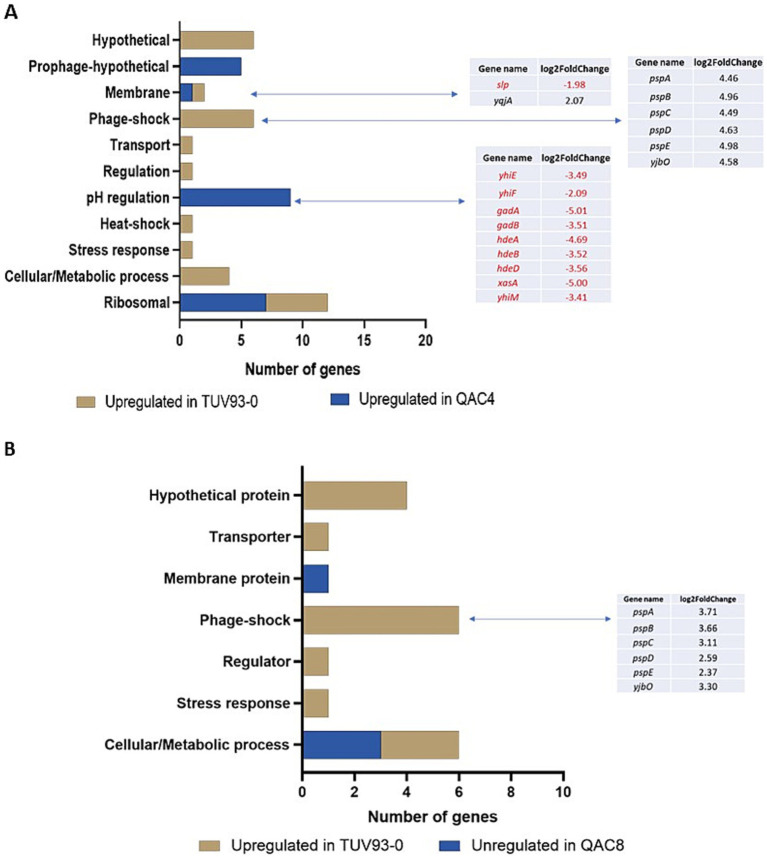
Disinfectants are essential for biosecurity, preventing the persistence and spread of zoonotic pathogens on farms and subsequent human infections. In this study, transcriptomics and genomics were utilised to assess the effect of disinfectant exposure on pathogenic . The exposure of O157:H7 to sub-optimal concentrations of commonly used farm disinfectants elicited changes in both the transcriptome and genome. The transcriptomics identified upregulation of >300 genes and downregulation of >100 genes with functions, which included stress response, metabolism, transcription, transportation, membrane-associated and virulence genes. The phage shock protein () operon was highly upregulated in response to a quaternary ammonium compound (QAC)-containing disinfectant, which has not previously been associated with a response to chemical stress. Disinfectant-adapted isolates generated by exposure to sub-lethal disinfectants levels demonstrated resistance to several common antibiotics and decreased sensitivity to biocides. Whole genome sequencing of the mutant strains indicated that they had acquired mutations in the genes associated with the upregulation of the multiple antibiotic resistance (MAR) efflux system ( protease and ) and topoisomerase genes ( and ). The disinfectant-adapted isolates also exhibited increased expression of transcription, respiration and several pH stress response genes localised in the "acid fitness island." This study demonstrated that sub-optimal disinfectant concentrations allow O157:H7 to adapt and survive disinfection and develop antibiotic resistance. These changes could have implications for disease treatment and elimination on farms. Although O157:H7 and farm disinfectants were the focus of this study, we believe these findings are also applicable to other settings, including hospitals.
消毒剂对于生物安全至关重要,可防止人畜共患病原体在农场持续存在和传播以及随后的人类感染。在本研究中,利用转录组学和基因组学来评估消毒剂暴露对病原体的影响。将O157:H7暴露于常用农场消毒剂的次优浓度下会引起转录组和基因组的变化。转录组学鉴定出300多个基因上调和100多个基因下调,其功能包括应激反应、代谢、转录、运输、膜相关和毒力基因。噬菌体休克蛋白()操纵子在暴露于含季铵化合物(QAC)的消毒剂时高度上调,此前该操纵子与对化学应激的反应无关。通过暴露于亚致死消毒剂水平产生的适应消毒剂的分离株对几种常见抗生素具有抗性,并且对杀菌剂的敏感性降低。突变菌株的全基因组测序表明,它们在与多重抗生素抗性(MAR)外排系统(蛋白酶和)和拓扑异构酶基因(和)上调相关的基因中获得了突变。适应消毒剂的分离株还表现出位于“酸适应性岛”中的转录、呼吸和几种pH应激反应基因的表达增加。本研究表明,次优消毒剂浓度使O157:H7能够适应消毒并存活下来,并产生抗生素抗性。这些变化可能对农场疾病的治疗和消除产生影响。尽管O157:H7和农场消毒剂是本研究的重点,但我们认为这些发现也适用于其他环境,包括医院。