Sarac Devrim Can, Durak Ediboglu Elif, Ozer Kaya Derya, Duran Gozde, Akatay Emre Alp, Gucenmez Sercan, Akar Servet, Bayraktar Deniz
Department of Physiotherapy and Rehabilitation, Faculty of Health Sciences, İzmir Katip Çelebi University, İzmir, Türkiye.
Division of Rheumatology, Department of Internal Medicine, Faculty of Medicine, İzmir Katip Çelebi University, İzmir, Türkiye.
Arch Rheumatol. 2024 Aug 26;39(3):447-458. doi: 10.46497/ArchRheumatol.2024.10720. eCollection 2024 Sep.
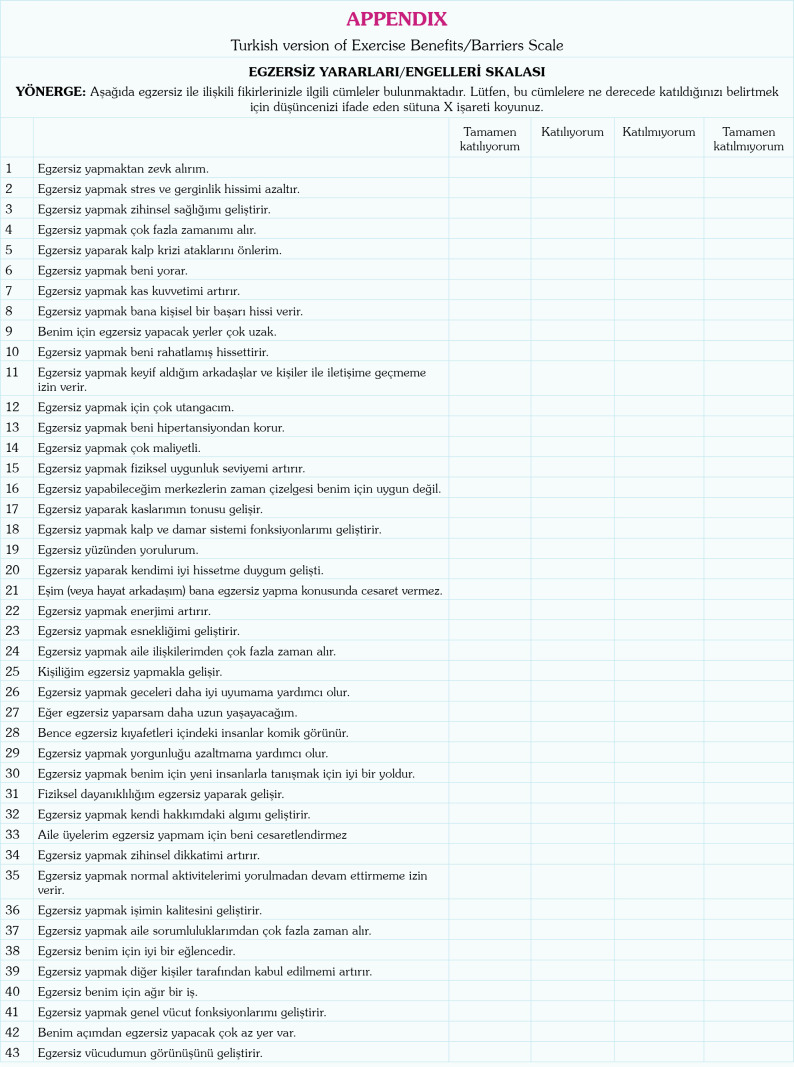
The aim of this study was to translate the Exercise Benefits/Barriers Scale (EBBS) into Turkish and investigate the perceptions of Turkish-speaking patients with different axial spondyloarthritis (axSpA) subtypes regarding exercise benefits and barriers.
This validation study was conducted between June 2018 and December 2021. Patients with axSpA were consecutively assessed regarding physical (age, sex and body mass index) and disease-related characteristics (disease activity, spinal mobility, functional status, quality of life, health status, emotional status, and kinesiophobia). Eligible participants were asked to complete the EBSS and other outcome measurements during their initial visits. EBBS was readministered 7 to 14 days later.
One hundred forty-eight patients (89 males, 59 females; mean age: 44.3±11.8 years; range, 19 to 65 years) were included in the study. Of the patients, 108 had radiographic axSpA, and 40 had nonradiographic axSpA. EBBS-Barriers and EBBS-Benefits subscales demonstrated adequate internal consistency (Cronbach's alphas of 0.82 and 0.95, respectively) and test-retest reliability (intraclass correlation coefficients of 0.837 and 0.807, respectively). No significant differences were observed between axSpA subtypes regarding EBBS-Barriers (p=0.12) and EBBS-Benefits (p=0.10) subscales. Significant relationships were detected between kinesiophobia and EBBS-Barriers scores (r=-0.424, p<0.01), as well as EBBS-Benefits scores (r=-0.344, p<0.01) for all patients. EBBS-Benefits scores were correlated to health status (r=-0.412, p=0.08) and quality of life (r=-0.394, p=0.01) in patients with nonradiographic axSpA.
According to our results, the Turkish EBBS is a valid and reliable tool for patients with axSpA. Perceptions of the patients with axSpA regarding exercise barriers and benefits do not differ according to the disease subtype. It appears that kinesiophobia may be an important parameter regarding exercise perception in axSpA.
本研究旨在将运动益处/障碍量表(EBBS)翻译成土耳其语,并调查不同轴性脊柱关节炎(axSpA)亚型的土耳其语患者对运动益处和障碍的看法。
本验证性研究于2018年6月至2021年12月进行。对axSpA患者依次评估其身体特征(年龄、性别和体重指数)和疾病相关特征(疾病活动度、脊柱活动度、功能状态、生活质量、健康状况、情绪状态和运动恐惧)。符合条件的参与者在初次就诊时被要求完成EBSS及其他结局测量。7至14天后再次进行EBBS评估。
148例患者(89例男性,59例女性;平均年龄:44.3±11.8岁;范围19至65岁)纳入研究。其中,108例有影像学axSpA,40例有非影像学axSpA。EBBS-障碍和EBBS-益处子量表显示出足够的内部一致性(Cronbach's α系数分别为0.82和0.95)和重测信度(组内相关系数分别为0.837和0.807)。axSpA各亚型在EBBS-障碍(p = 0.12)和EBBS-益处(p = 0.10)子量表上未观察到显著差异。所有患者的运动恐惧与EBBS-障碍评分(r = -0.424,p < 0.01)以及EBBS-益处评分(r = -0.344,p < 0.01)之间均检测到显著相关性。非影像学axSpA患者的EBBS-益处评分与健康状况(r = -0.412,p = 0.08)和生活质量(r = -0.394,p = 0.01)相关。
根据我们的结果,土耳其语版EBBS对axSpA患者是一个有效且可靠的工具。axSpA患者对运动障碍和益处的看法不因疾病亚型而异。运动恐惧似乎可能是axSpA患者运动认知的一个重要参数。