Petro Daniel A, Shaban Nyimvua, Aaron Sijenunu, Chacky Frank, Lazaro Samuel, Boni Maciej F, Ishengoma Deus S
Department of Mathematics, University of Dar es Salaam, Dar es Salaam, Tanzania.
Office of the Chief Medical Officer, Ministry of Health, National Malaria Control Programme, Dodoma, Tanzania.
Open Forum Infect Dis. 2024 Oct 11;11(11):ofae609. doi: 10.1093/ofid/ofae609. eCollection 2024 Nov.
Malaria transmission in Tanzania has declined significantly over the last 2 decades due to scaled-up control interventions. However, recent confirmation of artemisinin partial resistance (ART-R) in Kagera region in northwest Tanzania threatens the ongoing efforts to eliminate malaria in the country. This study was conducted according to the World Health Organization recommendation to generate evidence of malaria burden in areas with confirmed ART-R as the first step before developing a response strategy to the resistance.
We assessed the local burden of malaria in Kagera region by geospatial analysis, using data collected retrospectively from health facilities and community surveys from 2015 to 2023 to identify malaria hot spots.
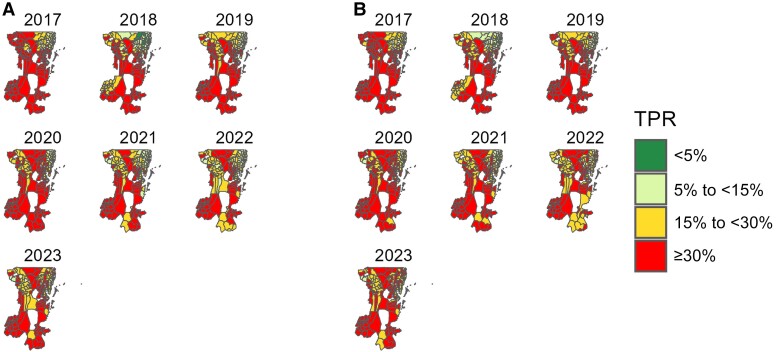
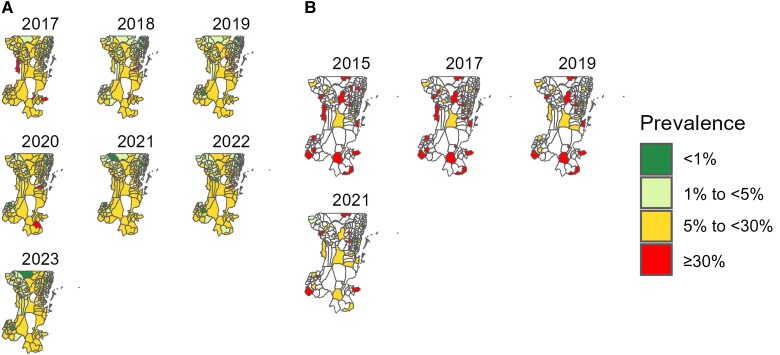
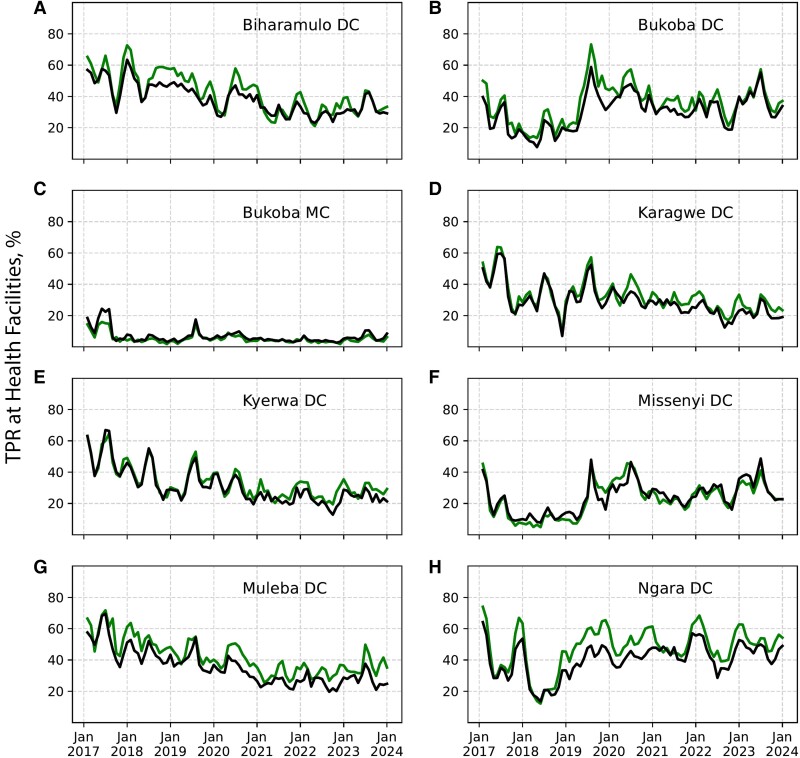
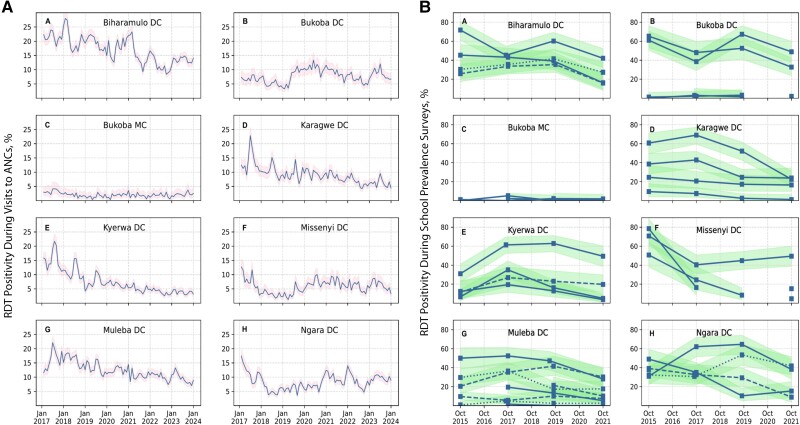
From 2017 to 2023, a total of 8 124 363 suspected malaria cases were reported by health facilities, and 2 983 717 (36.7% [95% range across wards, 22.7%-50.7%]) tested positive by rapid diagnostic tests. Test positivity rates were similar among patients aged <5 years (33.1% [95% range, 19.7%-46.5%]) and those aged ≥5 years (33.7% [21.0%-46.5%]). The malaria prevalence was 10.0% (95% range across wards, 5.1%-14.9% [n = 84 999 of 853 761]) in pregnant women and 26.1% (11.7%-40.6% [n = 3409 of 13 065]) in schoolchildren. Despite high temporal variations, we identified hot spots and cold spots, including persistently high burden in 69 of 192 wards (35.9%).
The malaria burden in Kagera exhibited high temporal and spatial heterogeneity, with schoolchildren showing the highest prevalence. This demographic pattern underlines the need for targeted interventions and provides evidence for developing an ART-R response for the region.
在过去20年中,由于扩大了控制干预措施,坦桑尼亚的疟疾传播显著下降。然而,最近在坦桑尼亚西北部卡盖拉地区证实存在青蒿素部分耐药性(ART-R),这威胁到该国正在进行的疟疾消除工作。本研究是根据世界卫生组织的建议进行的,旨在作为制定针对耐药性的应对策略的第一步,收集在已确认存在ART-R的地区的疟疾负担证据。
我们通过地理空间分析评估了卡盖拉地区的当地疟疾负担,使用了2015年至2023年从卫生设施回顾性收集的数据以及社区调查数据来确定疟疾热点地区。
2017年至2023年期间,卫生设施共报告了8124363例疑似疟疾病例,其中2983717例(36.7%[各病房的95%范围,22.7%-50.7%])通过快速诊断检测呈阳性。5岁以下患者(33.1%[95%范围,19.7%-46.5%])和5岁及以上患者(33.7%[21.0%-46.5%])的检测阳性率相似。孕妇中的疟疾患病率为10.0%(各病房的95%范围,5.1%-14.9%[853761例中的84999例]),学童中的疟疾患病率为26.1%(11.7%-40.6%[13065例中的3409例])。尽管存在较高的时间变化,但我们确定了热点地区和冷点地区,包括192个病房中的69个(35.9%)持续存在高负担。
卡盖拉地区的疟疾负担在时间和空间上表现出高度异质性,学童的患病率最高。这种人口统计学模式突出了针对性干预措施的必要性,并为制定该地区针对ART-R的应对措施提供了证据。