Behavioural Neuroscience Group, School of Psychology, University of Ottawa, Ottawa, Ontario, Canada.
Interdisciplinary School of Health Sciences, University of Ottawa, Ottawa, Ontario, Canada.
PLoS One. 2024 Nov 7;19(11):e0310771. doi: 10.1371/journal.pone.0310771. eCollection 2024.
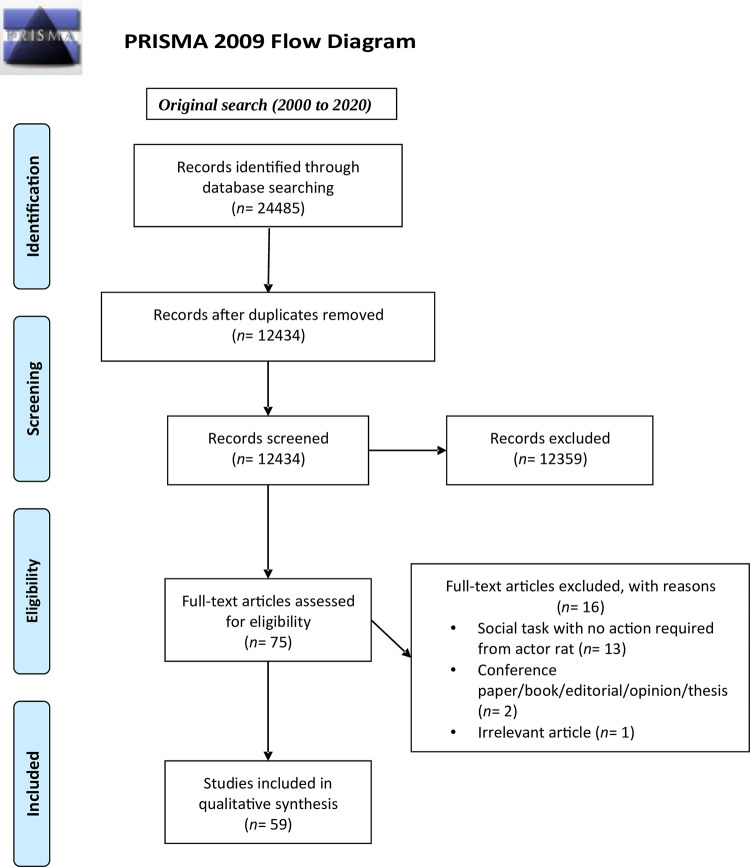
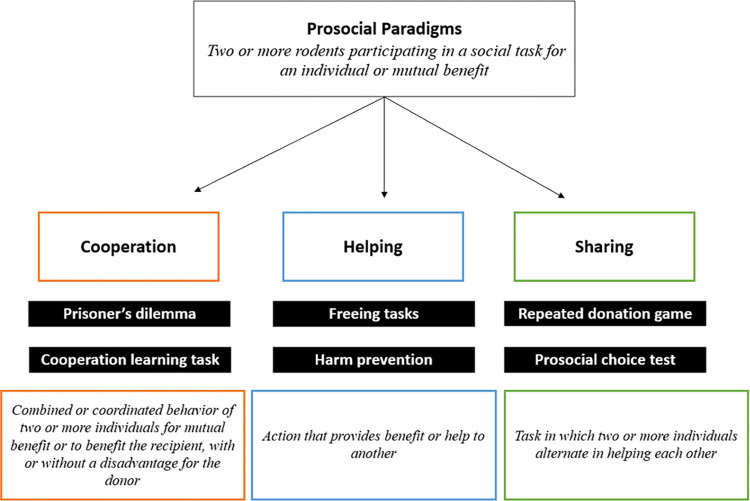
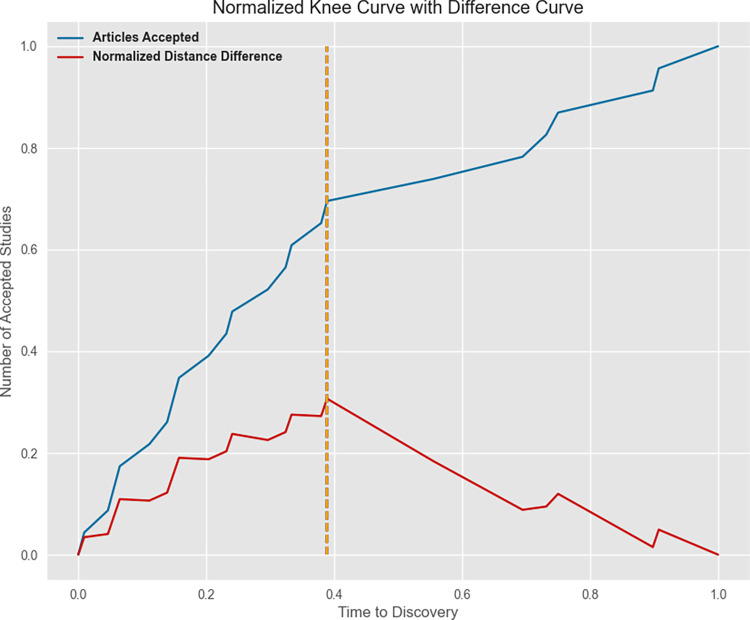
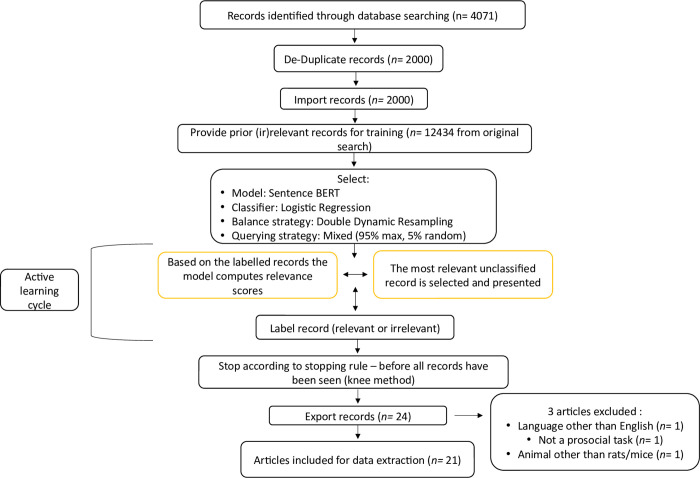
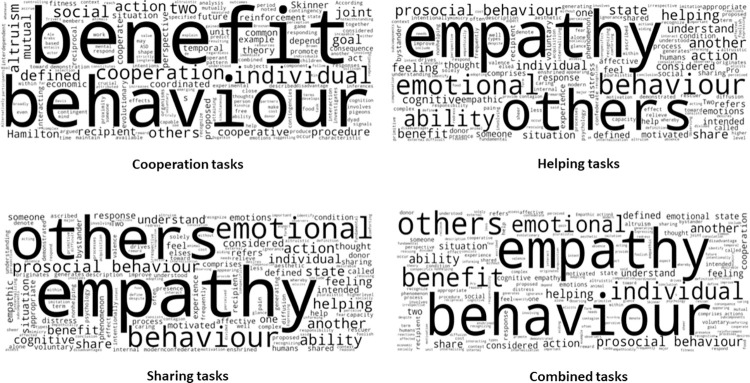
Studying prosociality in rodents can provide insight into brain mechanisms potentially related to neurodevelopmental disorders known to impact social behaviors (e.g., autism spectrum disorder). While many studies have been published suggesting promising models, current knowledge remains scattered, including potential factors mediating prosocial behaviors in rodents. Prosocial behavior is characterized by an action done to benefit another or promote their well-being. The goal of this scoping review is to characterize current findings regarding prosocial paradigms in rodents, highlight current gaps in reporting, and identify factors shown to be important in mediating prosocial responses in rodents. Five databases were consulted in search of relevant studies published between 2000 and 2020 (APA PsycInfo, Embase, MEDLINE, Scopus, Web of Science). An update using a semi-supervised machine learning approach (ASReview) was then conducted to collect studies from 2021-2023. In total, 80 articles were included. Findings were the following: (1) Three categories of prosocial paradigm were extracted: cooperation, helping, and sharing tasks, (2) Rodents showed the ability to perform prosocial actions in all three categories, (3) Significant gaps in reported methodologies (e.g., failure to report animals' characteristics, housing conditions, and/or experimental protocol) and mediating factors (e.g., sex, strain, housing, food restriction) were found, and (4) Behaviors are determinant when investigating prosociality in rodents, however many studies omitted to include such analyses. Together these results inform future studies on the impact of mediating factors and the importance of behavioral analyses on the expression of prosocial behaviors in rodents.
研究啮齿动物的亲社会行为可以深入了解潜在与神经发育障碍相关的大脑机制,这些障碍已知会影响社交行为(例如,自闭症谱系障碍)。虽然已经发表了许多表明有希望的模型的研究,但目前的知识仍然分散,包括介导啮齿动物亲社会行为的潜在因素。亲社会行为的特征是为了使另一个人受益或促进他们的幸福而采取的行动。本范围综述的目的是描述啮齿动物亲社会范式的当前发现,突出报告中的当前差距,并确定被证明在介导啮齿动物亲社会反应中重要的因素。五个数据库被咨询以寻找 2000 年至 2020 年期间发表的相关研究(APA PsycInfo、Embase、MEDLINE、Scopus、Web of Science)。然后使用半监督机器学习方法(ASReview)进行了更新,以收集 2021-2023 年的研究。总共包括 80 篇文章。研究结果如下:(1) 提取了三种亲社会范式类别:合作、帮助和分享任务,(2) 啮齿动物在所有三个类别中都表现出进行亲社会行为的能力,(3) 报告的方法学(例如,未能报告动物的特征、饲养条件和/或实验方案)和介导因素(例如,性别、品系、饲养、食物限制)存在显著差距,(4) 当在啮齿动物中研究亲社会行为时,行为是决定性的,但许多研究忽略了包括此类分析。这些结果共同为未来关于介导因素的影响以及行为分析对啮齿动物亲社会行为表达的重要性的研究提供了信息。