Department of Cardiology, Affiliated Sanming First Hospital, Fujian Medical University, Sanming, 365000, China.
Department of Rehabilitation Medicine, The First Affiliated Hospital, Sun Yat-sen University, Guangzhou, 510080, China.
BMC Cardiovasc Disord. 2024 Nov 9;24(1):631. doi: 10.1186/s12872-024-04307-x.
The prediction of maximal heart rate (MHR) and anaerobic threshold heart rate (HRAT) in patients with coronary heart disease (CHD), particularly among the Chinese population, remains a significant challenge. Existing equations for MHR prediction are primarily designed for healthy individuals not on medication for optimized β-blocker (BB) therapy, showing limited efficacy for individuals on various drug regimens. Moreover, the prediction of HRAT lacks established formulas. This study aims to develop equations for MHR and HRAT, assess the accuracy of historical MHR formulas, and examine their correlation with HR measurements at the anaerobic threshold (AT).
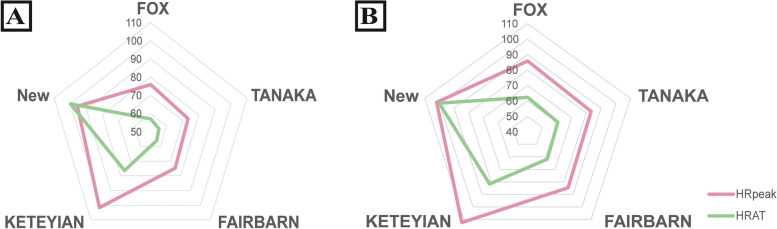
Among 2021 to 2023, 170 CHD patients were recruited. Patients were categorized into groups based on BB usage. BB dose was transformed into carvedilol dose. Multiple linear stepwise regression analysis was employed to identify predictors of MHR and HRAT, incorporating key patient variables according to prior studies (age, sex, height, weight, carvedilol dose, HRrest). The mean absolute percentage errors (MAPEs) were calculated and compared among abovementioned MHR and HRAT prediction formulas. Besides, the percentages of MHR in predicting HRAT among different formulas were calculated.
For the patients with BB medication, the simplified equations derived for MHR and HRAT were 176 - 1.2age + 0.7HRrest - 0.4weight and 98 - 0.6age + 0.7HRrest - 0.3weight, respectively. For those without BB medication, the derived equations for MHR and HRAT were 200 - 1.1age and 91 - 0.5age + 0.5*HRrest, respectively. There are significant differences between the results predicted by the new formula and the prior formulas. The new formulas are helpful for predicting the MHR of patients during exercise more accurately and guiding exercise training more scientifically.
The new equations for estimating MHR and HRAT in CHD patients enhance the accuracy of prior formulas. Given the BB impact on sympathetic nerve activity, the predictive formulas for MHR and HRAT were significantly improved.
预测冠心病(CHD)患者的最大心率(MHR)和无氧阈心率(HRAT),尤其是在中国人群中,仍然是一个重大挑战。现有的 MHR 预测方程主要针对未服用药物进行优化β受体阻滞剂(BB)治疗的健康个体,对于服用各种药物方案的个体效果有限。此外,HRAT 的预测尚无既定公式。本研究旨在制定 MHR 和 HRAT 的方程,评估历史 MHR 公式的准确性,并研究它们与无氧阈(AT)时 HR 测量的相关性。
在 2021 年至 2023 年间,共招募了 170 例 CHD 患者。根据 BB 使用情况将患者分为组。将 BB 剂量转换为卡维地洛剂量。根据既往研究(年龄、性别、身高、体重、卡维地洛剂量、HRrest),采用多元线性逐步回归分析来确定 MHR 和 HRAT 的预测因子。计算了上述 MHR 和 HRAT 预测公式的平均绝对百分比误差(MAPE)并进行比较。此外,还计算了不同公式预测 HRAT 时 MHR 的百分比。
对于服用 BB 药物的患者,得出的简化 MHR 和 HRAT 方程分别为 176-1.2年龄+0.7HRrest-0.4体重和 98-0.6年龄+0.7HRrest-0.3体重。对于未服用 BB 药物的患者,得出的 MHR 和 HRAT 方程分别为 200-1.1年龄和 91-0.5年龄+0.5*HRrest。新公式预测结果与既往公式存在显著差异。新公式有助于更准确地预测运动过程中的患者 MHR,并更科学地指导运动训练。
本研究为 CHD 患者提供了新的 MHR 和 HRAT 估算方程,提高了既往公式的准确性。考虑到 BB 对交感神经活性的影响,MHR 和 HRAT 的预测公式得到了显著改善。