Yap Justin, Hutton Jacob, Del Rios Marina, Scheuermeyer Frank, Nair Malini, Khan Laiba, Awad Emad, Kawano Takahisa, Mok Valerie, Christenson Jim, Grunau Brian
British Columbia Resuscitation Research Collaborative, Vancouver, British Columbia, Canada.
Faculty of Medicine, University of British Columbia, Vancouver, British Columbia, Canada.
Resusc Plus. 2024 Oct 25;20:100806. doi: 10.1016/j.resplu.2024.100806. eCollection 2024 Dec.
Previous studies have reported race-based health disparities in North America. It is unknown if emergency medical service (EMS) treatment of out-of-hospital cardiac arrest (OHCA) varies based on race. We sought to compare markers of resuscitation intensity among different racial groups.
Using data of adult EMS-treated OHCAs from the Trial of Continuous or Interrupted Chest Compressions During CPR, we analyzed data from participants for whom on-scene return of spontaneous circulation (ROSC) was not achieved. We fit multivariate regression models using a generalized estimating equation, to estimate the association between patient race (White vs. Black vs. "Other") and the following markers for resuscitation intensity: (1) resuscitation attempt duration; (2) intra-arrest transport; (3) number of epinephrine doses; (4) EMS arrival-to-CPR interval, and (5) 9-1-1 to first shock.
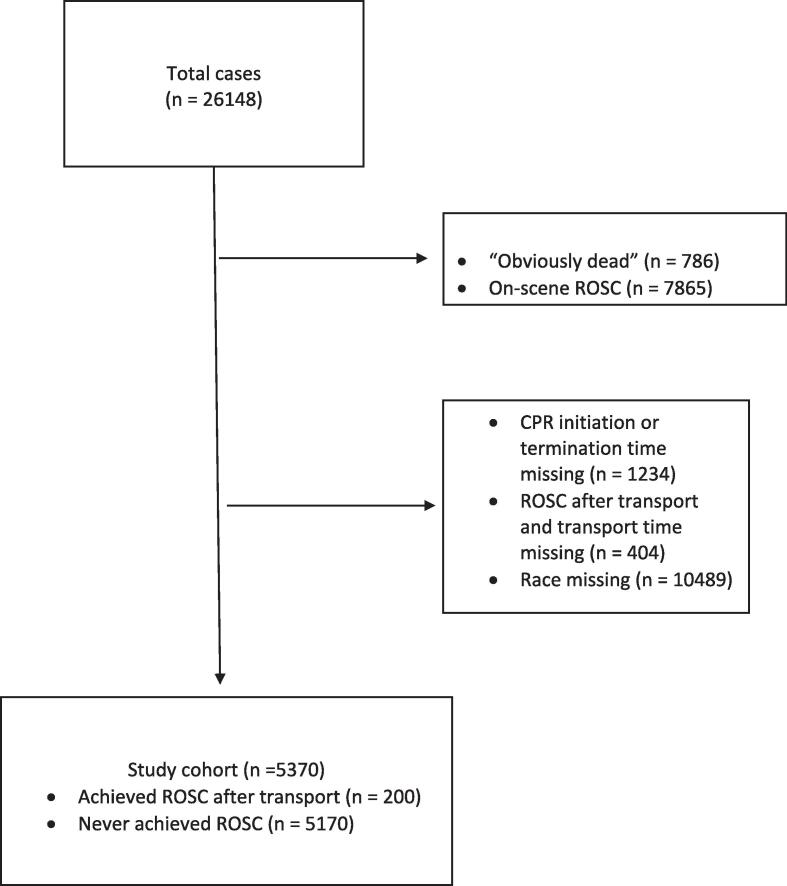
From our study cohort of 5370 cases, the median age was 65 years old (IQR: 53-78), 2077 (39 %) were women, 2121 (39 %) were Black, 596 (11 %) were "Other race", 2653 (49 %) were White, and 4715 (88 %) occurred in a private location. With reference to White race, Black race was associated with a longer resuscitation attempt duration and a lower number of epinephrine doses; Black and "Other" race were both associated with a lower odds of intra-arrest transport.
We identified race-based differences in EMS resuscitation intensity for OHCA within a North American cohort, although 40% of race data was missing from this dataset. Future research investigating race-based differences in OHCA management may be warranted.
此前的研究报道了北美地区基于种族的健康差异。院外心脏骤停(OHCA)的紧急医疗服务(EMS)治疗是否因种族而异尚不清楚。我们试图比较不同种族群体复苏强度的指标。
利用心肺复苏期间持续或间断胸外按压试验中成年EMS治疗的OHCA数据,我们分析了现场未实现自主循环恢复(ROSC)的参与者的数据。我们使用广义估计方程拟合多变量回归模型,以估计患者种族(白人、黑人与“其他”)与以下复苏强度指标之间的关联:(1)复苏尝试持续时间;(2)心脏骤停期间转运;(3)肾上腺素剂量数;(4)EMS到达至开始心肺复苏的间隔时间,以及(5)从拨打9-1-1到首次电击的时间。
在我们5370例的研究队列中,中位年龄为65岁(四分位间距:53-78岁),2077例(39%)为女性,2121例(39%)为黑人,596例(11%)为“其他种族”,2653例(49%)为白人,4715例(88%)发生在私人场所。与白人种族相比,黑人种族与更长的复苏尝试持续时间和更低的肾上腺素剂量数相关;黑人和“其他”种族均与心脏骤停期间转运的较低几率相关。
我们在北美队列中发现了OHCA的EMS复苏强度存在基于种族的差异,尽管该数据集中40%的种族数据缺失。未来有必要开展研究调查OHCA管理中基于种族的差异。