Mehta Nishaki K, Allam Sahitya, Mazimba Sula, Karim Saima
Department of Cardiovascular Medicine, William Beaumont Hospital, Oakland University School of Medicine, Royal Oak, Michigan.
Division of Cardiovascular Medicine, University of Virginia Medical Center, University of Virginia School of Medicine, Charlottesville, Virginia.
Heart Rhythm O2. 2022 Dec 16;3(6Part B):857-863. doi: 10.1016/j.hroo.2022.07.009. eCollection 2022 Dec.
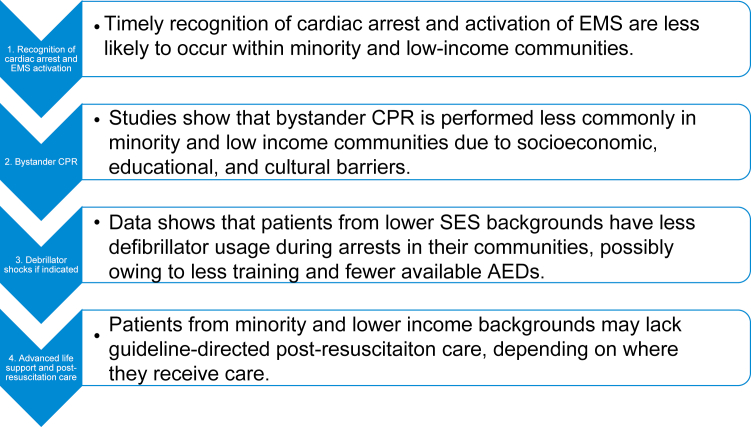
This review highlights the current evidence on racial, ethnic, and socioeconomic disparities in cardiac arrest outcomes within the United States. Several studies demonstrate that patients from Black, Hispanic, or lower socioeconomic status backgrounds suffer the most from disparities at multiple levels of the resuscitation pathway, including in the provision of bystander cardiopulmonary resuscitation, defibrillator usage, and postresuscitation therapies. These gaps in care may altogether lead to lower survival rates and worse neurological outcomes for these patients. A multisystem, culturally sensitive approach to improving cardiac arrest outcomes is suggested in this article.
本综述强调了美国心脏骤停结局在种族、民族和社会经济方面差异的现有证据。多项研究表明,来自黑人、西班牙裔或社会经济地位较低背景的患者在复苏途径的多个层面,包括旁观者心肺复苏的实施、除颤器的使用以及复苏后治疗等方面,受差异影响最大。这些护理差距可能共同导致这些患者的生存率降低和神经学结局更差。本文建议采用一种多系统、对文化敏感的方法来改善心脏骤停结局。