Universidade Estadual de Campinas CampinasSP Brazil Universidade Estadual de Campinas, Campinas, SP, Brazil.
Rev Bras Ginecol Obstet. 2024 Oct 23;46. doi: 10.61622/rbgo/2024rbgo83. eCollection 2024.
Evaluate the risk factors for the development of post-molar gestational trophoblastic neoplasia.
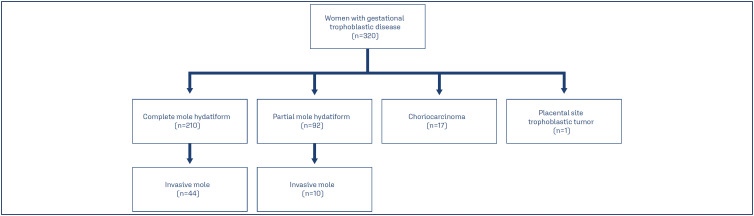
Retrospective cohort study with 320 women with gestational trophoblastic disease (GTD) followed in a tertiary hospital from January 2005 to January 2020. Data referring to the women's sociodemographic profile, clinical, laboratory and treatment aspects and types of GTD were analyzed.
The mean age of women with the benign form was 26.4±8.6 years and with the malignant forms 26.9±8.5 years (p=0.536). Most women with malignant forms came from regions further away from reference center (p=0.012), had vesicle elimination at the time of diagnosis (p=0.028) and needed more than one uterine evacuation (p<0.001) when compared to the benign forms. There was no difference between laboratory tests in both forms. Being between 30 and 39 years old increased the chance of developing invasive mole by 2.5 (p=0.004; 95%CI:1.3-4.9) and coming from regions far from reference center by 4.01 (p=0.020; CI95%: 1.2-12.9). The women with the highest risk of malignant forms were those with the longest time of become normal on human gonadotrophic hormone (hCG) testing (each week the risk increases 1.3 times; p<0.001, 95%CI: 1.2-1.3).
The prolonged hCG fall curve is the main indicator of an increased chance of GTN. Women from regions further away from reference center have a greater chance of developing malignant forms, probably due to the difficulty in accessing the reference center and, therefore, adequate follow-up that would allow early identification of more serious cases.
评估发生葡萄胎后妊娠滋养细胞肿瘤(GTN)的危险因素。
回顾性队列研究,纳入了 2005 年 1 月至 2020 年 1 月在一家三级医院接受治疗的 320 例妊娠滋养细胞疾病(GTD)患者。分析了患者的社会人口统计学特征、临床、实验室和治疗情况以及 GTD 的类型。
良性 GTD 患者的平均年龄为 26.4±8.6 岁,恶性 GTD 患者的平均年龄为 26.9±8.5 岁(p=0.536)。恶性 GTD 患者中,来自参考中心较远地区的患者比例较高(p=0.012),诊断时存在水泡状胎块(p=0.028),且需要多次刮宫术(p<0.001)的比例高于良性 GTD 患者。两种 GTD 患者的实验室检查结果无差异。30-39 岁组发生侵袭性葡萄胎的风险增加 2.5 倍(p=0.004;95%CI:1.3-4.9),来自参考中心较远地区的风险增加 4.01 倍(p=0.020;95%CI:1.2-12.9)。hCG 检测恢复正常时间最长的患者发生恶性 GTD 的风险最高(每增加一周,风险增加 1.3 倍;p<0.001,95%CI:1.2-1.3)。
hCG 下降曲线延长是 GTN 发生风险增加的主要指标。来自参考中心较远地区的患者发生恶性 GTD 的风险更高,这可能是由于难以获得参考中心,以及因此无法进行适当的随访,从而无法早期识别更严重的病例。