Department of Neuromedicine and Movement Science, Faculty of Medicine and Health Sciences, Norwegian University of Science and Technology, Trondheim, Norway.
Department of Neuromedicine and Movement Science, Norwegian University of Science and Technology, Trondheim, Norway.
Acta Neurochir (Wien). 2024 Nov 12;166(1):450. doi: 10.1007/s00701-024-06351-0.
Extent of resection, MGMT promoter methylation status, age, functional level, and residual tumor volume are established prognostic factors for overall survival in glioblastoma patients. Preoperative tumor volume has also been investigated, but the results have been inconclusive. We hypothesized that the surface area and the shape were more representative of the tumor's infiltrative capacities, and thus, the purpose of this study was to assess the prognostic value of tumor size and shape in patients with glioblastoma.
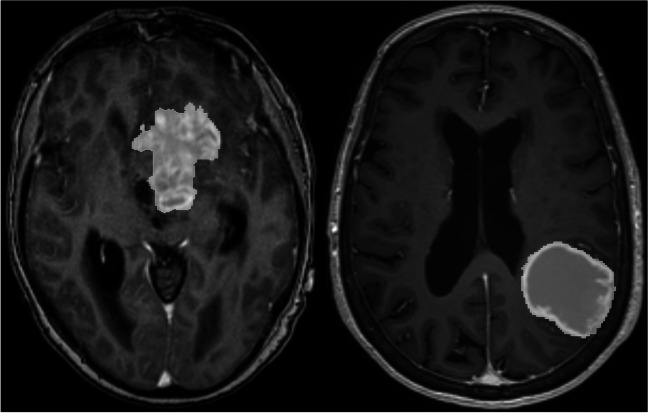
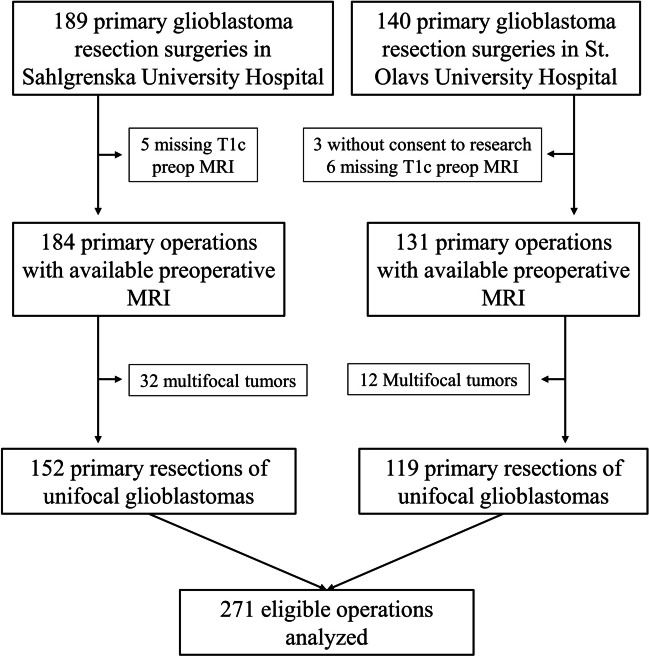
In total, 271 patients with primary, unifocal glioblastoma were included from two centers in Norway and Sweden, respectively. All tumors were automatically segmented on preoperative MRI scans and manually validated. Tumor volume was used as a measurement of size, whereas sphericity index and area-to-volume ratio defined the shape complexity of the tumor. Contact surface area of the tumor was considered a measurement of both size and shape. Multivariable Cox proportional hazards models were used to assess the prognostic value of the respective tumor measurements, with previously established prognostic factors as covariates.
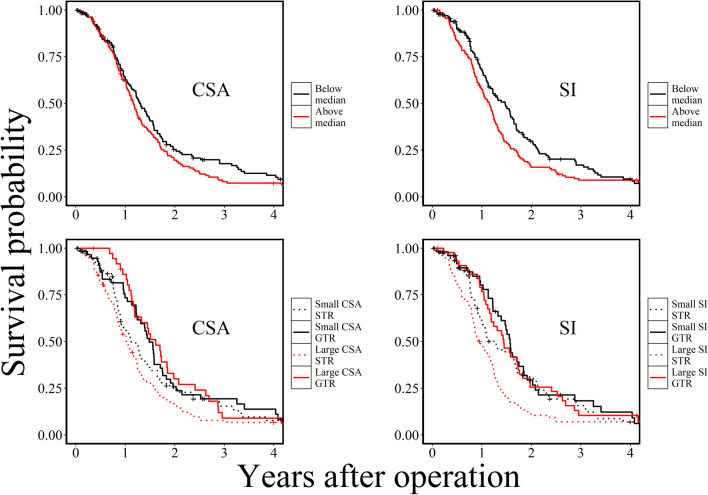
There were no associations between preoperative tumor volume and overall survival. Contact surface area (HR = 1.013, p = 0.002) and sphericity index (HR = 2.223, p = 0.001) were both significant independent prognostic factors for survival in the multivariable Cox models. Contact surface area was also associated with MGMT promoter methylation (p = 0.039) and extent of resection (p = 0.017).
Tumor shape complexity appears to be an independent prognostic factor in glioblastoma patients and may also be associated with MGMT promoter methylation status and extent of surgical resection.
在胶质母细胞瘤患者中,切除范围、MGMT 启动子甲基化状态、年龄、功能状态和残余肿瘤体积是总体生存的既定预后因素。术前肿瘤体积也进行了研究,但结果尚无定论。我们假设肿瘤的表面积和形状更能代表肿瘤的浸润能力,因此,本研究旨在评估胶质母细胞瘤患者肿瘤大小和形状的预后价值。
本研究共纳入来自挪威和瑞典的两个中心的 271 例原发性、单发胶质母细胞瘤患者。所有肿瘤均在术前 MRI 扫描上自动分割,并进行手动验证。肿瘤体积用于测量大小,而球形指数和面积-体积比定义了肿瘤形状的复杂性。肿瘤的接触表面积被认为是大小和形状的测量指标。多变量 Cox 比例风险模型用于评估各自肿瘤测量的预后价值,同时将先前确定的预后因素作为协变量。
术前肿瘤体积与总生存期之间无相关性。接触表面积(HR=1.013,p=0.002)和球形指数(HR=2.223,p=0.001)均为多变量 Cox 模型中生存的独立显著预后因素。接触表面积也与 MGMT 启动子甲基化(p=0.039)和切除范围(p=0.017)相关。
肿瘤形状的复杂性似乎是胶质母细胞瘤患者的独立预后因素,并且可能与 MGMT 启动子甲基化状态和手术切除范围相关。