
用于腹腔镜手术基本技能训练的增强现实技术:一项系统评价与荟萃分析
Augmented reality for basic skills training in laparoscopic surgery: a systematic review and meta-analysis.
作者信息
Xiong Jian, Dai Xiaoqin, Zhang Yuyang, Liu Xingchao, Zhou Xiyuan
机构信息
Institute of Dermatology and Venereology, Sichuan Provincial People's Hospital, University of Electronic Science and Technology. No. 32, Western 2nd Section, 1st Ring Road, Chengdu, Sichuan Province, People's Republic of China.
Clinical Immunology Translational Medicine Key Laboratory of Sichuan Province & Organ Transplantation Center, Sichuan Provincial People's Hospital, University of Electronic Science and Technology. No.32, Western 2nd Section, 1st Ring Road, Chengdu, Sichuan Province, People's Republic of China.
出版信息
Surg Endosc. 2025 Jan;39(1):307-318. doi: 10.1007/s00464-024-11387-5. Epub 2024 Nov 12.
BACKGROUND
Augmented reality (AR) has emerged as a transformative technology in medical education, particularly in training basic laparoscopic skills. Despite its growing applications, the effectiveness of AR in this specific domain remains underexplored, with a lack of standardized assessment frameworks and inconsistent methodologies across studies. This systematic review and meta-analysis aimed to evaluate the effectiveness of AR in laparoscopic basic skills training for medical students and junior physicians.
METHODS
We conducted a systematic review and meta-analysis following PRISMA guidelines. Databases searched included PubMed, Embase, Cochrane Library, Web of Science, and ClinicalTrials.gov. Studies were selected based on their focus on AR applications in laparoscopic training, involving both randomized controlled trials and non-randomized studies. Inclusion criteria focused on medical students and novice surgeons, assessing educational outcomes such as Global Operative Assessment of Laparoscopic Skills (GOALS) Global, Objective Structured Assessment of Technical Skills (OSATS) Global, OSATS Specific, Training Time, and Subjective Workload.
RESULTS
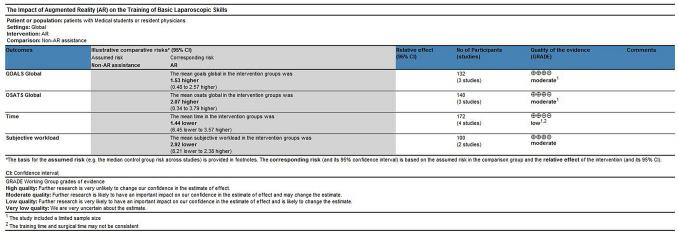
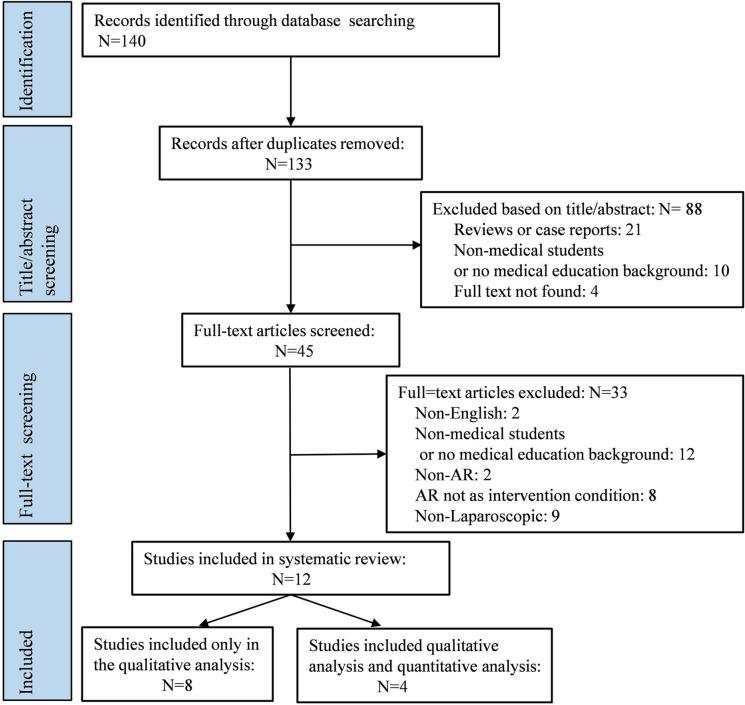
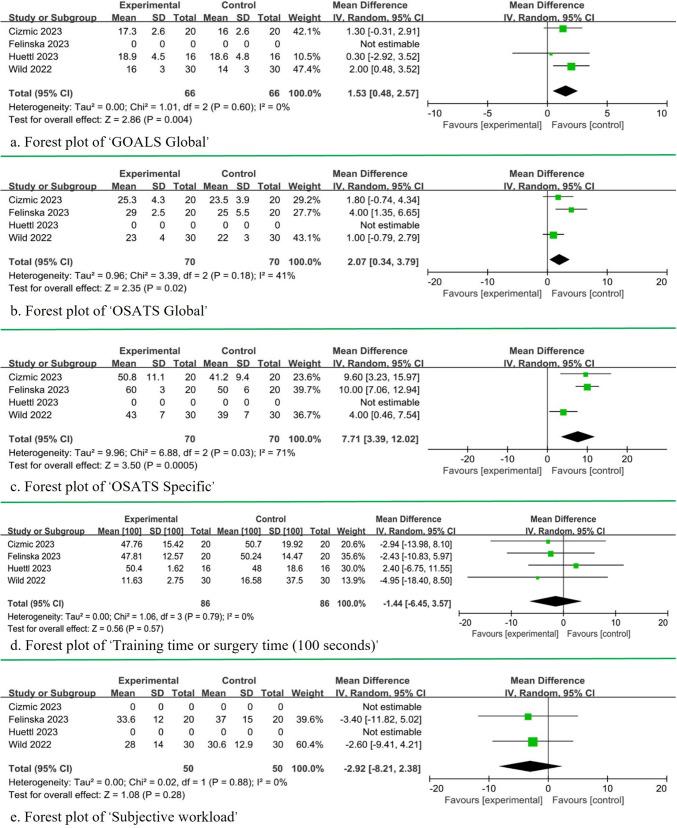
A total of 12 studies involving 434 participants met the inclusion criteria. The analysis revealed that AR technology significantly improved educational outcomes, with participants achieving higher GOALS and OSATS scores. Specifically, the mean difference for GOALS scores was 2.40 points (95% CI [1.30, 3.50], p < 0.001) and for OSATS scores, 7.71 points (95% CI [3.39, 12.03], p < 0.001). Additionally, AR-assisted training showed a reduction in subjective workload, with a mean decrease of 2.95 points (95% CI [- 4.95, - 0.95], p = 0.003).
CONCLUSIONS
The findings indicate that AR significantly enhances laparoscopic training outcomes, facilitating improved technical skills, efficiency, and learner independence. However, variability in study designs and outcomes limits generalizability. Future research should focus on standardize AR training protocols and evaluate long-term effectiveness to fully leverage AR's potential in surgical education.
背景
增强现实(AR)已成为医学教育中的一项变革性技术,尤其是在基础腹腔镜技能培训方面。尽管其应用日益广泛,但AR在这一特定领域的有效性仍未得到充分探索,各研究缺乏标准化的评估框架且方法不一致。本系统评价和荟萃分析旨在评估AR在医学生和初级医师腹腔镜基础技能培训中的有效性。
方法
我们按照PRISMA指南进行了系统评价和荟萃分析。检索的数据库包括PubMed、Embase、Cochrane图书馆、科学网和ClinicalTrials.gov。根据研究对AR在腹腔镜培训中的应用的关注程度进行选择,包括随机对照试验和非随机研究。纳入标准侧重于医学生和新手外科医生,评估教育成果,如腹腔镜技能全球手术评估(GOALS)总分、客观结构化技术技能评估(OSATS)总分、OSATS分项、培训时间和主观工作量。
结果
共有12项涉及434名参与者的研究符合纳入标准。分析表明,AR技术显著改善了教育成果,参与者的GOALS和OSATS得分更高。具体而言,GOALS得分的平均差异为2.40分(95%置信区间[1.30, 3.50],p < 0.001),OSATS得分的平均差异为7.71分(95%置信区间[3.39, 12.03],p < 0.001)。此外,AR辅助培训显示主观工作量有所减少,平均减少2.95分(95%置信区间[-4.95, -0.95],p = 0.003)。
结论
研究结果表明,AR显著提高了腹腔镜培训效果,有助于提高技术技能、效率和学习者的独立性。然而,研究设计和结果的变异性限制了可推广性。未来的研究应侧重于标准化AR培训方案并评估长期有效性,以充分发挥AR在外科教育中的潜力。
 Zotero 插件