School of Plant and Environmental Sciences, Virginia Polytechnic Institute and State University, Blacksburg, VA, USA.
Sci Rep. 2024 Nov 12;14(1):27666. doi: 10.1038/s41598-024-78650-6.
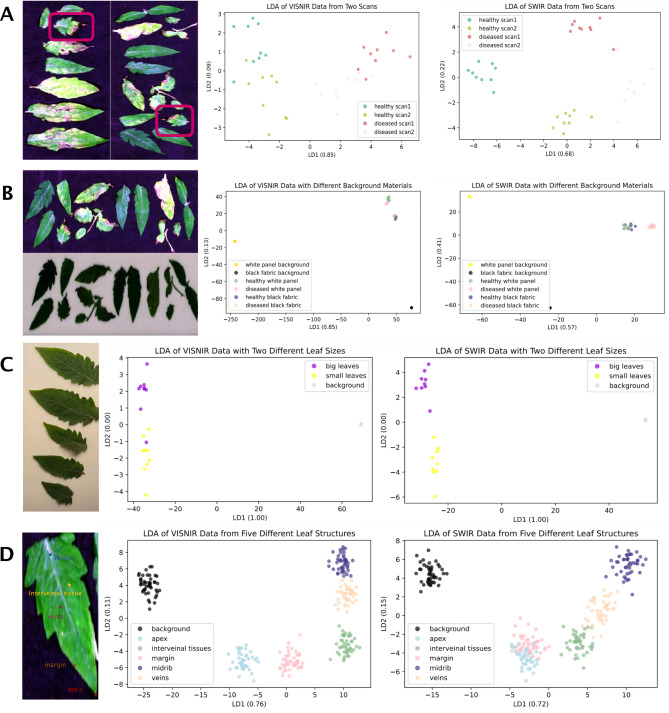
Recent advancements in hyperspectral imaging (HSI) for early disease detection have shown promising results, yet there is a lack of validated high-resolution (spatial and spectral) HSI data representing the responses of plants at different stages of leaf disease progression. To address these gaps, we used bacterial leaf spot (Xanthomonas perforans) of tomato as a model system. Hyperspectral images of tomato leaves, validated against in planta pathogen populations for seven consecutive days, were analyzed to reveal differences between infected and healthy leaves. Machine learning models were trained using leaf-level full spectra data, leaf-level Vegetation index (VI) data, and pixel-level full spectra data at four disease progression stages. The results suggest that HSI can detect disease on tomato leaves at pre-symptomatic stages and differentiate bacterial disease spots from abiotic leaf spots. Using VI data as features for machine learning improved overall classification performance by 26-37% compared to the direct use of raw data. Critical wavelength bands and VIs varied across disease progression stages, suggesting that pre-symptomatic disease detection relied more on changes in leaf water content (1400 nm) and plant defense hormone-mediated responses (750 nm) rather than changes in leaf pigments or internal structure (800-900 nm), which may become more crucial during symptomatic stages. In conclusion, this study provides valuable insights into the dynamics of bacterial spot disease, revealing the potential benefits of leaf structure segmentation and VI group pattern analysis in HSI studies for the early detection of leaf diseases.
近年来,高光谱成像(HSI)在早期疾病检测方面的进展显示出了很有前景的结果,但缺乏经过验证的高分辨率(空间和光谱)HSI 数据来代表植物在叶片疾病进展的不同阶段的响应。为了解决这些差距,我们使用番茄细菌性叶斑病(Xanthomonas perforans)作为模型系统。对番茄叶片的高光谱图像进行了分析,这些图像与连续七天的植物病原体种群进行了验证,以揭示感染叶片和健康叶片之间的差异。使用叶片水平全光谱数据、叶片水平植被指数(VI)数据以及四个疾病进展阶段的像素级全光谱数据对机器学习模型进行了训练。结果表明,HSI 可以在番茄叶片的无症状阶段检测到疾病,并将细菌性病斑与非生物性叶斑区分开来。与直接使用原始数据相比,使用 VI 数据作为特征来进行机器学习可以将整体分类性能提高 26-37%。关键波长带和 VI 在疾病进展阶段有所不同,这表明无症状疾病检测更多地依赖于叶片含水量的变化(1400nm)和植物防御激素介导的响应(750nm),而不是叶片色素或内部结构的变化(800-900nm),这些变化在症状阶段可能变得更加重要。总之,本研究深入了解了细菌性斑点病的动态,揭示了叶片结构分割和 VI 组模式分析在 HSI 研究中用于早期叶片疾病检测的潜在益处。