College of Computer Science and Electronic Engineering, Hunan University, Changsha 410083, China.
Brief Bioinform. 2024 Sep 23;25(6). doi: 10.1093/bib/bbae578.
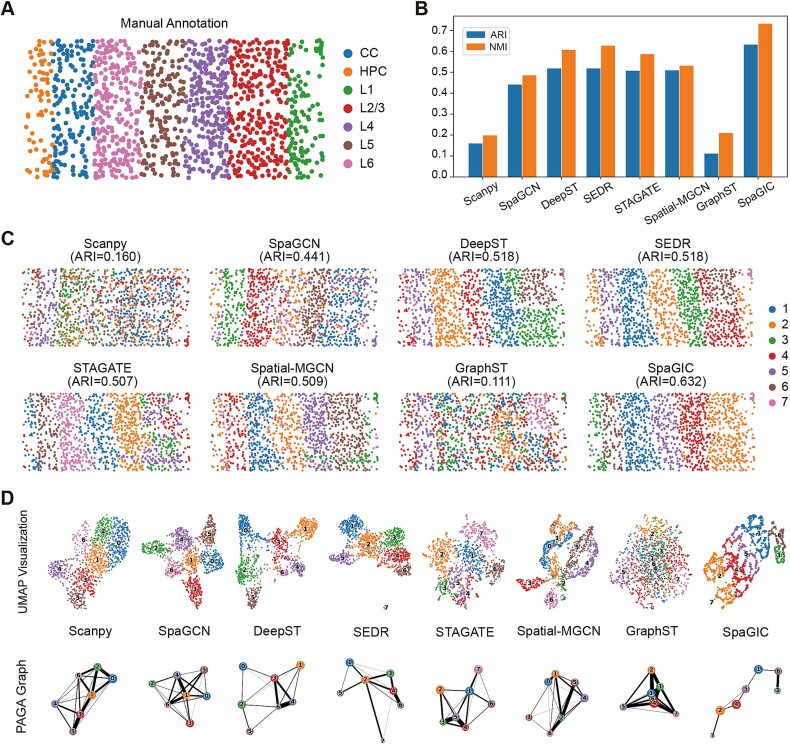
Spatial transcriptomics technologies enable the generation of gene expression profiles while preserving spatial context, providing the potential for in-depth understanding of spatial-specific tissue heterogeneity. Leveraging gene and spatial data effectively is fundamental to accurately identifying spatial domains in spatial transcriptomics analysis. However, many existing methods have not yet fully exploited the local neighborhood details within spatial information. To address this issue, we introduce SpaGIC, a novel graph-based deep learning framework integrating graph convolutional networks and self-supervised contrastive learning techniques. SpaGIC learns meaningful latent embeddings of spots by maximizing both edge-wise and local neighborhood-wise mutual information of graph structures, as well as minimizing the embedding distance between spatially adjacent spots. We evaluated SpaGIC on seven spatial transcriptomics datasets across various technology platforms. The experimental results demonstrated that SpaGIC consistently outperformed existing state-of-the-art methods in several tasks, such as spatial domain identification, data denoising, visualization, and trajectory inference. Additionally, SpaGIC is capable of performing joint analyses of multiple slices, further underscoring its versatility and effectiveness in spatial transcriptomics research.
空间转录组学技术能够在保留空间背景的同时生成基因表达谱,从而有潜力深入了解空间特异性组织异质性。有效地利用基因和空间数据对于在空间转录组学分析中准确识别空间域至关重要。然而,许多现有的方法尚未充分利用空间信息中的局部邻域细节。为了解决这个问题,我们引入了 SpaGIC,这是一种基于图的深度学习框架,集成了图卷积网络和自监督对比学习技术。SpaGIC 通过最大化图结构的边和局部邻域的互信息以及最小化空间相邻点之间的嵌入距离,来学习有意义的斑点潜在嵌入。我们在七个不同技术平台的空间转录组学数据集上评估了 SpaGIC。实验结果表明,SpaGIC 在多个任务中,如空间域识别、数据去噪、可视化和轨迹推断等方面,始终优于现有的最先进方法。此外,SpaGIC 能够对多个切片进行联合分析,进一步突出了其在空间转录组学研究中的多功能性和有效性。