Department of Translational Genomics, Faculty of Medicine, University Hospital Cologne, University of Cologne, Cologne, Germany.
Department I of Internal Medicine, Faculty of Medicine, University Hospital Cologne, University of Cologne, Cologne, Germany.
J Cancer Res Clin Oncol. 2024 Nov 14;150(11):496. doi: 10.1007/s00432-024-05942-9.
Small cell lung cancer (SCLC) has an extremely poor prognosis. Despite high initial response rates to chemotherapy and modest survival improvements with the addition of immune checkpoint inhibitors (ICI), almost all patients experience relapse and fatal outcomes. Recent genomic insights uncovered extensive molecular heterogeneity in addition to the almost uniform loss of RB1 and TRP53. Additionally, defective DNA mismatch repair (MMR) has recently been described in some SCLC cases. Here, we generated a novel SCLC mouse model capturing MMR deficiency and assessed immunotherapy responses.
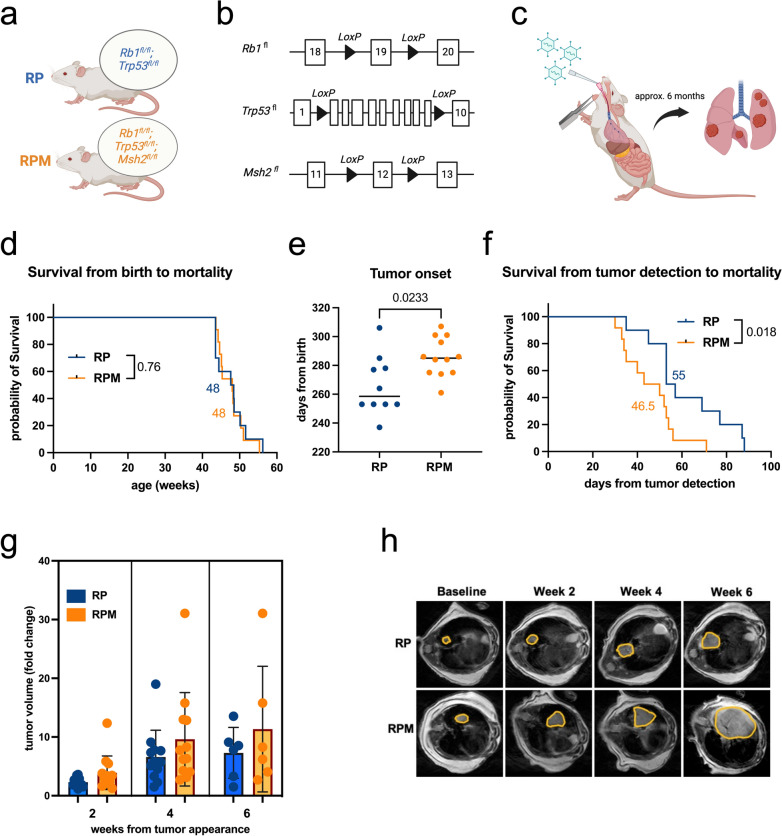
We developed an MMR-deficient genetically engineered mouse model (GEMM) of SCLC by introducing a conditional Msh2 gene, crucial for maintaining MMR integrity, into the standard Rb1;Trp53 (RP) model. Genomic characteristics and preclinical therapy responses were evaluated by focusing on overall survival and whole exome sequencing (WES) analyses.
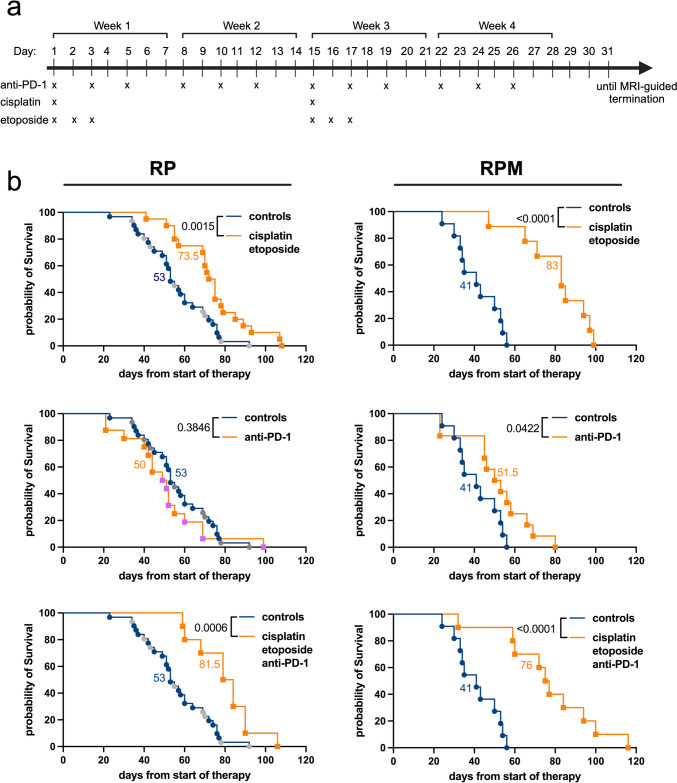
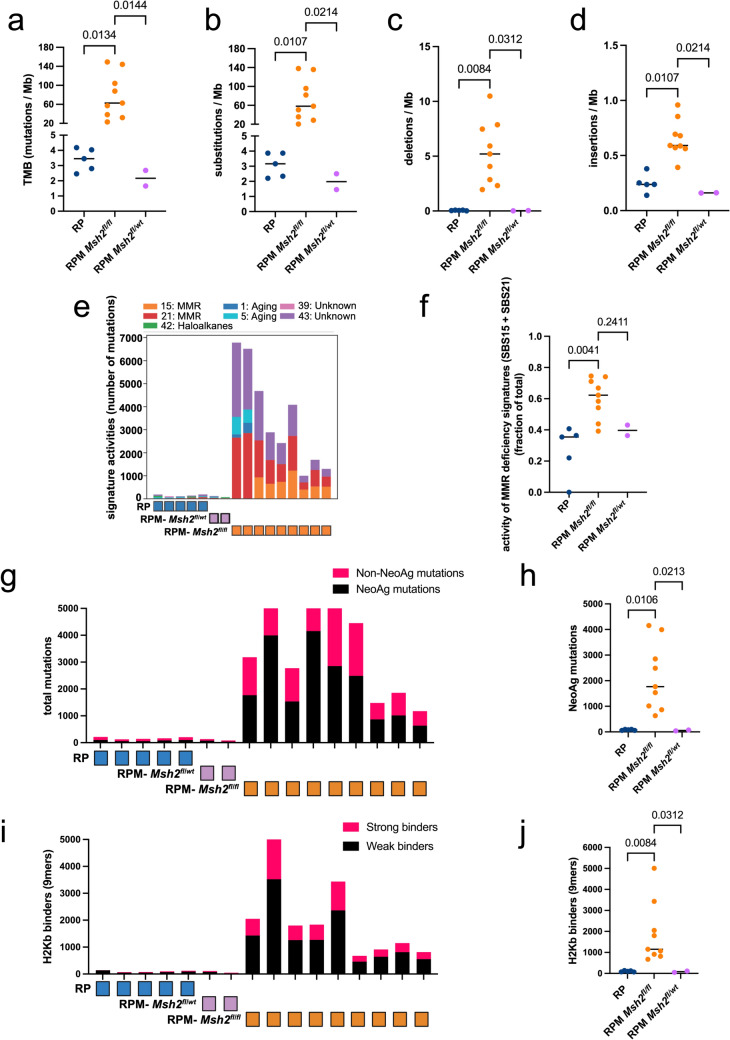
MMR-defective SCLC tumors (Rb1;Trp53;Msh2 (RPM)) developed later than tumors in MMR-proficient mice. However, the time from tumor manifestation to death of the affected animals was substantially shortened (median survival 55 days in RP vs. 46.5 days in RPM), indicating increased aggressiveness of MMR-defective tumors. RPM tumors exhibited MMR deficiency, high tumor mutational burden (TMB), and an elevated load of candidate neoantigens, compared to RP lesions (p = 0.0106), suggesting increased immunogenicity. Importantly, the overall survival of RPM animals was significantly improved when exposed to ICI.
We propose a novel RPM mouse model as a suitable system to mimic MMR-defective SCLC and tumors with high TMB. We provide in vivo evidence that Msh2 deficiency enhances ICI sensitivity. These findings could contribute to stratifying SCLC patients to immunotherapy, thereby improving treatment outcomes.
小细胞肺癌(SCLC)预后极差。尽管化疗初始反应率高,免疫检查点抑制剂(ICI)的加入使生存情况略有改善,但几乎所有患者最终都会复发并导致死亡。最近的基因组研究发现,除了几乎普遍存在的 RB1 和 TRP53 缺失外,还存在广泛的分子异质性。此外,最近在一些 SCLC 病例中描述了缺陷型 DNA 错配修复(MMR)。在此,我们构建了一种新的 SCLC 小鼠模型,模拟 MMR 缺陷,并评估免疫治疗反应。
我们通过将关键的 MMR 完整性维持基因 Msh2 引入标准的 Rb1;Trp53(RP)模型,构建了一种 MMR 缺陷型遗传工程小鼠模型(GEMM)。通过关注总生存期和全外显子组测序(WES)分析,评估了基因组特征和临床前治疗反应。
MMR 缺陷型 SCLC 肿瘤(Rb1;Trp53;Msh2(RPM))的发展晚于 MMR 功能正常的小鼠。然而,从肿瘤出现到受影响动物死亡的时间大大缩短(RP 组的中位生存期为 55 天,而 RPM 组为 46.5 天),表明 MMR 缺陷型肿瘤的侵袭性增加。与 RP 病变相比,RPM 肿瘤表现出 MMR 缺陷、高肿瘤突变负担(TMB)和大量候选新抗原,表明其具有更高的免疫原性(p=0.0106)。重要的是,当 RPM 动物暴露于 ICI 时,其总生存期显著延长。
我们提出了一种新型的 RPM 小鼠模型,可作为模拟 MMR 缺陷型 SCLC 和具有高 TMB 的肿瘤的合适系统。我们提供了体内证据,表明 Msh2 缺失可增强 ICI 敏感性。这些发现有助于对 SCLC 患者进行免疫治疗分层,从而改善治疗效果。