Department of Neurology, The Second Affiliated Hospital of Xinjiang Medical University, Xinjiang, China.
Jinshazhou Hospital of Guangzhou University of Chinese Medicine, Guangzhou, China.
PLoS One. 2024 Nov 15;19(11):e0313631. doi: 10.1371/journal.pone.0313631. eCollection 2024.
Parkinson's disease (PD) is a neurodegenerative disorder, primarily characterized by motor impairments. Vitamin D has several regulatory functions in nerve cell survival and gene expression via its receptors. Although research has shown that vitamin D deficiency is prevalent among PD patients, the causal link to PD risk remains unclear. This study aims to investigate the causal relationship between vitamin D and PD using a bidirectional two-sample Mendelian randomization (MR) analysis method.
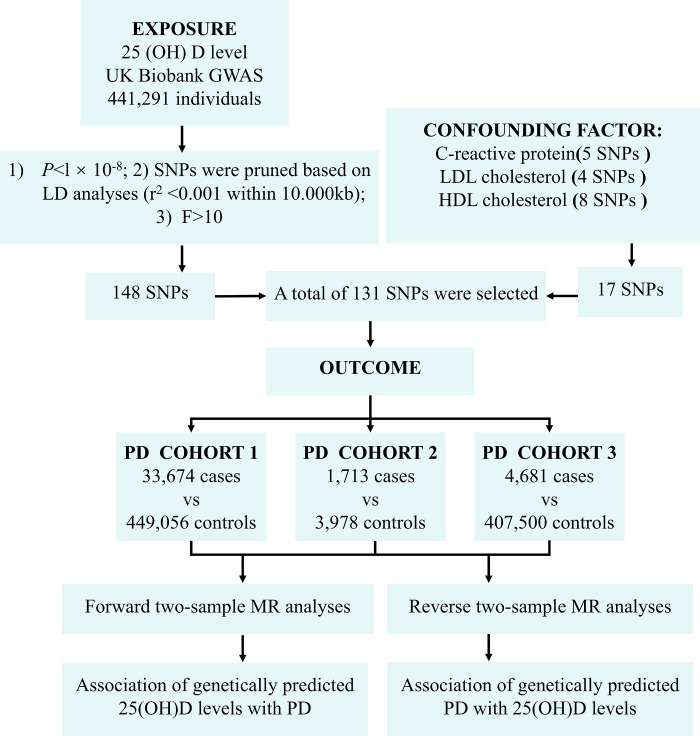
This study applied a bidirectional two-sample MR analysis to explore the causal link between vitamin D and PD. We selected statistically significant single nucleotide polymorphisms (SNPs) related to 25-hydroxyvitamin D (25(OH)D) as instrumental variables (IVs), ensuring no association with known confounders. The analysis used GWAS data from over 1.2 million Europeans across four major published datasets, elucidating the genetic correlation between vitamin D levels and PD.
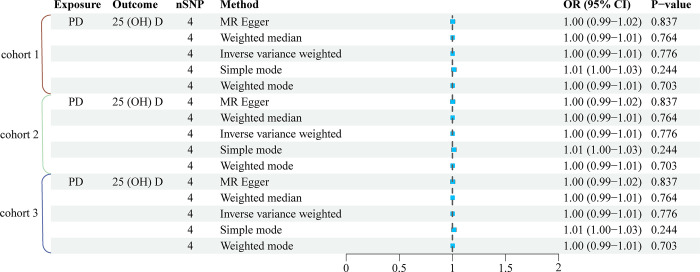
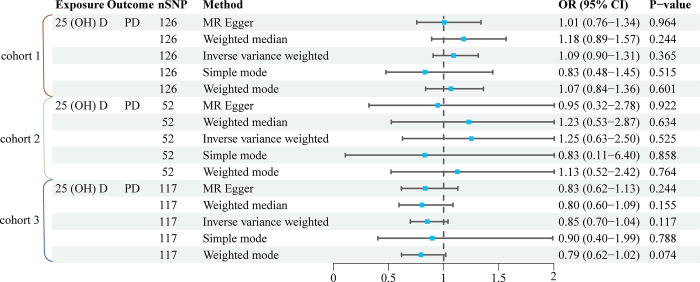
We identified 148 instrumental SNPs associated with 25(OH)D. After adjustment for confounding-related SNPs, 131 SNPs remained in the analysis. Data from three PD cohorts revealed no significant correlation between 25(OH)D levels and PD risk using the IVW method (Pcohort1 = 0.365, Pcohort2 = 0.525, Pcohort3 = 0.117). The reverse MR analysis indicated insufficient evidence of PD causing decreased vitamin D levels (P = 0.776).
This is the first study to use bidirectional MR across three PD cohorts to investigate the causal relationship between vitamin D and PD. The results indicate that vitamin D levels are not significantly causally related to PD risk at the genetic level. Therefore, future studies should exercise caution when investigating the relationship between vitamin D levels and PD risk. While no direct causal link exists between vitamin D levels and PD, this does not preclude the potential of vitamin D levels as a biomarker for PD diagnosis. Furthermore, larger-scale longitudinal studies are necessary to evaluate the diagnostic and predictive value of vitamin D levels in PD.
帕金森病(PD)是一种神经退行性疾病,主要表现为运动障碍。维生素 D 通过其受体在神经细胞存活和基因表达中具有多种调节功能。尽管研究表明 PD 患者中维生素 D 缺乏很常见,但与 PD 风险的因果关系仍不清楚。本研究旨在使用双向两样本 Mendelian 随机化(MR)分析方法研究维生素 D 与 PD 之间的因果关系。
本研究采用双向两样本 MR 分析方法探讨维生素 D 与 PD 之间的因果关系。我们选择与 25-羟维生素 D(25(OH)D)相关的统计学上显著的单核苷酸多态性(SNP)作为工具变量(IVs),确保它们与已知的混杂因素无关。该分析使用来自四个主要已发表数据集的超过 120 万欧洲人的 GWAS 数据,阐明了维生素 D 水平与 PD 之间的遗传相关性。
我们确定了 148 个与 25(OH)D 相关的工具 SNP。在调整与混杂因素相关的 SNP 后,仍有 131 个 SNP 进入分析。使用 IVW 方法,三个 PD 队列的数据显示 25(OH)D 水平与 PD 风险之间没有显著相关性(Pcohort1 = 0.365,Pcohort2 = 0.525,Pcohort3 = 0.117)。反向 MR 分析表明 PD 导致维生素 D 水平降低的证据不足(P = 0.776)。
这是第一项使用三个 PD 队列进行双向 MR 研究以调查维生素 D 与 PD 之间因果关系的研究。结果表明,在遗传水平上,维生素 D 水平与 PD 风险无显著因果关系。因此,未来的研究在研究维生素 D 水平与 PD 风险之间的关系时应谨慎行事。虽然维生素 D 水平与 PD 之间没有直接的因果关系,但这并不排除维生素 D 水平作为 PD 诊断生物标志物的可能性。此外,需要更大规模的纵向研究来评估维生素 D 水平在 PD 中的诊断和预测价值。