• 文献检索
  • 文档翻译
  • 深度研究
  • 学术资讯
  • Suppr Zotero 插件Zotero 插件
  • 邀请有礼
  • 套餐&价格
  • 历史记录
应用&插件
Suppr Zotero 插件Zotero 插件浏览器插件Mac 客户端Windows 客户端微信小程序
定价
高级版会员购买积分包购买API积分包
服务
文献检索文档翻译深度研究API 文档MCP 服务
关于我们
关于 Suppr公司介绍联系我们用户协议隐私条款
关注我们

Suppr 超能文献

核心技术专利:CN118964589B侵权必究
粤ICP备2023148730 号-1Suppr @ 2026

文献检索

告别复杂PubMed语法,用中文像聊天一样搜索,搜遍4000万医学文献。AI智能推荐,让科研检索更轻松。

立即免费搜索

文件翻译

保留排版,准确专业,支持PDF/Word/PPT等文件格式,支持 12+语言互译。

免费翻译文档

深度研究

AI帮你快速写综述,25分钟生成高质量综述,智能提取关键信息,辅助科研写作。

立即免费体验

基于食物图像的人工智能在膳食评估中的应用进展:范围综述。

Advancements in Using AI for Dietary Assessment Based on Food Images: Scoping Review.

机构信息

Theptarin Diabetes, Thyroid, and Endocrine Center, Vimut-Theptarin Hospital, Bangkok, Thailand.

Diabetes and Metabolic Care Center, Taksin Hospital, Medical Service Department, Bangkok Metropolitan Administration, Bangkok, Thailand.

出版信息

J Med Internet Res. 2024 Nov 15;26:e51432. doi: 10.2196/51432.

DOI:10.2196/51432
PMID:39546777
原文链接:https://pmc.ncbi.nlm.nih.gov/articles/PMC11607557/
Abstract

BACKGROUND

To accurately capture an individual's food intake, dietitians are often required to ask clients about their food frequencies and portions, and they have to rely on the client's memory, which can be burdensome. While taking food photos alongside food records can alleviate user burden and reduce errors in self-reporting, this method still requires trained staff to translate food photos into dietary intake data. Image-assisted dietary assessment (IADA) is an innovative approach that uses computer algorithms to mimic human performance in estimating dietary information from food images. This field has seen continuous improvement through advancements in computer science, particularly in artificial intelligence (AI). However, the technical nature of this field can make it challenging for those without a technical background to understand it completely.

OBJECTIVE

This review aims to fill the gap by providing a current overview of AI's integration into dietary assessment using food images. The content is organized chronologically and presented in an accessible manner for those unfamiliar with AI terminology. In addition, we discuss the systems' strengths and weaknesses and propose enhancements to improve IADA's accuracy and adoption in the nutrition community.

METHODS

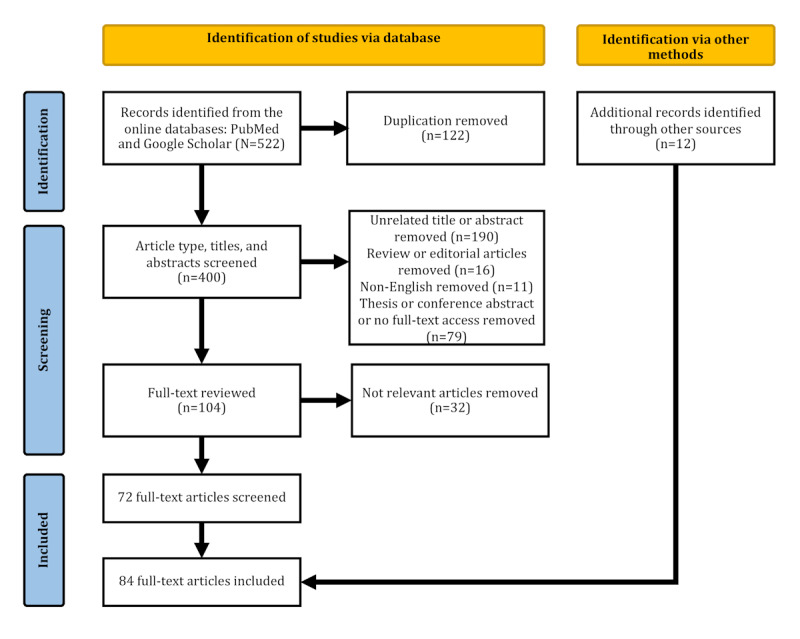
This scoping review used PubMed and Google Scholar databases to identify relevant studies. The review focused on computational techniques used in IADA, specifically AI models, devices, and sensors, or digital methods for food recognition and food volume estimation published between 2008 and 2021.

RESULTS

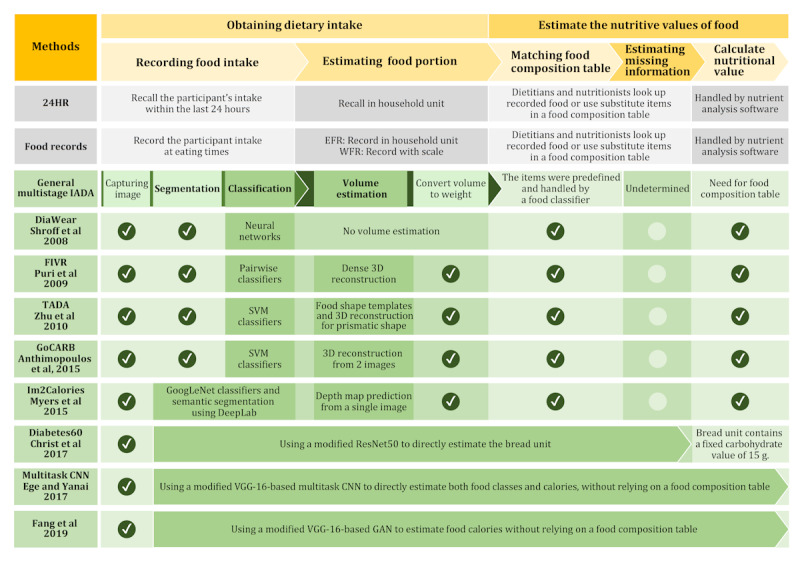
A total of 522 articles were initially identified. On the basis of a rigorous selection process, 84 (16.1%) articles were ultimately included in this review. The selected articles reveal that early systems, developed before 2015, relied on handcrafted machine learning algorithms to manage traditional sequential processes, such as segmentation, food identification, portion estimation, and nutrient calculations. Since 2015, these handcrafted algorithms have been largely replaced by deep learning algorithms for handling the same tasks. More recently, the traditional sequential process has been superseded by advanced algorithms, including multitask convolutional neural networks and generative adversarial networks. Most of the systems were validated for macronutrient and energy estimation, while only a few were capable of estimating micronutrients, such as sodium. Notably, significant advancements have been made in the field of IADA, with efforts focused on replicating humanlike performance.

CONCLUSIONS

This review highlights the progress made by IADA, particularly in the areas of food identification and portion estimation. Advancements in AI techniques have shown great potential to improve the accuracy and efficiency of this field. However, it is crucial to involve dietitians and nutritionists in the development of these systems to ensure they meet the requirements and trust of professionals in the field.
https://cdn.ncbi.nlm.nih.gov/pmc/blobs/455e/11607557/8baa0d4baf05/jmir_v26i1e51432_fig6.jpg
https://cdn.ncbi.nlm.nih.gov/pmc/blobs/455e/11607557/222cd3f5b7c6/jmir_v26i1e51432_fig1.jpg
https://cdn.ncbi.nlm.nih.gov/pmc/blobs/455e/11607557/68ed869fa7b4/jmir_v26i1e51432_fig2.jpg
https://cdn.ncbi.nlm.nih.gov/pmc/blobs/455e/11607557/2152e9b7c1b7/jmir_v26i1e51432_fig3.jpg
https://cdn.ncbi.nlm.nih.gov/pmc/blobs/455e/11607557/43547a3f345a/jmir_v26i1e51432_fig4.jpg
https://cdn.ncbi.nlm.nih.gov/pmc/blobs/455e/11607557/d1b4a57ebc68/jmir_v26i1e51432_fig5.jpg
https://cdn.ncbi.nlm.nih.gov/pmc/blobs/455e/11607557/8baa0d4baf05/jmir_v26i1e51432_fig6.jpg
https://cdn.ncbi.nlm.nih.gov/pmc/blobs/455e/11607557/222cd3f5b7c6/jmir_v26i1e51432_fig1.jpg
https://cdn.ncbi.nlm.nih.gov/pmc/blobs/455e/11607557/68ed869fa7b4/jmir_v26i1e51432_fig2.jpg
https://cdn.ncbi.nlm.nih.gov/pmc/blobs/455e/11607557/2152e9b7c1b7/jmir_v26i1e51432_fig3.jpg
https://cdn.ncbi.nlm.nih.gov/pmc/blobs/455e/11607557/43547a3f345a/jmir_v26i1e51432_fig4.jpg
https://cdn.ncbi.nlm.nih.gov/pmc/blobs/455e/11607557/d1b4a57ebc68/jmir_v26i1e51432_fig5.jpg
https://cdn.ncbi.nlm.nih.gov/pmc/blobs/455e/11607557/8baa0d4baf05/jmir_v26i1e51432_fig6.jpg
摘要

背景

为了准确捕捉个体的食物摄入量,营养师通常需要询问客户有关他们的食物频率和份量的信息,而这依赖于客户的记忆,这可能会带来负担。虽然在食物记录旁边拍摄食物照片可以减轻用户负担并减少自我报告中的错误,但这种方法仍然需要经过培训的工作人员将食物照片转换为饮食摄入数据。图像辅助饮食评估 (IADA) 是一种创新方法,它使用计算机算法来模拟人类从食物图像中估计饮食信息的能力。通过计算机科学的进步,特别是人工智能 (AI) 的进步,这个领域一直在不断改进。然而,该领域的技术性质可能会使那些没有技术背景的人难以完全理解。

目的

本综述旨在通过提供当前关于使用食物图像进行 AI 整合进行饮食评估的概述来填补这一空白。内容按时间顺序组织,以易于理解的方式呈现给不熟悉 AI 术语的人。此外,我们讨论了系统的优缺点,并提出了改进措施,以提高 IADA 在营养界的准确性和采用率。

方法

本范围综述使用 PubMed 和 Google Scholar 数据库来确定相关研究。综述重点介绍了 IADA 中使用的计算技术,特别是 AI 模型、设备和传感器,或用于食物识别和食物量估计的数字方法,这些方法发表于 2008 年至 2021 年期间。

结果

最初共确定了 522 篇文章。根据严格的选择过程,最终有 84 篇(16.1%)文章被纳入本综述。所选文章表明,早期系统(2015 年之前开发)依赖于手工制作的机器学习算法来管理传统的顺序过程,例如分割、食物识别、份量估计和营养计算。自 2015 年以来,这些手工制作的算法已在很大程度上被用于处理相同任务的深度学习算法所取代。最近,传统的顺序过程已被包括多任务卷积神经网络和生成对抗网络在内的先进算法所取代。大多数系统都经过了宏量营养素和能量估计的验证,而只有少数系统能够估计微量营养素,如钠。值得注意的是,IADA 领域取得了重大进展,努力复制人类表现。

结论

本综述强调了 IADA 的进展,特别是在食物识别和份量估计方面。人工智能技术的进步显示出极大地提高该领域的准确性和效率的潜力。然而,必须让营养师和营养学家参与这些系统的开发,以确保它们符合该领域专业人员的要求和信任。

相似文献

1
Advancements in Using AI for Dietary Assessment Based on Food Images: Scoping Review.基于食物图像的人工智能在膳食评估中的应用进展:范围综述。
J Med Internet Res. 2024 Nov 15;26:e51432. doi: 10.2196/51432.
2
Prescription of Controlled Substances: Benefits and Risks管制药品的处方:益处与风险
3
Sexual Harassment and Prevention Training性骚扰与预防培训
4
Short-Term Memory Impairment短期记忆障碍
5
The Black Book of Psychotropic Dosing and Monitoring.《精神药物剂量与监测黑皮书》
Psychopharmacol Bull. 2024 Jul 8;54(3):8-59.
6
The Lived Experience of Autistic Adults in Employment: A Systematic Search and Synthesis.成年自闭症患者的就业生活经历:系统检索与综述
Autism Adulthood. 2024 Dec 2;6(4):495-509. doi: 10.1089/aut.2022.0114. eCollection 2024 Dec.
7
Management of urinary stones by experts in stone disease (ESD 2025).结石病专家对尿路结石的管理(2025年结石病专家共识)
Arch Ital Urol Androl. 2025 Jun 30;97(2):14085. doi: 10.4081/aiua.2025.14085.
8
AI-based digital image dietary assessment methods compared to humans and ground truth: a systematic review.基于人工智能的数字图像膳食评估方法与人类和真实数据的比较:系统评价。
Ann Med. 2023;55(2):2273497. doi: 10.1080/07853890.2023.2273497. Epub 2023 Dec 7.
9
AI in Medical Questionnaires: Innovations, Diagnosis, and Implications.医学问卷中的人工智能:创新、诊断及影响
J Med Internet Res. 2025 Jun 23;27:e72398. doi: 10.2196/72398.
10
A deep learning approach to direct immunofluorescence pattern recognition in autoimmune bullous diseases.深度学习方法在自身免疫性大疱性疾病中的直接免疫荧光模式识别。
Br J Dermatol. 2024 Jul 16;191(2):261-266. doi: 10.1093/bjd/ljae142.

引用本文的文献

1
Looking Beyond Nutrients, How to Assess Diet Quality in an Inflammatory Bowel Disease Population-A Narrative Review.超越营养素:如何评估炎症性肠病患者的饮食质量——一篇叙述性综述
Nutrients. 2025 Jul 17;17(14):2343. doi: 10.3390/nu17142343.
2
Development of a nurse-led, evidence-based, and theory-informed dietary intervention to modify multiple unhealthy dietary behaviors in gastric cancer survivors.开发一种由护士主导、基于证据且理论指导的饮食干预措施,以改变胃癌幸存者的多种不健康饮食行为。
Asia Pac J Oncol Nurs. 2025 Jun 9;12:100739. doi: 10.1016/j.apjon.2025.100739. eCollection 2025 Dec.
3
Relative Validity of the Food Recording Smartphone App Libro in Young People Vulnerable to Eating Disorder: A Preliminary Cross-Over Study.

本文引用的文献

1
Applying Image-Based Food-Recognition Systems on Dietary Assessment: A Systematic Review.基于图像的食物识别系统在膳食评估中的应用:系统评价。
Adv Nutr. 2022 Dec 22;13(6):2590-2619. doi: 10.1093/advances/nmac078.
2
Human-Mimetic Estimation of Food Volume from a Single-View RGB Image Using an AI System.使用人工智能系统从单视角RGB图像进行食物体积的拟人化估计。
Electronics (Basel). 2021 Jul;10(13). doi: 10.3390/electronics10131556. Epub 2021 Jun 28.
3
A Framework of Visual Checkout System Using Convolutional Neural Networks for Bento Buffet.
针对易患饮食失调症的年轻人,食物记录智能手机应用程序Libro的相对效度:一项初步交叉研究。
Nutrients. 2025 May 27;17(11):1823. doi: 10.3390/nu17111823.
基于卷积神经网络的盒饭自助餐视觉结账系统框架。
Sensors (Basel). 2021 Apr 8;21(8):2627. doi: 10.3390/s21082627.
4
Explainability for artificial intelligence in healthcare: a multidisciplinary perspective.人工智能在医疗保健中的可解释性:多学科视角。
BMC Med Inform Decis Mak. 2020 Nov 30;20(1):310. doi: 10.1186/s12911-020-01332-6.
5
Carbohydrate Counting App Using Image Recognition for Youth With Type 1 Diabetes: Pilot Randomized Control Trial.基于图像识别的 1 型糖尿病青少年碳水化合物计数应用:试验性随机对照试验。
JMIR Mhealth Uhealth. 2020 Oct 28;8(10):e22074. doi: 10.2196/22074.
6
goFOOD: An Artificial Intelligence System for Dietary Assessment.goFOOD:一个用于膳食评估的人工智能系统。
Sensors (Basel). 2020 Jul 31;20(15):4283. doi: 10.3390/s20154283.
7
A Systematic Review of Technology-Driven Methodologies for Estimation of Energy Intake.技术驱动的能量摄入估算方法的系统评价
IEEE Access. 2019;7:49653-49668. doi: 10.1109/access.2019.2910308. Epub 2019 Apr 11.
8
Image-Based Food Classification and Volume Estimation for Dietary Assessment: A Review.基于图像的食物分类和体积估计在膳食评估中的应用:综述。
IEEE J Biomed Health Inform. 2020 Jul;24(7):1926-1939. doi: 10.1109/JBHI.2020.2987943. Epub 2020 Apr 30.
9
Current Developments in Digital Quantitative Volume Estimation for the Optimisation of Dietary Assessment.数字定量容积估计在膳食评估优化中的最新进展。
Nutrients. 2020 Apr 22;12(4):1167. doi: 10.3390/nu12041167.
10
Volumetric Food Quantification Using Computer Vision on a Depth-Sensing Smartphone: Preclinical Study.使用深度感应智能手机上的计算机视觉进行容积式食物定量:临床前研究。
JMIR Mhealth Uhealth. 2020 Mar 25;8(3):e15294. doi: 10.2196/15294.