El-Sayed Amr A, Bolous Nancy S
Public Health Institute, Faculty of Health, Liverpool John Moores University, Liverpool, UK.
Medical Affairs Department, Novo Nordisk Egypt, Cairo, Egypt.
Pharmacoecon Open. 2025 Mar;9(2):179-205. doi: 10.1007/s41669-024-00540-4. Epub 2024 Nov 15.
Haemophilia is a rare genetic bleeding disorder that leads to musculoskeletal complications. The high cost of haemophilia treatment necessitates a thorough evaluation of its economic burden. However, due to the difficulty of estimating direct non-medical, indirect, and intangible costs, studies often underestimate the actual economic burden of haemophilia. This scoping review aims to summarise economic studies in haemophilia conducted from a societal perspective.
A systematic search across eight scholarly databases, grey literature, and reference lists until the 5 of July 2023 was conducted to identify relevant studies. The inclusion criteria encompassed full-text, English-language publications of economic analyses in congenital haemophilia from a societal perspective. Model-based studies and those adopting a payer perspective were excluded. Costs were adjusted to international dollars (I$) and US dollars (US$) in 2022 for comparability.
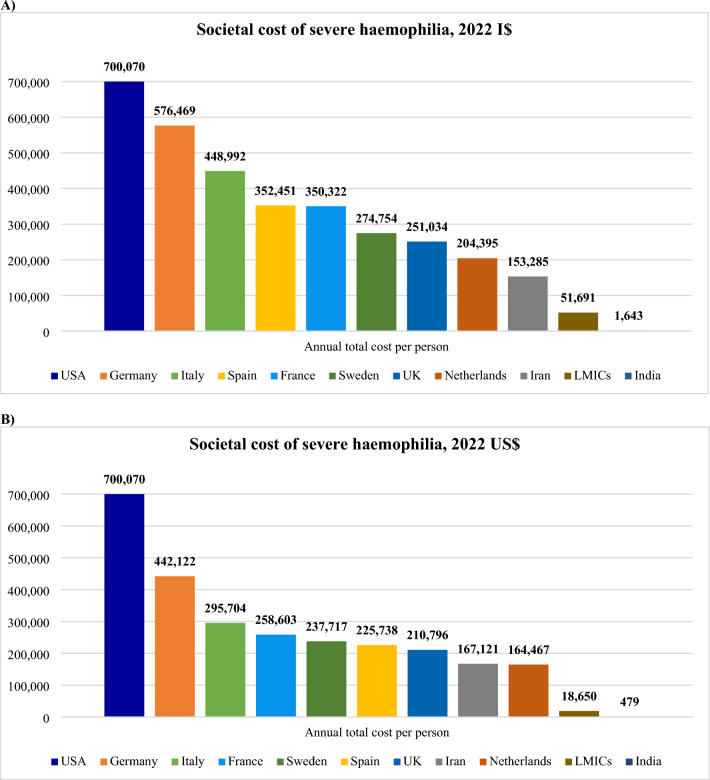
Out of 2993 potential sources identified, 25 studies met the inclusion criteria, covering 7226 persons with haemophilia across 22 countries. All studies reported direct medical costs, with four excluding the cost of haemostatic therapy. Fifteen studies reported direct formal non-medical costs, while eight reported direct informal non-medical costs. All but one study reported the indirect costs. The average annual costs of haemophilia varied widely based on treatment modality, disease severity, geographical location, and included cost categories. When including the cost of clotting factor replacement therapy (CFRT), the total cost for severe haemophilia without inhibitors ranged from 1566 I$ to 700,070 I$ per person per year (lowest value reported in India and highest in the United States). CFRT represented up to 99.9% of the total cost for those receiving prophylaxis and up to 95.1% for episodic treatment. Haemostatic therapies accounted for 82% of the total cost in patients with inhibitors.
There is a significant heterogeneity in defining cost categories required for a comprehensive economic analysis from a societal perspective. While haemostatic therapies constitute a substantial portion of the overall cost, direct non-medical and indirect costs are crucial as they are often paid out-of-pocket and may impede access to treatment. It is essential for haematologists and economists to establish a standardised costing framework for future studies, particularly in the era of novel therapies.
血友病是一种罕见的遗传性出血性疾病,可导致肌肉骨骼并发症。血友病治疗费用高昂,因此有必要对其经济负担进行全面评估。然而,由于难以估算直接非医疗、间接和无形费用,研究往往低估了血友病的实际经济负担。本综述旨在总结从社会角度开展的血友病经济研究。
对八个学术数据库、灰色文献和参考文献列表进行系统检索,直至2023年7月5日,以确定相关研究。纳入标准包括从社会角度对先天性血友病进行经济分析的全文英文出版物。基于模型的研究和采用支付方视角的研究被排除。为便于比较,成本已调整为2022年的国际美元(I$)和美元(US$)。
在确定的2993个潜在来源中,有25项研究符合纳入标准,涵盖22个国家的7226名血友病患者。所有研究均报告了直接医疗费用,其中四项未包括止血治疗费用。15项研究报告了直接正式非医疗费用,8项报告了直接非正式非医疗费用。除一项研究外,所有研究均报告了间接费用。血友病的年均费用因治疗方式、疾病严重程度、地理位置和纳入的费用类别而异。当纳入凝血因子替代疗法(CFRT)的费用时,无抑制物的重度血友病患者每人每年的总费用从1566国际美元到700,070国际美元不等(印度报告的最低值,美国最高)。对于接受预防治疗的患者,CFRT占总费用的比例高达99.9%,对于按需治疗的患者则高达95.1%。止血治疗占抑制剂患者总费用的82%。
从社会角度进行全面经济分析所需定义的费用类别存在显著异质性。虽然止血治疗占总体费用的很大一部分,但直接非医疗和间接费用也很关键,因为它们通常需要自掏腰包,可能会阻碍获得治疗。血液学家和经济学家有必要为未来的研究建立一个标准化的成本核算框架,特别是在新疗法时代。