Georgia Institute of Technology, Atlanta, GA, USA.
Mediterranean Institutes for Advanced Studies (IMEDEA, CSIC-UIB), Esporles, Spain.
Nat Commun. 2024 Nov 15;15(1):9906. doi: 10.1038/s41467-024-53787-0.
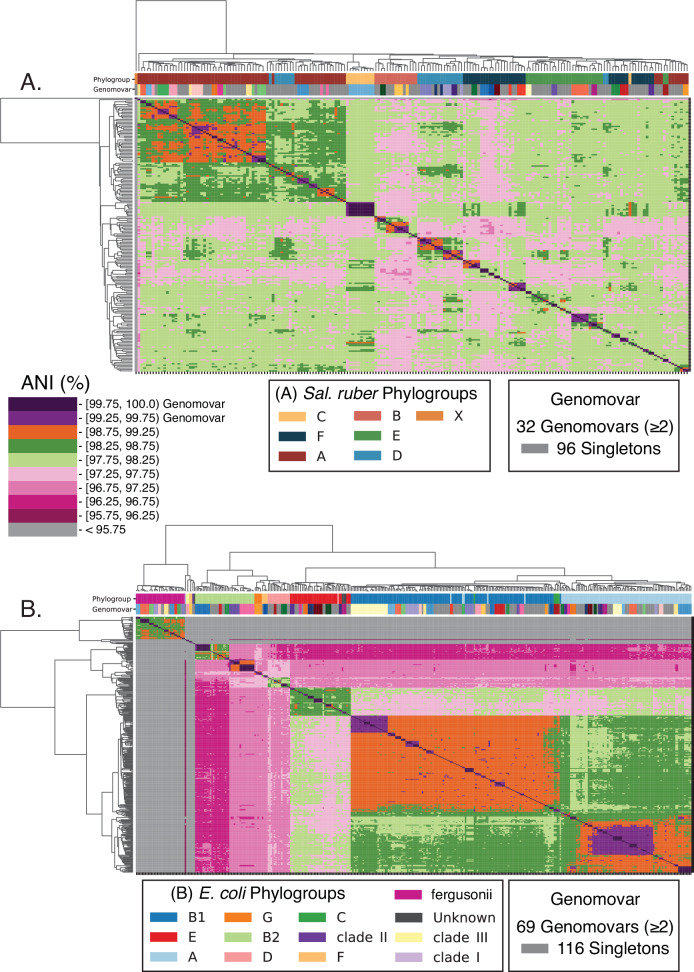
Recent genomic analyses have revealed that microbial communities are predominantly composed of persistent, sequence-discrete species and intraspecies units (genomovars), but the mechanisms that create and maintain these units remain unclear. By analyzing closely-related isolate genomes from the same or related samples and identifying recent recombination events using a novel bioinformatics methodology, we show that high ecological cohesiveness coupled to frequent-enough and unbiased (i.e., not selection-driven) horizontal gene flow, mediated by homologous recombination, often underlie these diversity patterns. Ecological cohesiveness was inferred based on greater similarity in temporal abundance patterns of genomes of the same vs. different units, and recombination was shown to affect all sizable segments of the genome (i.e., be genome-wide) and have two times or greater impact on sequence evolution than point mutations. These results were observed in both Salinibacter ruber, an environmental halophilic organism, and Escherichia coli, the model gut-associated organism and an opportunistic pathogen, indicating that they may be more broadly applicable to the microbial world. Therefore, our results represent a departure compared to previous models of microbial speciation that invoke either ecology or recombination, but not necessarily their synergistic effect, and answer an important question for microbiology: what a species and a subspecies are.
最近的基因组分析表明,微生物群落主要由持久的、序列离散的物种和种内单位(基因组变种)组成,但创造和维持这些单位的机制仍不清楚。通过分析来自相同或相关样本的密切相关的分离株基因组,并使用一种新的生物信息学方法识别最近的重组事件,我们表明,高生态凝聚性加上足够频繁且无偏(即非选择驱动)的水平基因流,由同源重组介导,通常是这些多样性模式的基础。生态凝聚性是基于相同和不同单位的基因组在时间丰度模式上的更大相似性推断出来的,重组被证明影响基因组的所有相当大的片段(即全基因组),并且对序列进化的影响是点突变的两倍或更大。这些结果在嗜盐古菌(一种环境嗜盐生物)和大肠杆菌(模型肠道相关生物和机会性病原体)中都观察到了,这表明它们可能更广泛地适用于微生物世界。因此,与以前的微生物物种形成模型相比,我们的结果代表了一种背离,以前的模型要么只考虑生态,要么只考虑重组,但不一定考虑它们的协同作用,并且回答了微生物学的一个重要问题:什么是物种和亚种。