Department of Clinical Laboratory, Zigong First People's Hospital, Zigong, China.
Sci Rep. 2024 Nov 18;14(1):28386. doi: 10.1038/s41598-024-80116-8.
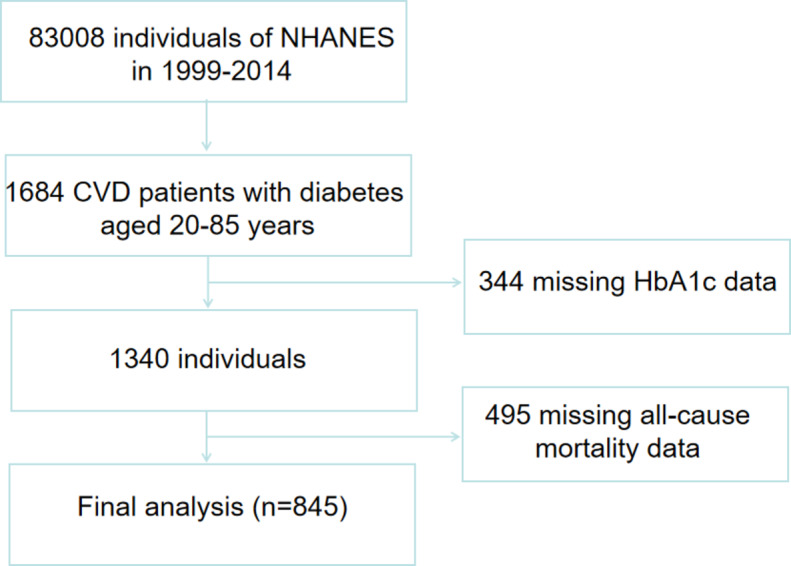
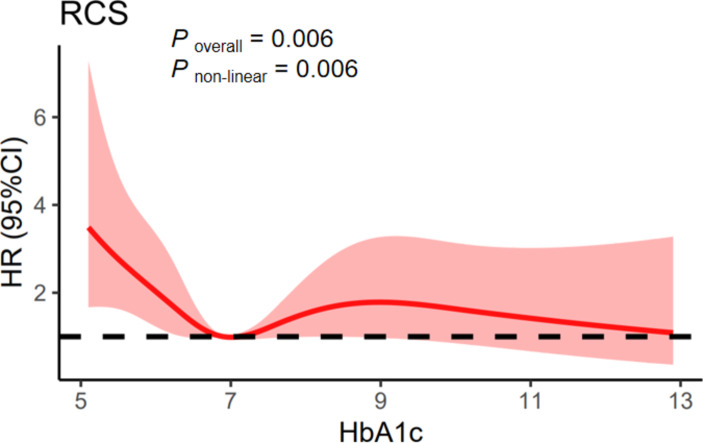
In this analysis, the association of baseline glycated hemoglobin (HbA1c) levels with all-cause mortality in cardiovascular disease (CVD) patients with diabetes was investigated using data from NHANES 1999-2014. Under examination were 845 CVD patients who had diabetes and were followed for a median follow-up of 7.3 years, and an all-cause mortality rate of 22.60% was observed. To examine the association between HbA1c and mortality, multivariable Cox proportional hazard models using spline models determined the non-linear association. HbA1c as a continuous variable was not associated with mortality. However, a significant association was observed when HbA1c was classified according to quartiles. Particularly, after adjustment for potential confounders, in comparison to participants with HbA1c levels below 6.2%, patients with HbA1c levels of 6.2-6.8% and 6.9-7.6% had lower risks of all-cause mortality (hazard ratio: 0.49, 95% CI: 0.30-0.80 and hazard ratio: 0.64, 95% CI: 0.39-1.03, respectively). Using restricted cubic splines, further testing confirmed the lack of a linear association and instead suggested a U-shaped relationship between HbA1c and mortality, with an optimal HbA1c target value of 6.9%. A 1-unit increase in HbA1c with HbA1c less than or equal to 6.9% was predictive of a 55% reduction in all-cause mortality compared to HbA1c levels above 6.9%, which exhibited an elevation in risk. All told, these data suggest that the relationship between HbA1c and all-cause mortality in CVD patients with diabetes is non-linear and U-shaped, and therefore may suggest that individualization of glycemic control may be beneficial for this patient population.
本分析利用 NHANES 1999-2014 年的数据,研究了基线糖化血红蛋白(HbA1c)水平与合并糖尿病的心血管疾病(CVD)患者全因死亡率之间的关系。共纳入 845 例合并糖尿病且中位随访时间为 7.3 年的 CVD 患者,观察到全因死亡率为 22.60%。为了研究 HbA1c 与死亡率之间的关系,使用样条模型的多变量 Cox 比例风险模型确定了非线性关系。HbA1c 作为连续变量与死亡率无关。然而,当根据四分位数对 HbA1c 进行分类时,观察到显著的相关性。特别是,在校正潜在混杂因素后,与 HbA1c 水平低于 6.2%的患者相比,HbA1c 水平为 6.2-6.8%和 6.9-7.6%的患者全因死亡率风险较低(风险比:0.49,95%可信区间:0.30-0.80 和风险比:0.64,95%可信区间:0.39-1.03)。使用限制立方样条进一步检验证实了线性关系的缺乏,而是表明 HbA1c 与死亡率之间存在 U 型关系,HbA1c 的最佳目标值为 6.9%。与 HbA1c 水平大于 6.9%相比,HbA1c 小于或等于 6.9%时 HbA1c 每增加 1 个单位,全因死亡率降低 55%,风险升高。总的来说,这些数据表明,合并糖尿病的 CVD 患者中 HbA1c 与全因死亡率之间的关系是非线性和 U 型的,因此可能表明针对该患者人群进行个体化血糖控制可能是有益的。