
顶端整合素作为调节上皮屏障的可切换靶点。
Apical integrins as a switchable target to regulate the epithelial barrier.
作者信息
Peterson Raven J, Reed Ryan C, Zamecnik Colin R, Sallam Marwa A, Finbloom Joel A, Martinez Francisco J, Levy Joshua M, Moonwiriyakit Aekkacha, Desai Tejal A, Koval Michael
机构信息
Division of Pulmonary, Allergy, Critical Care and Sleep Medicine, Department of Medicine, Emory University School of Medicine, Atlanta, GA 30322, USA.
Department of Bioengineering and Therapeutic Sciences, University of California San Francisco, San Francisco, CA 94158, USA.
出版信息
J Cell Sci. 2024 Dec 15;137(24). doi: 10.1242/jcs.263580. Epub 2024 Dec 20.
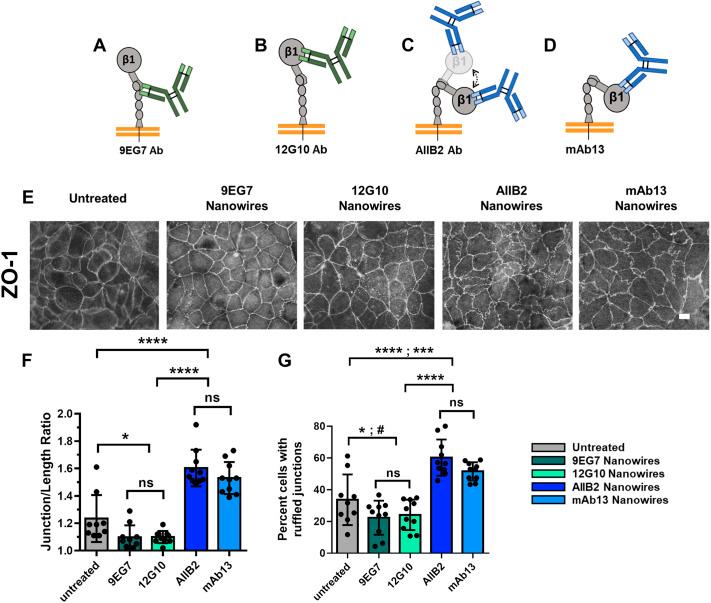
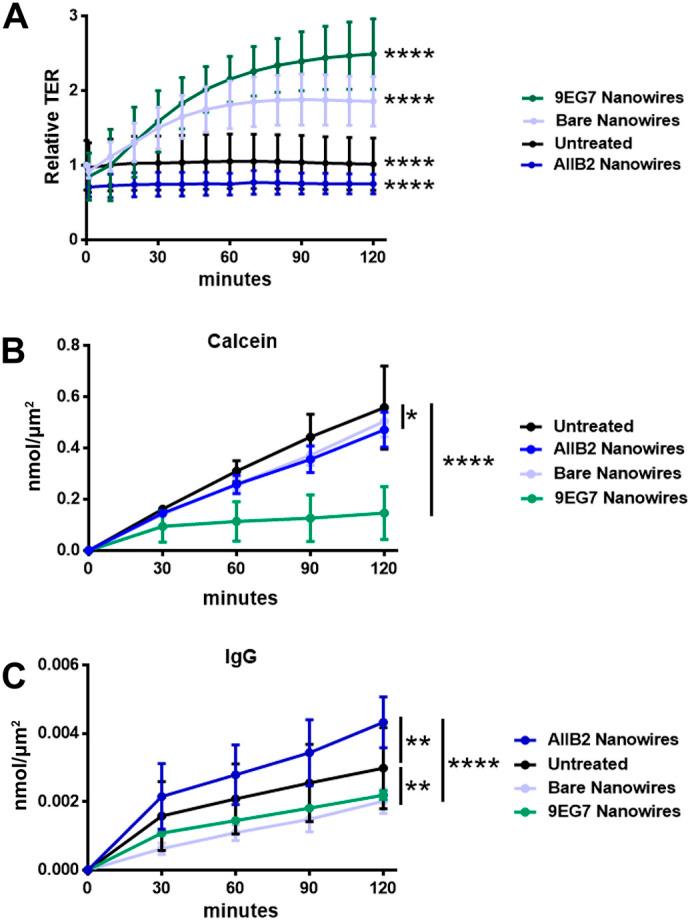
Tight junctions regulate epithelial barrier function and have been shown to be influenced by multiple classes of proteins. Apical integrins have been identified as potential regulators of epithelial barrier function; however, only indirect approaches have been used to measure integrin regulation of the epithelial barrier. Here, we used polymeric nanowires conjugated with anti-integrin β1 antibodies to specifically target apically localized integrins in either their closed or open conformation. Barrier regulation by apical integrins was found to be conformation specific. Nanowires targeting integrins in the closed conformation increased epithelial permeability and caused zonula occludens-1 (ZO-1, also known as TJP1) to change from a linear to a ruffled morphology. Claudin-2 and claudin-4 colocalized with ZO-1 and were also ruffled; however, claudin-1 and claudin-7 remained linear. Ruffling was dependent on myosin light chain kinases (MLCKs) and Rho kinases (ROCKs). Conversely, targeting integrins in the open conformation decreased epithelial permeability and made junctions more linearized. Anti-integrin β1 nanowires differentially affected actin and talin (analyzed using pan-talin antibodies), depending on whether they contained activating or inhibitory antibodies. Thus, apical integrins can act as a conformation-sensitive switch that regulates epithelial barrier function.
紧密连接调节上皮屏障功能,并且已被证明受多种蛋白质的影响。顶端整合素已被确定为上皮屏障功能的潜在调节因子;然而,仅使用间接方法来测量整合素对上皮屏障的调节作用。在这里,我们使用与抗整合素β1抗体偶联的聚合物纳米线,以特异性靶向处于封闭或开放构象的顶端定位整合素。发现顶端整合素对屏障的调节具有构象特异性。靶向处于封闭构象的整合素的纳米线增加了上皮通透性,并导致紧密连接蛋白1(ZO-1,也称为TJP1)从线性形态转变为褶皱形态。Claudin-2和Claudin-4与ZO-1共定位,也呈褶皱状;然而,Claudin-1和Claudin-7保持线性。褶皱依赖于肌球蛋白轻链激酶(MLCKs)和Rho激酶(ROCKs)。相反,靶向处于开放构象的整合素会降低上皮通透性,并使连接更加线性化。抗整合素β1纳米线对肌动蛋白和踝蛋白(使用泛踝蛋白抗体分析)有不同影响,这取决于它们包含激活抗体还是抑制抗体。因此,顶端整合素可以作为一种构象敏感开关来调节上皮屏障功能。






 Zotero 插件