Biyutskaya Ekaterina V, Gasanov Elyar E, Khazova Kseniia V, Patrashkin Nikita A
Lomonosov Moscow State University, Russia.
Psychol Russ. 2024 Jun 15;17(2):64-84. doi: 10.11621/pir.2024.0205. eCollection 2024.
Although quite a few classifications of coping strategies have been proposed, with different premises, much less is known about the methods of interpretation and how people using different types of coping perceive their life difficulties.
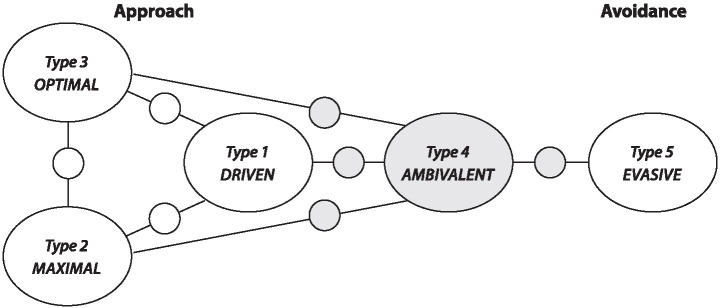
To develop a verifiable algorithm for classifying perceived difficulties. The proposed classification was developed deductively, using "approach-avoidance" as the basis for cognitive activity aimed at taking on (approaching) a difficult situation or escaping from it, avoiding a solution to the problem. The classification comprises 1) driven, 2) maximal, 3) optimal, 4) ambivalent, and 5) evasive types of perception of difficult life tasks (DLTs). Types 1, 2, and 3 correspond to approaching a difficult situation, and 5 to avoiding it. Type 4 involves a combination of approach and avoidance.
The type is determined by an expert psychologist in a complex way, based on a combination of 1) the respondent's profile according to the "Types of Orientations in Difficult Situations" questionnaire (TODS) and 2) features that are significant for the type as shown in qualitative data - descriptions of DLTs (answers to open questions). Machine learning methods and A.S. Podkolzin's computer modeling of logical processes are used to develop the algorithm. The sample comprised 611 adult participants (M = 25; SD = 5.8; 427 women).
Using machine-learning algorithms, various options were tested for separation into classes; the best results were obtained with a combination of markup and questionnaire features and sequential separation of classes. Using computer modeling of logical processes, classification rules were tested, based on the psychologist's description of the features of the type of perception. The classification accuracy using these rules of the final algorithm is 77.17% of cases.
An algorithm was obtained that allows step-by-step tracing of the process by which a classification problem is solved by the psychologist. We propose a new model for studying situational perception using a mixed research design and computer-modeling methods.
尽管已经提出了不少应对策略分类方法,但其前提各不相同,对于解读方法以及使用不同应对方式的人如何看待生活困难了解得却少得多。
开发一种可验证的算法来对感知到的困难进行分类。所提出的分类是演绎得出的,以“趋近 - 回避”作为旨在应对(趋近)困难情境或从中逃避、避免解决问题的认知活动基础。该分类包括1)驱动型、2)最大化型、3)最优型、4)矛盾型和5)逃避型对困难生活任务(DLT)的感知类型。类型1、2和3对应于趋近困难情境,类型5对应于逃避困难情境。类型4涉及趋近与回避的结合。
该类型由专业心理学家以复杂方式确定,基于1)根据“困难情境中的取向类型”问卷(TODS)得出的受访者概况,以及2)定性数据中显示的对该类型具有重要意义的特征——DLT的描述(开放性问题的答案)。使用机器学习方法以及A.S. 波德科尔津对逻辑过程的计算机建模来开发算法。样本包括611名成年参与者(M = 25;标准差 = 5.8;427名女性)。
使用机器学习算法,对各种分类选项进行了测试;通过标记和问卷特征的组合以及类别的顺序分离获得了最佳结果。使用逻辑过程的计算机建模,根据心理学家对感知类型特征的描述对分类规则进行了测试。最终算法使用这些规则的分类准确率为77.17%。
获得了一种算法,该算法能够逐步追踪心理学家解决分类问题的过程。我们提出了一种使用混合研究设计和计算机建模方法来研究情境感知的新模型。