Honda Takahiro, Tauchi Shunsuke
Department of Thoracic Surgery, Akashi Medical Center, Hyogo, Japan.
J Thorac Dis. 2024 Oct 31;16(10):6644-6650. doi: 10.21037/jtd-24-1069. Epub 2024 Oct 18.
Despite advances in chest drainage technology, such as the use of digital drainage systems (DDS), there is still no consensus on the most effective method for reducing air leaks after lung resection. To evaluate the optimal drainage method, we compared traditional water seal with low suction pressure settings on DDS.
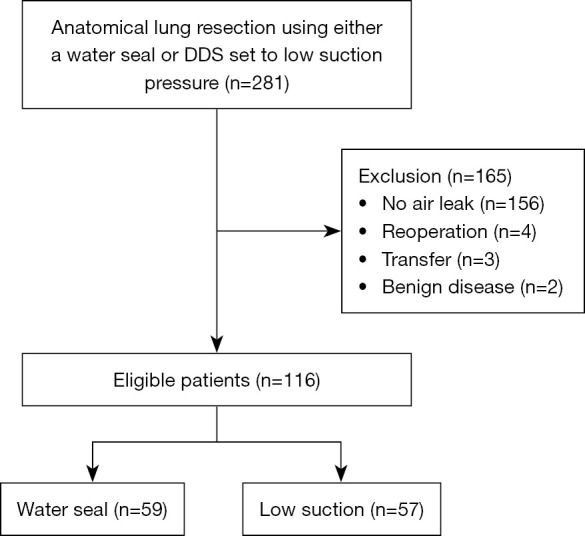
We retrospectively analyzed the postoperative data of patients between August 2015 and April 2023 who underwent anatomical lung resection at our hospital and who had postoperative chest drains managed with either a water seal or DDS set to low suction pressure. We excluded cases without air leak on the first postoperative morning from the consideration in this study. We divided the patients into two groups according to the chest drainage method on the first postoperative morning and we compared air leak and chest drainage durations of both groups.
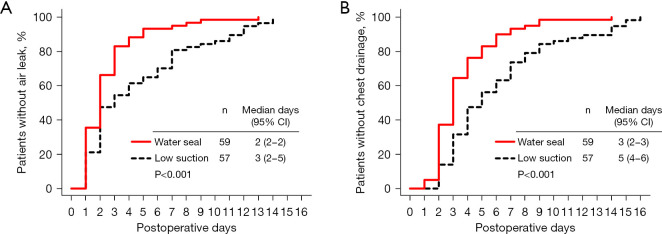
We retrospectively analyzed 116 patients. The groups (water seal: 59 patients; low suction: 57 patients) were well balanced for baseline and degree of air leakage on the first operative morning. The water seal group showed significantly shorter air leak duration (2 3 days, P<0.001) and chest drainage duration (3 5 days, P<0.001) compared with the low suction group. Pleurodesis (P=0.002) and conversion (P=0.001) were higher in the low suction group, with no significant differences in drain reinsertion.
Water seal management was suggested to be safe and comparably effective to low suction on DDS in reducing air leak and chest drainage durations after lung resection.
尽管胸腔闭式引流技术有所进步,如使用数字引流系统(DDS),但对于肺切除术后减少漏气的最有效方法仍未达成共识。为评估最佳引流方法,我们比较了传统水封引流与DDS低负压设置引流。
我们回顾性分析了2015年8月至2023年4月在我院接受解剖性肺切除术且术后胸腔引流采用水封引流或DDS低负压设置引流的患者的术后数据。本研究排除了术后第一个早晨无漏气的病例。根据术后第一个早晨的胸腔引流方法将患者分为两组,比较两组的漏气时间和胸腔引流时间。
我们回顾性分析了116例患者。两组(水封引流组:59例患者;低负压引流组:57例患者)在首次手术早晨的基线和漏气程度方面均衡良好。与低负压引流组相比,水封引流组的漏气时间(2至3天,P<0.001)和胸腔引流时间(3至5天,P<0.001)明显更短。低负压引流组的胸膜固定术(P=0.002)和转换率(P=0.001)更高,引流管重新插入情况无显著差异。
在减少肺切除术后的漏气时间和胸腔引流时间方面,水封引流管理被认为是安全的,且与DDS低负压引流效果相当。