Ando Takayuki, Sasaki Takashi, Abe Yukiko, Nishimoto Yoshinori, Hirata Takumi, Haruta Junji, Arai Yasumichi
Center for General Medicine Education Keio University School of Medicine Shinjuku-ku Tokyo Japan.
Center for Supercentenarian Medical Research Keio University School of Medicine Shinjuku-ku Tokyo Japan.
J Gen Fam Med. 2024 Sep 8;25(6):376-383. doi: 10.1002/jgf2.728. eCollection 2024 Nov.
Multimorbidity increases with age, leading to various adverse outcomes, including higher mortality, care dependency, hospitalizations, and healthcare costs. Polydoctoring, managing a patient with multimorbidity by multiple healthcare providers, can be a risk of fragmented care and increased healthcare expenditures. This study aims to identify patient-related factors contributing to polydoctoring in older adults with multimorbidity.
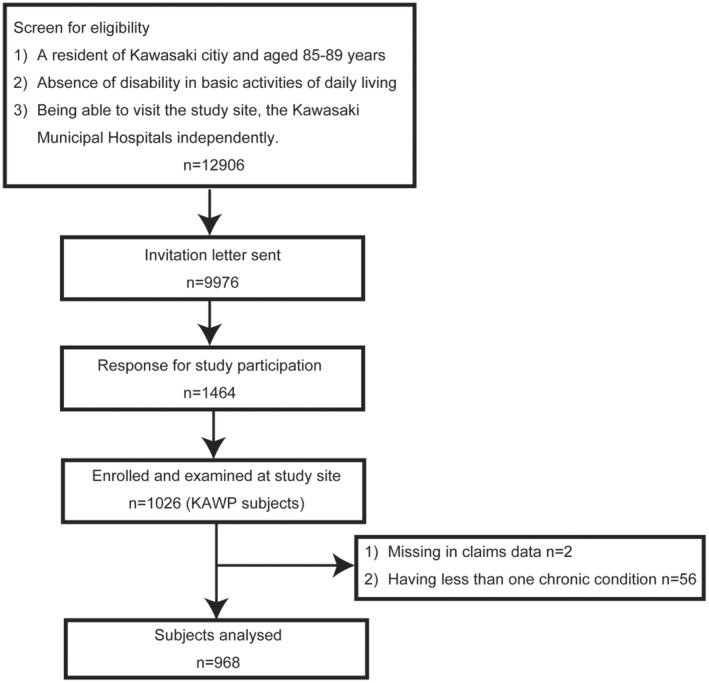
This study is a cross-sectional study using baseline data from the Kawasaki Aging and Wellbeing Project. Participants were residents of Kawasaki City aged 85-89 years, without disability in basic activities of daily living, and being able to visit study site. The regularly visited facilities (RVF) index was employed to quantify polydoctoring. Polydoctoring was defined as having two or more RVFs. Poisson regression analysis was conducted to assess the association between polydoctoring and patient demographics, including types of chronic conditions and socioeconomic factors.
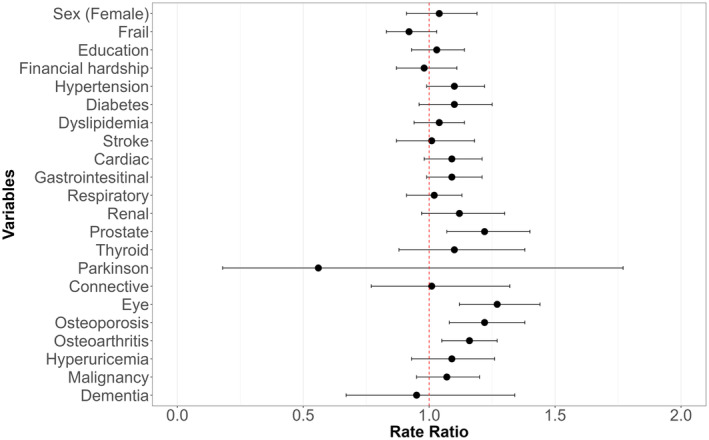
A total of, 968 participants with multimorbidity were analyzed. Increased RVF was significantly associated with eye diseases (rate ratio [RR] 1.27, 95% confidence interval [CI] 1.12-1.44), osteoporosis (RR 1.22, 95% CI 1.08-1.38), prostate diseases (RR 1.22, 95% CI 1.07-1.40), and osteoarthritis (RR 1.16, 95% CI 1.05-1.27). No significant correlation was found with educational status or financial hardship.
The study indicated that certain chronic conditions are linked to increased polydoctoring among multimorbid older adults in Japan. However, most of those conditions are considered to be within a scope of family medicine/general practice. Training general practitioners to manage these conditions could reduce healthcare costs and the treatment burden, indicating a direction for future healthcare policy and medical education.
多种疾病并存的情况随年龄增长而增加,会导致各种不良后果,包括更高的死亡率、护理依赖、住院率和医疗费用。多医生诊疗,即由多个医疗服务提供者为患有多种疾病的患者提供治疗,可能存在医疗服务碎片化和医疗支出增加的风险。本研究旨在确定导致患有多种疾病的老年人多医生诊疗的患者相关因素。
本研究是一项横断面研究,使用了川崎衰老与幸福项目的基线数据。参与者为川崎市85 - 89岁的居民,日常生活基本活动无残疾,且能够前往研究地点。采用定期就诊机构(RVF)指数来量化多医生诊疗情况。多医生诊疗定义为有两个或更多的RVF。进行泊松回归分析以评估多医生诊疗与患者人口统计学特征(包括慢性病类型和社会经济因素)之间的关联。
共分析了968名患有多种疾病的参与者。RVF增加与眼部疾病(率比[RR] 1.27,95%置信区间[CI] 1.12 - 1.44)、骨质疏松症(RR 1.22,95% CI 1.08 - 1.38)、前列腺疾病(RR 1.22,95% CI 1.07 - 1.40)和骨关节炎(RR 1.16,95% CI 1.05 - 1.27)显著相关。未发现与教育程度或经济困难有显著相关性。
该研究表明,在日本,某些慢性病与患有多种疾病的老年人多医生诊疗增加有关。然而,这些疾病大多被认为属于家庭医学/全科医学的范畴。培训全科医生管理这些疾病可以降低医疗成本和治疗负担,为未来的医疗政策和医学教育指明了方向。