Liu Guanyu, Li Jing, Li Xichen, Ying Tong
Department of Atmospheric and Oceanic Sciences, School of Physics, Peking University, Beijing 100871, China.
Institute of Atmospheric Physics, Chinese Academy of Sciences, Beijing 100029, China.
Proc Natl Acad Sci U S A. 2024 Dec 3;121(49):e2414241121. doi: 10.1073/pnas.2414241121. Epub 2024 Nov 18.
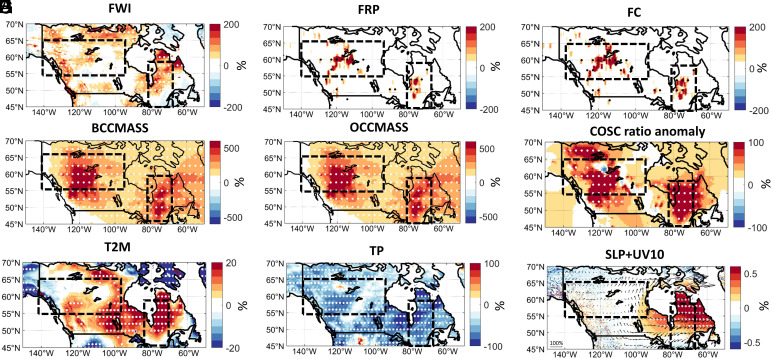
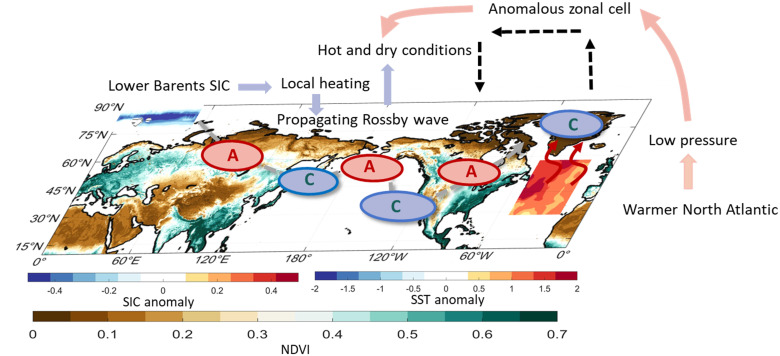
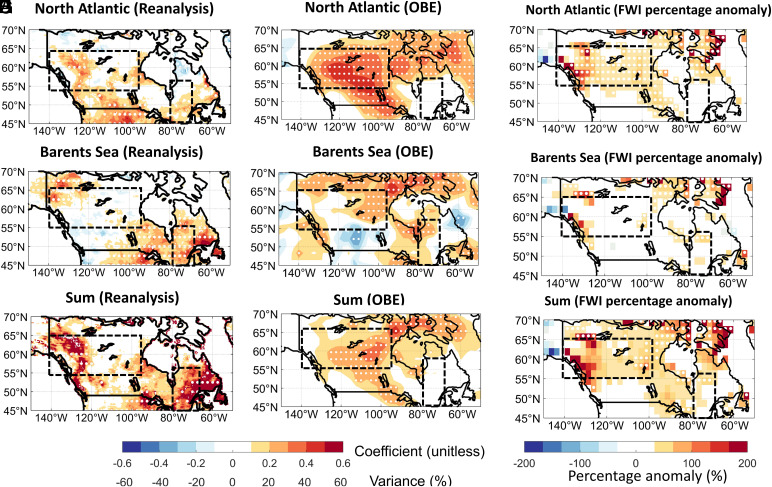
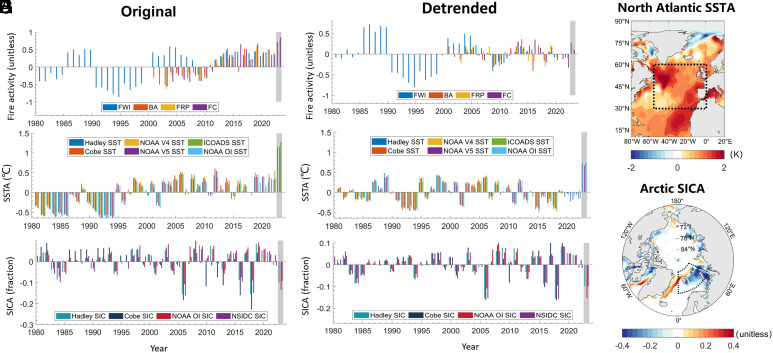
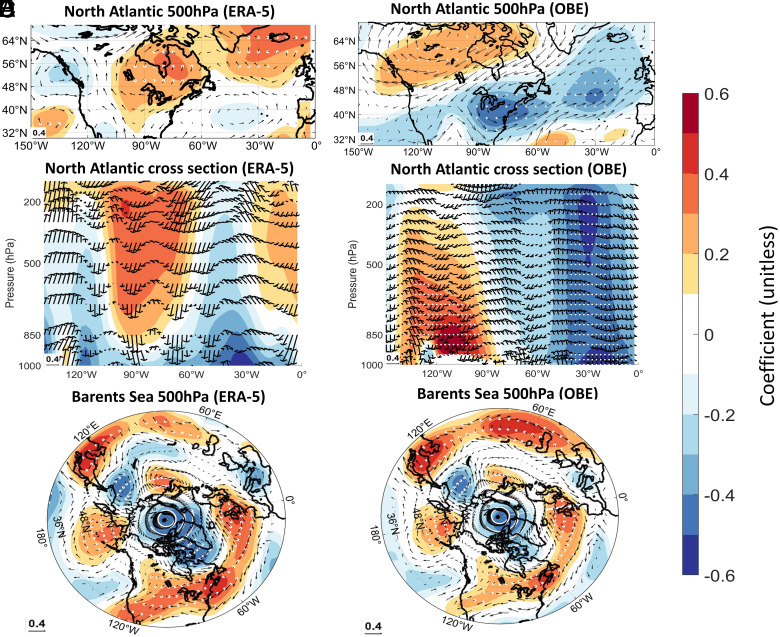
In the late spring to summer season of 2023, Canada witnessed unprecedented wildfires, with an extensive burning area and smoke spreading as far as the East Coast of the United States and Europe. Here, using multisource data analysis and climate model simulations, we show that an abnormally warm North Atlantic, as well as an abnormally low Barents Sea ice concentration (SIC), are likely key climate drivers of this Canadian fire season, contributing to ~80% of the fire weather anomaly over Canada from June to August 2023. Specifically, the warm North Atlantic forms an anomalous regional zonal cell with ascending air over the Atlantic and descending air encircling Canada, creating hot and dry local conditions. Meanwhile, reduced Barents SIC leads to a high-pressure center and reinforces the dry northern winds in Canada through Rossby wave dynamics. These exacerbated dry and hot conditions create a favorable environment for the ignition and spread of fires, thus contributing to the prolonged and extreme fire season in Canada. These teleconnections can extend to decadal scales and have important implications for understanding and predicting decadal fire activity in Canada and the surrounding regions.
在2023年春末至夏季,加拿大遭遇了前所未有的野火,燃烧面积广泛,烟雾扩散至美国东海岸和欧洲。在此,我们利用多源数据分析和气候模型模拟表明,异常温暖的北大西洋以及异常低的巴伦支海冰浓度(SIC)可能是造成此次加拿大火灾季节的关键气候驱动因素,占2023年6月至8月加拿大火灾天气异常的约80%。具体而言,温暖的北大西洋形成了一个异常的区域纬向环流圈,大西洋上空空气上升,环绕加拿大的空气下沉,造成当地炎热干燥的条件。同时,巴伦支海冰浓度降低导致一个高压中心,并通过罗斯贝波动力学加强了加拿大北部的干燥北风。这些加剧的干热条件为火灾的点燃和蔓延创造了有利环境,从而导致加拿大火灾季节延长且极端。这些遥相关可延伸至年代际尺度,对理解和预测加拿大及周边地区的年代际火灾活动具有重要意义。