Yu Hongbin, Yang Yang, Wang Hailong, Tan Qian, Chin Mian, Levy Robert C, Remer Lorraine A, Smith Steven J, Yuan Tianle, Shi Yingxi
Earth Sciences Division, NASA Goddard Space Flight Center, Greenbelt, MD, USA.
Pacific Northwest National Laboratory, Richland, WA, USA.
Atmos Chem Phys. 2020 Jan;20(1):139-161. doi: 10.5194/acp-20-139-2020. Epub 2020 Jan 3.
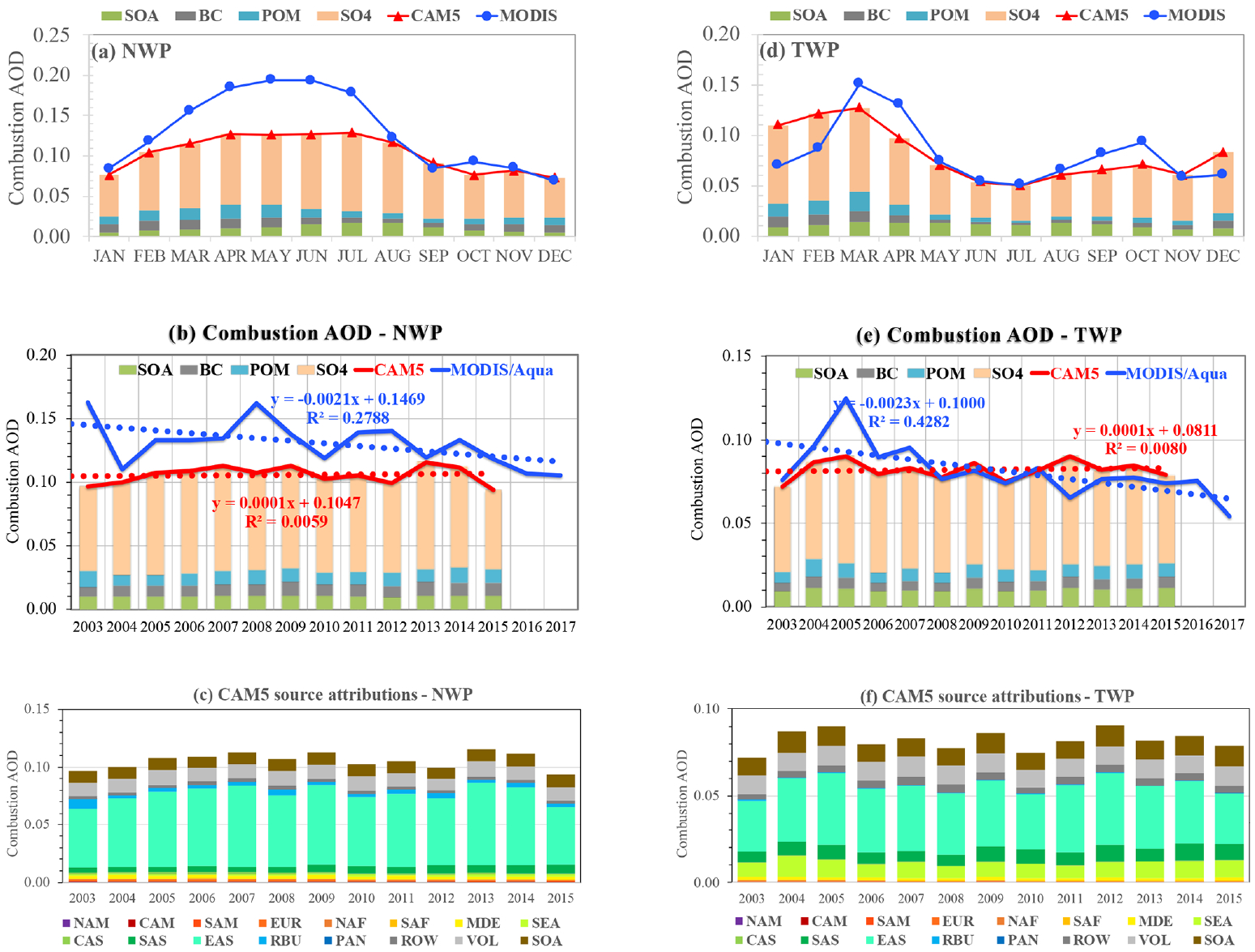
Emissions and long-range transport of mineral dust and combustion-related aerosol from burning fossil fuels and biomass vary from year to year, driven by the evolution of the economy and changes in meteorological conditions and environmental regulations. This study offers both satellite and model perspectives on the interannual variability and possible trends of combustion aerosol and dust in major continental outflow regions over the past 15 years (2003-2017). The decade-long record of aerosol optical depth (AOD, denoted as ), separately for combustion aerosol ( ) and dust ( ), over global oceans is derived from the Collection 6 aerosol products of the Moderate Resolution Imaging Spectroradiometer (MODIS) onboard both Terra and Aqua. These MODIS Aqua datasets, complemented by aerosol source-tagged simulations using the Community Atmospheric Model version 5 (CAM5), are then analyzed to understand the interannual variability and potential trends of and in the major continental outflows. Both MODIS and CAM5 consistently yield a similar decreasing trend of -0.017 to -0.020 per decade for over the North Atlantic Ocean and the Mediterranean Sea that is attributable to reduced emissions from North America and Europe, respectively. On the contrary, both MODIS and CAM5 display an increasing trend of +0.017 to +0.036 per decade for over the tropical Indian Ocean, the Bay of Bengal, and the Arabian Sea, which reflects the influence of increased anthropogenic emissions from South Asia and the Middle East in the last 2 decades. Over the northwestern Pacific Ocean, which is often affected by East Asian emissions of pollution and dust, the MODIS retrievals show a decreasing trend of -0.021 per decade for and -0.012 per decade for , which is, however, not reproduced by the CAM5 model. In other outflow regions strongly influenced by biomass burning smoke or dust, both MODIS retrievals and CAM5 simulations show no statistically significant trends; the MODIS-observed interannual variability is usually larger than that of the CAM5 simulation.
燃烧化石燃料和生物质所产生的矿物尘埃以及与燃烧相关的气溶胶的排放和远距离传输,会因经济发展、气象条件变化以及环境法规的演变而逐年变化。本研究从卫星和模型两个角度,探讨了过去15年(2003 - 2017年)主要大陆外流区域燃烧气溶胶和尘埃的年际变化及可能趋势。全球海洋上长达十年的气溶胶光学厚度(AOD,记为 )记录,分别针对燃烧气溶胶( )和尘埃( ),源自搭载在Terra和Aqua卫星上的中分辨率成像光谱仪(MODIS)的第6版气溶胶产品。然后,结合使用社区大气模型第5版(CAM5)进行的气溶胶源标记模拟,对这些MODIS Aqua数据集进行分析,以了解主要大陆外流区域 和 的年际变化及潜在趋势。MODIS和CAM5均一致显示,在北大西洋和地中海, 每十年呈现出 -0.017至 -0.020的下降趋势,这分别归因于北美和欧洲排放量的减少。相反,在热带印度洋、孟加拉湾和阿拉伯海,MODIS和CAM5均显示 每十年呈现出 +0.017至 +0.036的上升趋势,这反映了过去20年南亚和中东人为排放量增加的影响。在经常受到东亚污染和尘埃排放影响的西北太平洋,MODIS反演结果显示 每十年下降趋势为 -0.021, 为 -0.012,然而,CAM5模型并未再现这一结果。在其他受生物质燃烧烟雾或尘埃强烈影响的外流区域,MODIS反演结果和CAM5模拟均未显示出具有统计学意义的趋势;MODIS观测到的年际变化通常大于CAM5模拟结果。